

From multimillion-dollar government bids to everyday supplier agreements, procurement contracts quietly shape the flow of goods, services, and trust across industries. As legally binding agreements between buyer and supplier, they set clear expectations on price, delivery timelines, performance standards, and other important conditions for providing specific goods or services.
Additionally, contracts are essential for ensuring legal compliance and maintaining control over procurement spend.
But in many organizations, procurement contracts are scattered across teams and managed inconsistently, leading to approval delays and missed obligations, and exposure to legal and financial risk. That’s why having a structured contract management process is critical.
In this blog, we define the main types of procurement contracts and explain key clauses to look for. We also explain why leading enterprises are using Source-to-Contract platforms and Contract Lifecycle Management (CLM) tools to streamline operations, reduce risk, and improve visibility.
Key Takeaways
- Procurement contracts are strategic tools that shape supplier performance, control costs, and ensure compliance.
- Inconsistent language, manual tracking, and fragmented ownership can create major operational risks, which is why contract governance must be procurement-led.
- Modern Source-to-Contract platforms like Ivalua enable end-to-end visibility, smarter clause management, and automated workflows that reduce risk and improve outcomes.
Why Procurement Contracts Are Core to Enterprise Sourcing Strategy
Procurement contracts are foundational tools that drive strategic value across the enterprise. When managed solely by legal teams, contracts can become static documents focused on risk avoidance. However, when procurement takes ownership, contracts can positively impact performance, accountability, and spend control.
The main purpose of procurement contracts is to define terms of engagement, including the scope of work, service levels, delivery schedules, payment terms, penalties for non-performance, and more.
Contracts protect both the buyer and supplier legally and, when well-structured, support procurement planning by locking in pricing, clarifying responsibilities, and aligning deliverables with business timelines. They can also improve forecasting, budgeting, and compliance enforcement.
In regulated industries such as Healthcare or Government, contracts are essential for proving adherence to sourcing thresholds and disclosure requirements. Without clear and consistent contract terms, your organization risks misalignment, overspending, or even regulatory penalties.
That’s why leading procurement teams now rely on contract lifecycle management (CLM) and Source-to-Contract platforms to embed contracts directly into sourcing workflows and ensure they are enforceable, visible, and strategically aligned from the start.
Procurement Contracts Are Operational Tools, Not Just Legal Forms
Procurement contracts do much more than set legal expectations. For example, they provide a playbook for how to hold vendors accountable for things like cost, quality, delivery, and ongoing performance.
Clauses such as Service Level Agreements (SLAs) define exactly what performance is expected in terms of on-time delivery or defect rates, and what penalties you can apply if those targets are missed.
Terms on cost, such as fixed pricing, discount schedules, or escalation clauses, protect buyers from surprises, and delivery clauses establish timelines and consequences for delays. Quality clauses ensure goods meet agreed standards (e.g. tolerances, testing regimes).
Even renewal and termination clauses matter, because they give procurement leverage to renegotiate or move away from under‑performing suppliers.
Operationally, procurement is responsible for contract management and enforcement, which can involve tracking metrics, managing exceptions, and ensuring supplier behavior aligns with business outcomes.
When contracts are vague or under‑monitored, the risk of overpaying, quality failures, or missed deadlines can cause companies to lose value.
Source‑to‑Contract solutions and Contract Lifecycle Management (CLM) tools make tracking these clauses easier, integrate performance data in real time, and enable enterprises to act proactively, not just respond to failures.
The Cost of Inconsistent Terms and Manual Workflows
Procurement teams face real operational and financial consequences when contracts contain inconsistent language and are managed using disconnected spreadsheets:
- Missed renewal deadlines and auto-renewals: Without centralized tracking, contracts can quietly auto-renew at unfavorable terms, locking teams into outdated pricing or service levels.
- Non-compliant purchases and maverick spend: Inconsistent language across contracts around scope, pricing, or terms can lead to confusion or off-contract buying.
- Delayed project kickoffs and missed timelines: Bottlenecks in contract approvals stall the strategic sourcing process and onboarding, causing downstream delays in production and delivery.
- Inability to enforce SLAs or penalties: When performance clauses are buried in PDFs or not aligned across systems, you can’t track vendor compliance or hold suppliers accountable. This leads to cost overruns and missed performance targets.
These risks are characteristic of traditional procurement contract management models. Modern procurement contract management software enables procurement to move faster, control costs, and reduce risk.
Where Procurement, Legal, and Finance Must Coordinate
Contract management in procurement works best when ownership is clearly defined. While legal ensures enforceability and mitigates liability, procurement teams are closest to supplier relationships, pricing structures, and performance terms. That makes them best positioned to draft the initial contract language.
Legal teams should act as reviewers and advisors, while finance should play a supporting role by validating budget alignment and payment terms.
When procurement leads the workflow and stakeholders collaborate through a centralized CLM platform, contracts move faster, with clear terms and accountability.
Next we’ll examine the various types of procurement contracts, including some use cases.
When Each Procurement Contract Type Makes (or Breaks) the Deal
Choosing the right type of procurement contract is a strategic decision that directly impacts risk sharing, supplier accountability, cost control, and delivery outcomes.
Procurement leaders must weigh factors like pricing transparency, flexibility, and administrative burden, and align the contract type to the project’s scope, timeline, and risk profile.
If you get this part wrong, you risk scope creep, budget overruns, or poor supplier performance. But if you get it right, the contract can help create value for your organization.
The table below summarizes the major procurement contract types, each with its own cost, flexibility, and strategic fit:
| Contract Type | Cost Risk | Scope Flexibility | Use Case Example |
| Fixed-Price | Low (for buyer) | Low | Construction |
| Cost-Reimbursable | High (for buyer) | High | Research |
| Time & Materials (T&M) | Medium | Medium | IT Services |
| Unit Price | Shared | Medium | Software Licensing |
| Performance-Based | Variable | High | Facilities Management |
In the sections that follow, we take a closer look at each type of contract, including when to use them, what to watch for, and how you can tailor them to specific sourcing scenarios.
Fixed Price Contracts: Risk Transfer With Limited Flexibility
Fixed price contracts lock in a pre-agreed total cost for goods or services, regardless of the supplier’s actual effort or the materials they use. This puts most of the cost risk on the supplier.
A fixed-price contract is ideal for well-scoped, low-volatility purchases such as construction projects, equipment orders, or other direct procurement categories. Because pricing is fixed, buyers benefit from predictable budgeting and easier cost control.
However, that predictability comes with trade-offs. If requirements change mid-project, or if material costs spike due to inflation, suppliers may issue change orders or build risk premiums into bids.
That’s why the procurement team’s role during scoping, specification writing, and competitive tendering is so crucial. Any ambiguity during the drafting phase can lead to delays, disputes, or hidden costs later.
Cost Reimbursable Contracts: Flexibility With Limited Cost Control
Cost reimbursable contracts allow suppliers to charge the buyer for actual incurred costs, such as labor, materials, and overhead – plus a fixed fee or percentage. This structure is very flexible and suitable for research and development (R&D), innovation pilots, or complex engineering builds where scope and outcomes are uncertain.
However, in cost reimbursable contracts, the buyer assumes greater financial risk since expenses can rise unpredictably. Procurement teams must play an active role in the contract risk management approach by implementing not-to-exceed clauses, milestone-based gating, and real-time performance reporting to control spend and ensure accountability.
Unlike fixed-price contracts, the legal department is rarely responsible for enforcing the contract once it’s signed. Procurement owns the day-to-day oversight, and success depends on strong vendor relationships and operational controls.
Time and Materials Contracts: Speed vs. Spend Governance
Time and materials (T&M) contracts enable you to get products started rapidly because procurement pays for the actual labor hours and materials used. A fully defined up front scope isn’t necessary.
This model is ideal for short-term IT services, consulting engagements, or agile deployments, where speed and flexibility are more important than cost predictability. However, without enforceable thresholds, predefined hourly rates, and frequent reviews, costs can spiral quickly.
When managed properly, T&M arrangements can bridge the gap between rigid fixed-price models and the evolving needs of modern, iterative projects.
Procurement must work closely with budget owners from the beginning to set clear expectations and implement weekly reporting, spend ceilings, and rate agreements for T&M arrangements, to help maintain fiscal discipline while still allowing the agility T&M contracts are designed for.
Performance-Based Contracts: Driving Supplier Accountability
Performance-based contracts tie supplier payment directly to predefined outcomes rather than hours worked or materials used. These are common in logistics, facilities maintenance, and outsourced business processes, and they reward on-time delivery rates and defect-free service levels.
Since suppliers are incentivized to perform, procurement can drive higher accountability and better value from engagements. However, success depends on clear, measurable KPIs established during the contract drafting phase.
Procurement teams should collaborate closely with operational stakeholders to define KPIs ahead of time that are realistic and enforceable. It’s also critical to have systems in place to track and report against KPIs in real time.
Unit Price and Framework Agreements: Simplifying Recurring Buys
Unit price contracts and framework agreements streamline recurring purchasing by locking in rates and standard terms ahead of time. Unit price contracts assign a fixed cost per unit (e.g. per kilometer of delivery, per user license, per unit of product, etc.), so they’re ideal for commodities or scalable services (think Software-as-a-Service, office supplies, or cleaning services).
Framework agreements are widely used in public procurement. They predefine terms with one or more vendors and allow for call-off contracts without renegotiating each purchase. This reduces administrative overhead while shortening procurement cycles.
Procurement teams can use them to consolidate demand across departments and eliminate off-contract spend. They’re especially valuable when the same goods or services are needed repeatedly, but flexibility is still required regarding timing and quantities.
Each procurement contract type sets a foundation, but contract clauses truly define how risk is shared, how performance is measured, and how suppliers are held accountable. In the next section, we explore how key contractual clauses impact governance and supplier behavior.
How Clauses Shape Risk, Governance, and Supplier Behavior
The real power of a procurement contract lies in its clauses – the specific terms that dictate how work gets done, how suppliers are paid, how issues are handled, and how risk is distributed.
Well-structured clauses align supplier incentives with business outcomes while setting clear expectations for accountability. On the flipside, poorly written or inconsistent clauses can lead to misinterpretation, missed deadlines, and unnecessary costs.
Working with legal, finance, and business stakeholders, procurement teams must define, track, and enforce contract clauses to ensure value is realized across the contact lifecycle.
Key clauses to include in procurement contracts include:
- Scope of Work: Clearly defines deliverables, timelines, technical specifications, and responsibilities to avoid ambiguity and scope creep.
- Payment Terms: Outlines payment structure (e.g. milestone-based, time-based, or outcome-based), including penalties for delays or late fees.
- Termination Clauses: Specifies conditions under which either party can end the contract, including termination for cause or for convenience.
- Intellectual Property and Confidentiality: Protects ownership of work outputs and ensures sensitive data is handled appropriately, and not disclosed or misused.
In the following sections, we explain the various clauses that fall under these categories.
Milestones, SLAs, and Deliverables Are the Real Contract Backbone
Performance clauses are what turn a contract into a management tool. Procurement must take ownership of these terms to ensure suppliers meet expectations and deliver value. Key clauses include:
- Service Level Agreements (SLAs): Define measurable performance targets (e.g., uptime, defect rates, response times) that suppliers must meet.
- Delivery Timelines: Clearly spell out due dates, lead times, and penalties for delays to maintain operational continuity.
- Milestone-Based Payments: Tie payments to defined progress checkpoints to align incentives and reduce upfront risk.
- Performance Bonuses or Penalties: Encourage superior performance and discourage shortfalls by linking financial outcomes to quality and timeliness.
These clauses signal to suppliers what matters most and create tangible ways for procurement to manage accountability throughout the contract.
Termination, Renewal, and Change Control Terms Define Adaptability
Procurement contracts must balance structure with flexibility. Termination, renewal, and contract change control clauses define how well a contract can respond to change, whether that means shifting business priorities, dealing with poor performance, or handling external disruption.
- Well-written termination clauses establish clear grounds for ending an agreement, including for cause or convenience.
- Renewal terms ensure contracts don’t auto-renew without review, giving procurement a chance to reevaluate value and renegotiate if needed.
- Change control clauses define the process for modifying scope, pricing, or deliverables mid-contract, which is crucial in dynamic environments like IT or logistics.
Without clear language here, procurement may find itself locked into underperforming contracts or scrambling to document agreed-upon changes.
Compliance and Risk Allocation Clauses Should Be Procurement-Readable
Even when drafted by your legal team, procurement should be careful to fully understand and operationalize certain clauses. These include:
- Audit Rights: Allow the buyer to verify supplier performance, cost claims, or compliance with agreed terms.
- Liability Caps: Limit the financial exposure of each party, which can affect recourse in the event of failure or breach.
- Payment Terms: Set timelines, currency, invoicing requirements, and late payment penalties, which is essential for cash flow planning.
- Dispute Resolution: Define how to handle disagreements, whether through arbitration, mediation, or litigation.
It’s critical to review these clauses with your legal team, but stay hands-on to ensure that they reflect the needs of your business and your suppliers. Contract Management in Procurement is only as effective as the process that supports it.
Next, we explore the full procurement contract lifecycle, from initial drafting through approval, execution, and eventual renewal.
The Procurement Contract Lifecycle, from Draft to Renewal
Procurement contracts are not one-and-done documents. They evolve throughout a structured lifecycle that demands continuous involvement from the procurement team.
From the moment you identify a purchasing need to the point where you close or renew a contract, there are opportunities to improve outcomes and mitigate risk.
That’s why leading procurement organizations treat the contract management process as a strategic process, rather than an administrative task.
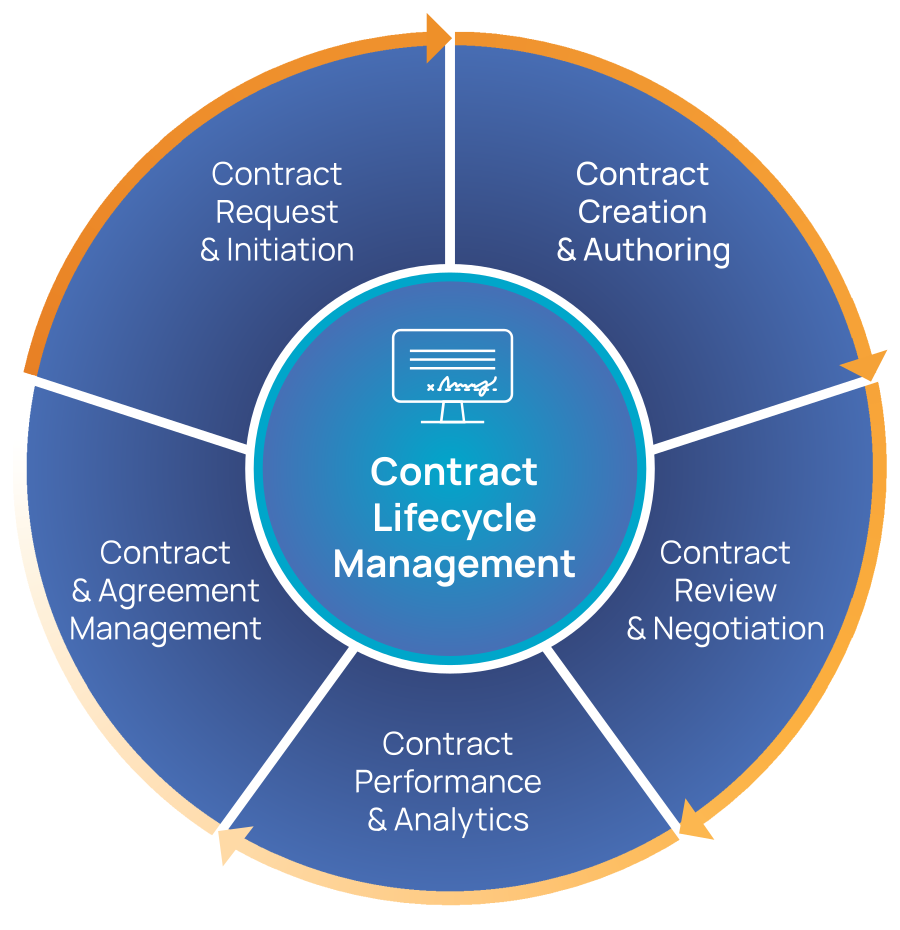
Owning the full contract lifecycle allows you to shape vendor performance and extract long-term value from every agreement. But doing this effectively and reducing risk requires structured workflows, cross-functional governance, and procurement automation.
Below is an overview of the five key phases of the procurement contract lifecycle and what each phase entails:
| Phase | Description | Key Activities |
| Planning | Identify need, budget, scope | RFx creation, vendor shortlisting |
| Selection | Evaluate vendors, negotiate | Tendering, risk assessment |
| Contracting | Draft, review, sign | Legal review, digital signature |
| Execution | Deliverables, payment, QA | Milestone tracking, issue resolution |
| Closure | Acceptance, evaluation | Performance review, lessons learned |
Let’s look closer at each of these stages, and examine procurement’s role.
Drafting and Clause Selection Must Be Governed and Role-Based
Drafting is where risk management, supplier expectations, and performance accountability begin. To that end, procurement must lead with structure, not ad hoc edits.
Rather than reinventing contracts from scratch, mature organizations rely on clause libraries and conditional templates that align terms with spend category, geography, or supplier risk profile. This ensures consistency across suppliers while allowing flexibility where it’s needed most.
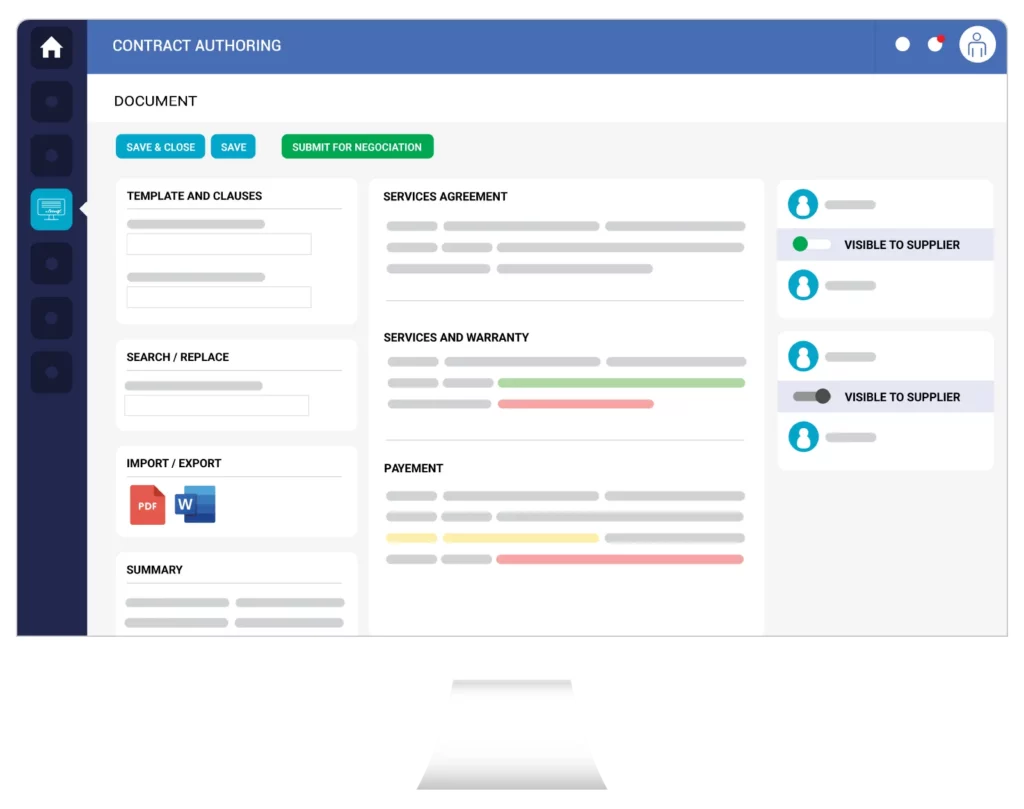
Role-based drafting workflows help procurement collaborate efficiently with legal, finance, and business stakeholders, assigning owners to clauses like SLAs, payment terms, or IP rights based on their expertise. Source-to-Contract platforms make this scalable.
Ivalua’s Source-to-Contract solution supports clause standardization with guided authoring, pre-approved templates, and configurable clause libraries, making it easy to tailor agreements without sacrificing control. This enables faster cycle times and fewer legal escalations, as well as the ability to set clearer expectations for suppliers before anyone signs.
Reviews and Approvals Require Structured, Not Ad Hoc, Workflows
Approval flows are the control center of procurement contract governance. To avoid delays and ambiguity, these workflows must be role-based (who approves what) and time-bound (how long each step should take).
It’s critical to assign responsibilities to procurement, legal, finance, and business owners based on contract category, value, and risk level.
Built-in escalation triggers such as stalled approvals or missed review windows help prevent bottlenecks. When clauses deviate from standard language, or when risk thresholds are exceeded, legal review should be triggered automatically to ensure compliance, without overwhelming the legal team with low-risk reviews.
Ivalua provides a configurable workflow engine that routes contracts dynamically based on predefined criteria such as category, spend, region, or supplier tier, ensuring the right stakeholders are involved at the right time.
With Ivalua, you maintain flexibility while achieving faster cycle times, improved auditability, and greater contract consistency.
Execution Isn’t the End: Post-Award Tracking Is Where Most Contracts Fail
Once a contract is signed and the contract award notice has been sent, procurement teams must ensure that what’s on paper translates into performance. Yet this post-signature phase is where many organizations struggle, especially if they rely on spreadsheets or email to track execution.
Here are key post-signature steps that you should actively monitor:
- Deliverables and Milestones: Track supplier outputs against agreed timelines and specifications to ensure accountability.
- Spend Thresholds: Monitor cumulative spend to avoid overages or to trigger renegotiation clauses as volumes increase.
- Service Level Agreements (SLAs): Validate that performance commitments like uptime, defect rates, or resolution times are being met.
- Renewal and Termination Triggers: Set alerts for contract end dates, renewal windows, or early termination options to avoid unplanned extensions or missed renegotiation opportunities.
Automation helps to ensure these checkpoints don’t fall through the cracks, and helps avoid contract leakage and compliance risks.
Renewal Decisions Must Be Performance-Driven
Contract renewals should be intentional. Instead of relying on calendar-based reminders, you should assess whether the supplier is still the right strategic fit.
This means evaluating KPIs such as delivery performance, cost competitiveness, and SLA adherence, as well as broader alignment with ESG goals and evolving business needs.
Ivalua’s platform surfaces real-time insights into supplier performance monitoring, contract utilization, and risk indicators, offering a level of visibility essential for making informed renewal decisions.
By tying renewals to performance and fit, you can renegotiate more effectively, replace underperformers, or restructure agreements for better outcomes.
Who Is Responsible for Managing Procurement Contracts?
Managing procurement contracts is a cross-functional responsibility that touches nearly every part of the enterprise. From drafting to approval to execution, contracts must pass through multiple hands. That’s why clearly defined roles and a centralized system are essential.
The table below outlines how each team typically contributes to a procurement contract management plan:
| Role | Responsibilities |
| Procurement Officer | Leads vendor negotiations, drafts contract terms, and ensures alignment with sourcing strategies and procurement goals. Owns the process from intake to renewal. |
| Legal Counsel | Reviews contract language for legal compliance, intellectual property rights, and dispute resolution clauses. Ensures enforceability and manages legal risk. |
| Finance Team | Verifies cost allocations, reviews payment terms, and confirms budget availability. Ensures contracts support financial governance and approvals. |
| Project Manager | Oversees execution, milestone delivery, and supplier performance monitoring against contract terms. Bridges the gap between contract obligations and operational delivery. |
To ensure these roles stay coordinated and nothing falls through the cracks, organizations rely on contract lifecycle management software like Ivalua. It provides role-based access, audit trails, and automated workflows that streamline collaboration and accelerate results.
How to Mitigate Risks in Procurement Contracts?
Mitigating risk in procurement contracts starts with building consistency, accountability, and visibility into every stage of the contracting process.
While no agreement is entirely risk-free, you can proactively reduce your exposure by standardizing contract language and embedding governance from the start. Here are some best practices to mitigate risk:
- Use pre-approved templates for consistency. Standardized contract templates ensure that all agreements follow legal, financial, and compliance norms. This reduces ambiguity and protects the organization from omissions or risky terms.
- Perform vendor due diligence. Assess supplier risk before contracts are signed. Review financial health, regulatory history, cybersecurity posture, and past performance to avoid surprises post-award.
- Include escalation and dispute resolution mechanisms. Well-defined resolution paths such as mediation or arbitration clauses help you to resolve issues quickly, and avoid costly litigation or stalled deliverables.
- Automate contract reminders and reviews. Missed renewals, expired insurance certificates, or untracked SLAs can create costly exposure. Automated alerts help your team stay ahead of deadlines and obligations.
- Involve legal early in the process. Involving your legal team early helps to ensure that risk tolerance clauses, IP rights, and regulatory terms are airtight before you finalize negotiations, reducing costly rewrites or delays.
Together, these best practices can help you turn your contracts into strategic safeguards, not liabilities.
Why Enterprise Teams Need A Procurement Contract Lifecycle Management Technology
Given the complexity of today’s procurement environment, contract lifecycle management is no longer a nice-to-have. According to Gartner, CLM technology is a “solution that proactively manages contracts from initiation through negotiation, execution, compliance and renewal.”
Modern Source-to-Contract platforms like Ivalua deliver the structure, visibility, and automation needed to manage contracts at scale.
Here’s what to expect from contract management software:
- Clause libraries with conditional logic for standardizing risk terms and adapting to deal context.
- Guided authoring that helps non-legal users draft compliant contracts quickly.
- Role-based approval workflows with automated routing by value, risk, and category.
- Integrated e-signature to streamline execution and eliminate manual handoffs.
- Real-time contract analytics and dashboards for tracking obligations, spend thresholds, and renewals.
- Audit trails and version control to ensure transparency and compliance across every contract.
With the right CLM platform, you can be less reactive and more strategic, while reducing risk, accelerating cycle times, and enforcing supplier accountability.
Clause Libraries and Guided Authoring Speed Up Drafting
Modern contract platforms use clause libraries and guided authoring to help procurement teams draft contracts faster and with fewer legal bottlenecks.
By embedding pre-approved clauses into conditional templates, you can tailor contracts to specific categories, geographies, or risk profiles, without starting from scratch or waiting on legal for every revision. This approach ensures consistency across sourcing events and lowers the risk of non-standard language slipping through.
Guided authoring also reduces errors and accelerates time to contract by surfacing relevant terms based on deal context (e.g., value for money, supplier risk, delivery model). It helps standardize and enforce agreements that align with procurement strategy, policy and legal requirements.
Role-Based Routing Keeps Legal in the Loop Without Slowing Down
With role-based routing, Source-to-Contract platforms allow you to manage routine agreements autonomously, while automatically flagging non-standard or high-risk terms for legal review.
This way, your legal team stays informed and gets involved only when needed. This balance between efficiency and compliance ensures governance is embedded throughout the contract lifecycle, optimizing the procurement process.
Real-Time Monitoring of Contract Performance and Obligations
Once you have a signed contract, performance monitoring is key. Dashboards, alerts, and reporting tools help track deliverables, spend thresholds, renewal dates, and SLA adherence – by supplier, category, or contract value.
Real-time monitoring can help to ensure no one forgets their contractual obligations, and enables you to address any underperformance issues before it becomes costly.
Ivalua’s CLM module connects contract terms to actual supplier performance, making it easier to enforce accountability, trigger escalation workflows, and assess renewal readiness.
Customer Story: How Orange Streamlined Contract Lifecycle Management
Orange, a global telecommunications leader serving nearly 300 million customers across 26 countries, faced mounting pressure to improve procurement efficiency, manage rising ESG and compliance risks, and enhance the user experience for internal stakeholders.
As regulations tightened and cybersecurity concerns grew, Orange needed a flexible, future-ready e-procurement platform that could integrate with its complex ERP landscape and external data providers. Their internal teams also required a more agile, intuitive experience to drive adoption without compromising on governance.
Orange selected Ivalua for its robust Source-to-Pay capabilities, dynamic configurability, and proven track record supporting enterprise-scale procurement. Ivalua’s platform became the foundation of Orange’s sustainable procurement transformation, integrating with over a dozen systems, simplifying clause management by 70–80%, and improving contract lifecycle workflows.
With Ivalua, Orange benefits from increased agility, greater operational control, and stronger supplier accountability.
“We are doing a second transformation in contract lifecycle management. And we reduced, by 70-80% our number of clauses and templates. So for sure, it has really helped streamlining our processes.”
–Florent Bazin, Chief Information Officer, Orange
Conclusion: Stronger Procurement Contracts Require Stronger Control
Procurement contracts create the foundation for supplier performance, cost management, compliance tracking, and operational agility – but without structured processes and the right procurement technology, even the best-drafted agreements can be problematic. Visibility, governance, and control from start to finish is the key to successful, low-risk, and lucrative procurement contracts.
By standardizing clauses, streamlining approvals, tracking performance in real time, and taking advantage of AI agents and generative AI in procurement, modern procurement software like Ivalua can help ensure that every contract delivers lasting value.
Standardize, Streamline, and Manage Every Contract With Confidence
Procurement Contract FAQs
Contract lifecycle management (CLM) is the process of managing a contract from initial request through drafting, negotiation, approval, execution, performance monitoring, and renewal or termination. For procurement teams, CLM ensures that supplier agreements are consistent, enforceable, and aligned with sourcing strategy.
Common procurement contract types include fixed-price, cost-reimbursable, time and materials (T&M), unit price, and performance-based contracts. Each type allocates cost, risk, and oversight differently, depending on the scope, timeline, and goals of the engagement.
Procurement teams use contract terms such as SLAs, KPIs, and milestones to track performance. With the right tools, they can monitor deliverables, flag non-compliance, and initiate corrective actions in real time, rather than waiting for quarterly reviews or renewals.
Procurement typically owns performance-related clauses like milestones, penalties, payment terms, and delivery schedules. Legal teams should review risk and compliance areas such as indemnification, IP rights, dispute resolution, and regulatory requirements to ensure enforceability without delaying operations.
Technology automates key steps such as clause selection, approval routing, performance tracking, and renewal alerts, reducing delays and manual errors. Source-to-Contract platforms provide end-to-end visibility and governance, making your contract management plan more scalable and strategic.
Procurement leads the process, but legal and finance both play critical roles. Legal reviews for compliance tracking and risk, while finance ensures cost controls and budget alignment. It’s a multi-stakeholder approach that balances agility with governance.
Further Reading
- Learn how to improve contract management in procurement to boost compliance, reduce risk, and drive supplier accountability.
- Explore best practices for contract lifecycle management (CLM) and ensure every stage of the process—from drafting to renewal—is covered.
- Discover how a structured strategic sourcing process can improve vendor selection, negotiation, and long-term supplier value.
- Align your sourcing decisions with a long-term procurement strategy that balances cost, risk, and performance.
- Unlock the benefits of next-gen procurement technology to streamline workflows, improve collaboration, and boost adoption.
- See how generative AI in procurement is reshaping sourcing, negotiation, and contract intelligence.