


You already know the difference between a purchase requisition and a purchase order, but definitions aren’t the problem.
The real challenge is making sure these processes work as intended across complex systems, shifting budgets, and decentralized teams.
In this article, we clarify key differences between purchase requisitions and purchase orders, then take a deep dive into why and where requisition-to-order workflows can fail in the enterprise.
We discuss how gaps in policy enforcement and approval routing lead to compliance risk, and share how best-in-class automation can support users without slowing them down.
Key Takeaways
- Requisitions and POs serve different functions but must be tightly aligned for effective spend control.
- Inconsistent intake and approval workflows lead to delays and compliance risks.
- Automation and AI improve speed, accuracy, and visibility across the Procure-to-Pay process.
Purchase Requisition Vs Purchase Order: Definitions And Key Differences
Let’s start with a review of purchase requisition vs. purchase order processes.
- A purchase requisition is an internal document used to request the purchase of goods or services, and the starting point of the procurement process. It ensures that spending is reviewed and approved before any vendor is engaged.
Requisitions help organizations maintain budget discipline and enforce internal approval controls by routing requests through the appropriate approval workflows.
- A purchase order is an external document sent to a supplier once a requisition has been approved. The purchase order form serves as a formal, legally binding agreement that confirms what’s being purchased, at what price, and under what terms.
The PO is the basis for delivery, invoicing, and ultimately payment, making it critical to contract enforcement and compliance.
While both purchase requisitions and purchase orders are foundational to procurement, their roles are distinct. The requisition is inward-facing, used for planning, review, and control. The PO is outward-facing, used to communicate and commit to the supplier.
The purchase requisition form captures the internal request for goods or services and is routed through internal approval workflows. Once approved, a purchase order form is generated as an external document to engage with the supplier.
A clear understanding how these two documents function is essential to prevent gaps in policy enforcement, ensure spend visibility, and maintain three-way match accuracy.. The table below highlights the key differences to keep in mind.
| Purchase Requisition | Purchase Order | |
| Function | Initiates internal review and approval of a purchase request | Confirms the purchase externally with the supplier |
| Ownership | Created by the requester; routed through internal approvers | Issued by procurement or AP to the vendor |
| Timing | Comes before any vendor commitment | Comes after requisition approval—authorizes the purchase |
| Compliance Impact | Enforces internal policy and budget control | Legally binds the organization to supplier terms and pricing |
Now let’s get into the nuts and bolts of the purchase requisition process.
Inside the Purchase Requisition Process
During the purchase requisition process, inconsistent intake and approval workflows can quietly erode compliance and slow down the purchasing department’s progress.
Fragmented processes with communication spread across email, spreadsheets, and disconnected systems can delay requisition approvals and strain budgets.
So how do you reduce these risks? With automation, consistency and a powerful platform.
This section walks through the requisition to purchase order process — from request submission to approval routing to PO conversion — and shows where structured, automated procurement workflows that leverage AI can reduce risk.
Step-by-Step: What Happens After a Request Is Submitted
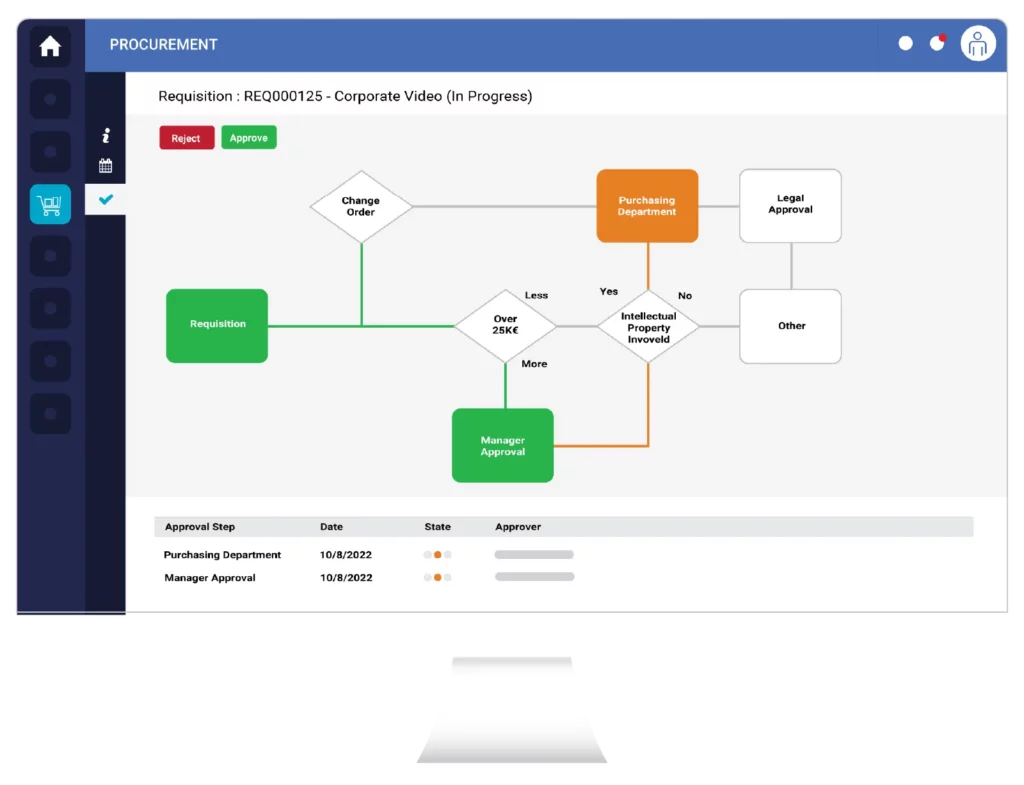
A requisition starts when a stakeholder – often outside the procurement team – submits a request for goods or services. That request kicks off a chain of checks and approvals before it becomes a PO:
- Intake: A structured form captures key details like item type, spend category, cost center, vendor, and justification. This initial step sets the tone for compliance.
- Validation: The system checks if the request aligns with budgets, approved vendors, and existing contracts.
- Approval Routing: The requisition is routed to the right approvers, based on business logic such as spend thresholds, category, or department.
- Conversion: Once fully approved, the request is automatically converted into a purchase order which will be sent to the supplier.
Each step in this process depends on the accuracy and completeness of the one before it. A missing cost center or misclassified vendor can delay the entire process.
Where Manual Workflows Break Down
Manual or ad hoc workflows are a major source of delay and compliance risk. How do they happen?
- Requests often arrive in procurement’s inbox as emails, spreadsheets, or casual chat messages.
- Authorization chains stall when someone is out of office.
- Policy exceptions slip through because the process isn’t built to enforce them.
These are just a few of the potential pitfalls.
Take this scenario: A marketing manager needs event software and submits a request directly to IT, bypassing procurement. There’s no contract on file, no validation of pricing, and no centralized record. Procurement only gets involved when the invoice shows up, and by then, it’s too late to negotiate terms or flag risk.
These gaps create problems later, including duplicate orders across teams, budget mismatches, and incomplete or inaccurate audit trails.
How Automation Enforces Policy and Accelerates Approvals
Automated workflows standardize and streamline the entire process.
At the intake point, requesters are guided through forms that dynamically adapt based on role, location, or category. Validation rules, such as budget checks or contract presence, are enforced before the request moves forward.
Since you’ve predefined rules for approval routing, requests automatically go to the right people, with built-in escalation paths. Because every action is logged, you have a complete audit trail. Keep in mind: Automation doesn’t mean inflexibility.
When you apply the right guardrails without adding friction, approvers can act quickly, and you retain full visibility into what’s being requested and why.
Where AI Adds Value in the Requisition Process
AI enhances these workflows by filling the gaps where manual effort typically slows things down. Rather than replace existing workflows, it can work within them to improve speed, consistency, and insight.
For example, AI can interpret unstructured or freeform text and map it to the correct category, improving classification accuracy. It can also flag potential duplicate requests and suggest consolidation.
AI can predict approval paths based on historical behavior, as well, and help route requests more efficiently. It can even anticipate bottlenecks before they occur.
By combining automation and AI, your team will have better control over spending and compliance, and faster, smarter purchasing, without having to sacrifice user experience.
What Happens After the PO Is Issued?
Issuing a purchase order isn’t the end of the road. IRather, it marks the start of the transition to the fulfillment stage of the procurement process. Once the vendor receives the PO, the next steps are order confirmation, fulfillment, goods receipt, and invoice processing.
Each of these touchpoints must align for payment to proceed without delays or disputes. Let’s walk through the progression:
- The vendor confirms the PO.
- The vendor fulfills the order and ships the goods or delivers the service.
- The receiving team logs the delivery in the system.
- The vendor submits an invoice that should match the original PO terms and what was actually received.
Next comes three-way matching – a standard part of the Purchase-to-Pay process.
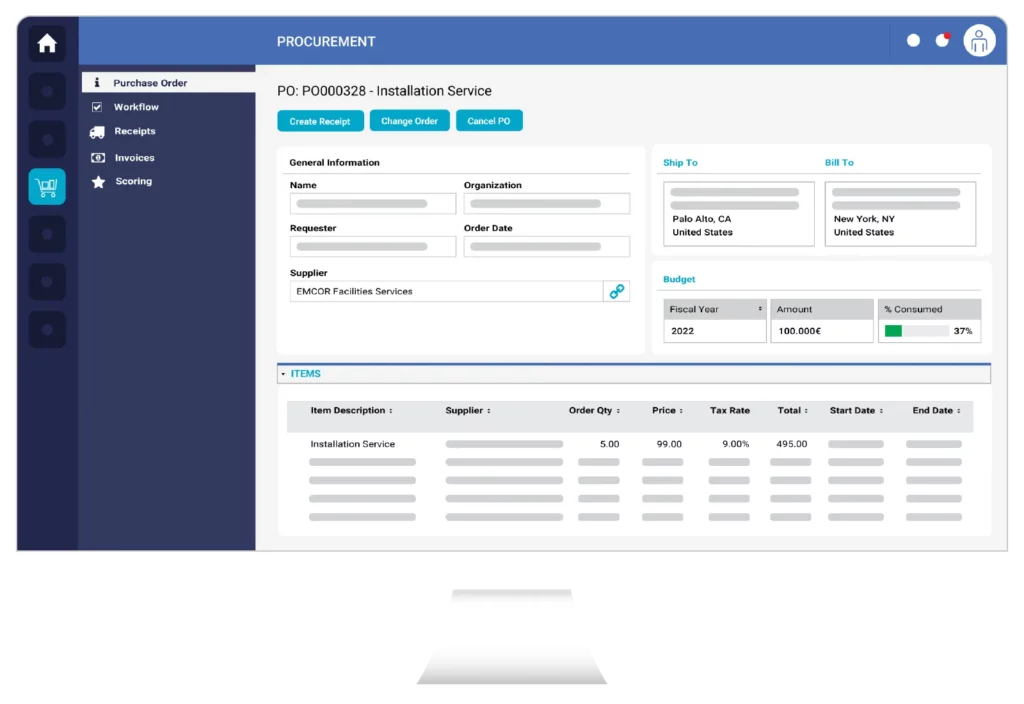
Before payment is released, the system compares three records: the PO, the goods receipt, and the invoice. If all three align in quantity, pricing, and terms, payment is approved.
However, if any of those touchpoints mismatches with the others, Accounts Payable has to chase down the data and make corrections.
A breakdown such as this can happen when any of the upstream steps are disconnected. If the PO doesn’t reflect negotiated terms, or if goods receipts aren’t logged properly, the system can’t match the records, and payment stalls.
That’s why enterprise systems that link requisition numbers to PO numbers and receipts in a single workflow are so critical. They maintain data continuity and reduce the need for manual corrections.
AI strengthens this process by flagging anomalies early. What can it flag? Unusual pricing, missing receipts, invoice discrepancies, etc. It can also prioritize matches likely to pass, streamlining payment cycles and allowing AP teams to focus on exceptions rather than every transaction.
When procurement and finance work from connected, intelligent systems, the path from PO to payment is fast, accurate and efficient.
Bell, Canada’s largest telecom provider, discovered the power of AI-powered Procure-to-Pay workflows with Ivalua:
How Bell Unified Requisitions And Purchase Orders
Bell manages over $90 million in annual spend and supports a workforce of more than 45,000 employees. hey needed a procurement software solution that could handle both out-of-pocket and corporate card expenses at scale, without compromising control.
The challenge was to enforce compliance, simplify reconciliation, and support thousands of decentralized users initiating spend, all while minimizing friction and maintaining operational speed.
To meet these needs, Bell implemented Ivalua’seProcurement software, Invoicing, and Spend Analysis solutions. This allowed them to centralize expense data and streamline workflows, while eliminating redundant infrastructure.
Today, over 40,000 employees can access the system and benefit from policy-aligned workflows that guide spend intake and ensure accountability.
While Bell’s focus was on expense and corporate card management, the challenges they addressed – distributed users, complex approval routing, and the need for centralized oversight – mirror those faced in managing enterprise requisitions.
Why The Requisition-To-Order Handoff Matters
Now let’s take a look at the importance of handoffs between requisition and purchasing.
Requisitions play a critical role in protecting budgets and enforcing procurement policy before any financial commitment is made. They allow organizations to vet requests, validate supplier choices, and route approvals based on business rules like cost center, spend threshold, or contract presence.
This front-end discipline ensures that only authorized, budget-aligned purchases move forward.
The purchase order, by contrast, is where the commitment becomes real. It finalizes the transaction, communicates terms to the supplier, and creates a legal obligation for fulfillment and payment.
When the handoff from requisition form to PO is clean and automated, procurement shifts from being perceived as a bottleneck to becoming a strategic enabler.
Seamless, AI-driven, automated workflows help reduce maverick spend, speed up cycle times, and provide the complete, traceable audit trail that’s so critical for compliance and financial transparency. Getting the handoff right allows procurement to scale while maintaining speed and control.
Enabling Smarter, Compliant Procurement
While it’s important knowing the difference between purchase requisitions and purchase orders, in large organizations, the real risk isn’t confusing the terms – it’s in poorly functioning workflows. Gaps between intake, approval, and ordering lead to maverick spend, delayed purchasing, and financial audit headaches.
It’s therefore critical to ensure that these steps function as a single, governed process, from the first request to the final PO. Structured thoughtfolly, AI-powered Procure-to-Pay workflows help you gain control over spend, without slowing you down.
Ivalua brings these capabilities together in a single, unified procurement platform that helps you enforce policy, streamline approvals, and connect every step of the requisition-to-order process.
Simplify Procurement With Ivalua's Unified Source-to-Pay Platform
Purchase Requisitions and Purchase Orders FAQs
Yes, but it introduces risk. When POs are created ad hoc, it bypasses budget checks and policy controls, leading to maverick spend and weakens auditability.
Approvers typically depend on spend thresholds, cost centers, or request types. Enterprises often configure multi-tiered approval chains to ensure the right oversight.
When the PO doesn’t match the requisition, downstream processes fail. AP teams can’t complete a clean three-way match, which delays payment and increases friction with suppliers.
No. But in regulated industries and large enterprises, they’re a standard control mechanism to manage financial exposure and ensure accountability.
In mature procurement systems, requisitions and POs are linked in a single workflow, to ensure approvals, data accuracy, and compliance across the full cycle.