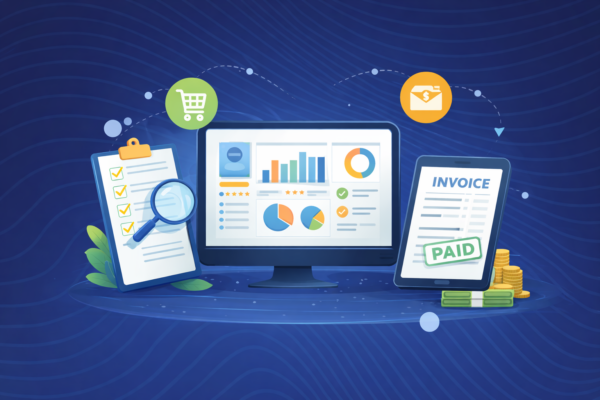



Spend in procurement is made up of direct and indirect expenses, so understanding the difference between direct spend vs. indirect spend is essential.
- Direct spend refers to the costs of materials, components, and packaging that become part of the finished product.
- Indirect spend covers the operational goods and services that support the business such as IT, facilities, and professional services but do not end up in products themselves.
In addition to definitions, this blog explores how each spend category impacts operations, including how they affect supplier strategy, risk management, and cost control.
Key Takeaways
- Direct spend covers materials and items that become part of the finished product, while indirect spend supports operations but doesn’t pay for anything in the product itself.
- Many organizations manage direct spend and indirect spend using separate systems, which creates visibility gaps, duplication, and manual work.
- Unified procurement platforms like Ivalua manage both spend types to increase visibility, control, and agility of procurement operations.
What Is Direct Spend?
Direct spend refers to procurement costs directly tied to the production of goods, such as raw materials, components, packaging, and contract manufacturing – things that become part of the finished product.
In manufacturing organizations, direct spend often represents up to 80% of total procurement spend and flows directly into materials cost within cost of goods sold (COGS). It is typically characterized by high volumes, tightly defined specifications, and formal supplier relationships focused on quality and reliability.
Examples include steel, plastics, semiconductors, motors, and inbound freight used to transport production materials.
Production continuity depends on these inputs, so organizations must manage supplier collaboration, demand signals, and engineering changes carefully. This is why many manufacturers invest heavily in structured supplier partnerships and a formal direct sourcing strategy that balances production efficiency and inventory costs.
Ivalua’s platform supports this complexity with Direct Materials Management, supporting both Direct Material Sourcing which may include BOM and Cost Breakdown sourcing and Product Quality Management and launch, and Supply Chain Collaboration capabilities such as Planned Order Collaboration, Forecast Collaboration, and Inventory Collaboration. Built natively as a single platform with one data model and one user experience, Ivalua delivers best-of-breed direct procurement capabilities without relying on a patchwork of acquired tools.
Next, let’s look at indirect spend and how it differs from direct spend operationally.
What Is Indirect Spend?
Indirect spend includes the operational expenses that keep the business running but are not a part of the finished product. These purchases support day-to-day operations and typically account for 20–30% of revenue. They are spread across dozens of categories and often managed by stakeholders outside procurement.
Compared with direct spend, indirect spend usually involves higher supplier counts and lower per-transaction values. Examples include SaaS subscriptions, legal and consulting professional services, facilities and MRO supplies, travel expenses, and HR services.
Companies often struggle to gain full visibility and oversight into this area of spend, which leads to to maverick spend and inefficient tail spend management across departments. Effective spend management requires bringing these decentralized purchases under consistent policies and workflows.
Ivalua’s platform addresses indirect fragmentation through Intake Management (a central portal with AI triage); eProcurement capabilities such as catalogs, requisitions, and purchase orders; and AP Automation. Because Ivalua is built as a single platform, these indirect capabilities share the same data model and user experience as direct procurement tools.
A unified approach enables you to standardize processes across the company, while adapting workflows to different spend categories and regulatory requirements without any coding.
Now let’s compare direct vs. indirect spend and why managing both together matters.
Direct vs. Indirect Spend: Key Differences
There are several distinct differences between direct spend and indirect spend.
- Product impact: Direct spend management affects key elements like product quality, supply chain risk profile, and COGS, while indirect spend influences operational efficiency and cost control.
- Supplier relationships: Direct procurement typically involves fewer suppliers with longer term, more strategic and critical partnerships, while indirect purchasing spans a wider vendor base with more transactional interactions.
- Specifications: These are tighter in direct procurement and often governed by engineering tolerances, industry standards, and customer requirements. Indirect categories tend to have more flexible requirements based on the needs of internal stakeholders and departments. .
- Purchasing patterns: Direct purchases are planned around production schedules and demand forecasts, while indirect spend is often decentralized and more ad hoc.
- Risk profiles: Disruptions in direct procurement can threaten production and therefore revenue, while disruptions in indirect procurement can cause compliance risk and cost leakage.
These differences require distinct governance models within category management and coordinated supplier management, yet many organizations still manage them in siloed systems that limit spend analysis and true spend visibility.
Ivalua’s unified platform supports all processes from intake through payments and manages both direct materials and indirect categories in one environment.
Because Ivalua is natively built as a single platform with one data model and one user experience, it delivers unified data that enables enterprise-wide visibility. At the same time, its flexibility allows you to apply different governance models for direct and indirect categories at very granular levels. This aligns with broader procurement and supply chain management strategies while enabling you to easily adapt workflows to different markets, categories, business units, and regulatory requirements.
Next, we look at some of the lesser-known operational realities of both spend categories.
What Generic Guides Get Wrong About Managing Spend
Many generic guides present direct and indirect spend categories as cleanly separated with straightforward management approaches. In practice, the environment is far messier. Manual workflows still exist, and procurement often enters product development too late. As a result, true costs remain hidden and supply disruptions can intensify.
Addressing these realities requires stronger process efficiency and a more proactive procurement strategy..
The Spreadsheet Problem Is Worse Than You Think
Despite decades of procurement technology investment, 50% of procurement organizations still use Excel spreadsheets for data analysis. Teams spend hours correcting spreadsheet errors and manually reconciling data scattered across disconnected systems, undermining spend analysis and obscuring opportunities for cost savings.
What’s more, nearly half of procurement teams report productivity slows due to manual data entry and error correction, while only 43% of procurement leaders prioritize digitization, leaving most organizations stuck in the cycle.
Why? Because direct and indirect spend typically live in separate systems, or in no system at all for many indirect categories. Without a unified data foundation, consolidated visibility and effective procurement savings management is impossible. Even tracking meaningful procurement KPIs is difficult when you’re spending too much time reconciling spreadsheets, and organizations that digitize procurement processes see up to a 40% reduction in manual workloads.
Ivalua’s unified data model and integrated spend analysis tools eliminate fragmentation at the source. Because both direct and indirect spend data live in the same platform, procurement analytics software can run across all categories. AI capabilities – including Agentic AI for retrieving, analyzing and summarizing data – help to transform spend analysis into an on-demand insight engine.
The NPI Blind Spot That Kills Your Margins
Direct spend tends to explode during new product introductions, yet procurement teams consistently get involved too late.
Historically, only about 12% of manufacturers involve procurement before the prototype phase – even though as much as 70-80% of a product’s cost is locked in at the design stage. Once engineering finalizes specs, procurement’s ability to influence cost evaporates.
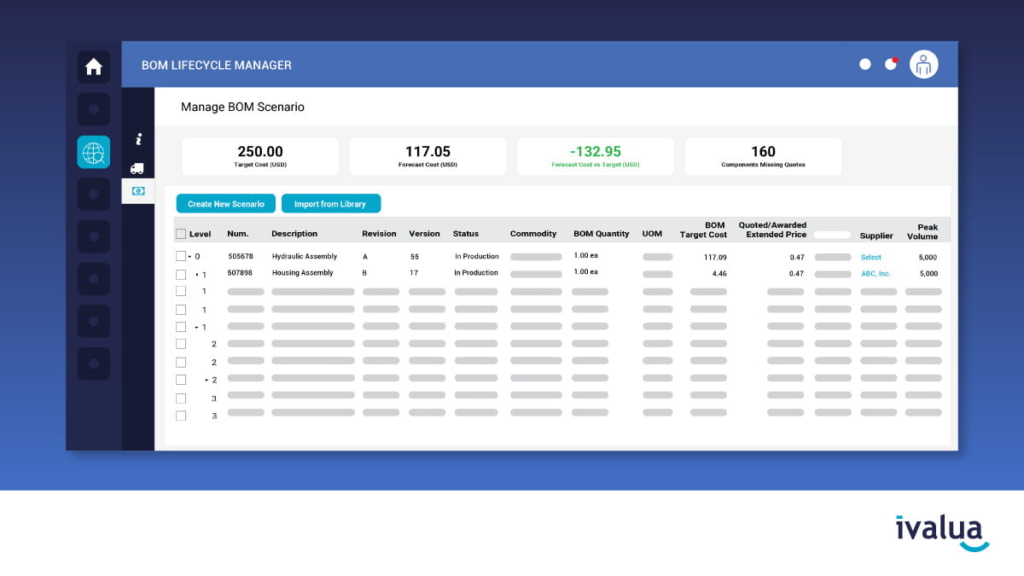
Ivalua’s built in collaboration capabilities along with Program Management, BOM Lifecycle Manager, and Direct Material Sourcing capabilities enable procurement to engage during design, not after specs are locked. The platform supports the collaboration between engineering and procurement that NPI demands: sharing BOM and item data, evaluating supplier qualifications and capabilities against specifications, and identifying cost/risk tradeoffs while design decisions are still fluid. Product Quality modules support supplier and component qualification under the pressure of launch timelines.
The Total Landed Cost Black Box
Generic guides say “direct spend affects COGS” without explaining why true cost calculation is so difficult. The reality is that while nearly all organizations (95%) have visibility into their tier-one suppliers, less than half (42%) can see beyond that.
This matters because total landed cost – the true cost of a component including duties, tariffs, freight, handling, and carrying costs – depends on information that’s usually scattered across systems and stakeholders.
Supplier contracts and supplier relationship management live in procurement, freight invoices live in transportation, duty payments live in customs, carrying costs live in finance, etc. This makes it extremely challenging to compare bids across global suppliers operating in different currencies with different tariff exposures.
About 82% of supply chains are now affected by new tariffs, with 20-40% of supply chain activity impacted. When tariff rates shift, you can’t model the impact fast enough when you don’t have unified cost data.
Roughly 39% of organizations are seeing increases in supplier and material costs, but many can’t trace exactly where those increases originate or how to mitigate them. So, they’re taking a defensive stance – 45% are increasing inventories as tariff mitigation and 39% are pursuing dual sourcing. Still,without visibility into true landed cost, these strategies won’t hold up.
This is why it is a best practice to capture comprehensive cost breakdowns and cost drivers in the sourcing process up-front prior to the supplier award. This allows a thorough apples-to-apples comparison, including raw materials, but also labor, processing, purchased components, logistics, tooling costs, and more.
Without this granular visibility, procurement teams are forced to compare opaque, “flat” quotes that hide fluctuating commodity costs, varying regional labor rates, and hidden transportation premiums. By standardizing these cost components across all bids, organizations can remove supplier bias, expose the actual economic variables of each proposal, and transform negotiations from an adversarial price war into a collaborative, data-driven optimization of the total landed cost.
Disruption Risk Is Compounding, Not Stabilizing
Supply chain disruptions have intensified, increasing 38% year-over-year in 2024. The top five most disrupted industries for the fourth consecutive year being Life Sciences, Healthcare, General Manufacturing, High Tech, and Automotive.
Drivers include extreme weather disruptions, which jumped 119% (floods up 214%, hurricanes up 101%); geopolitical risks, which surged 123%; and regulatory changes including tariffs increasing by 128%. Meanwhile, commodity price volatility hit its highest level in at least half a century between 2020-2024.
In this environment, procurement teams can no longer rely on stable supplier relationships and predictable pricing. They need the ability to quickly identify alternative suppliers, model cost impacts, and pivot sourcing strategies in real time. This is why practices such as vendor-managed inventory are becoming more common, allowing suppliers to monitor demand signals and replenish stock proactively to reduce disruption risk.
Additionally, the #1 disruption type for six consecutive years is when a factory fire takes out a key supplier. In such cases, procurement needs to know immediately which alternatives are qualified, what the cost and lead time implications are, and how to redirect orders. Unified supplier data and pre-established relationships with alternatives enable procurement risk management.
Ivalua’s Supply Chain Collaboration tools and supplier risk monitoring enable proactive disruption response. It doesn’t simply send an alert if there’s a problem – it helps you find and pivot to an alternative, pre-qualified supplier, with visibility into their capacity, onboard and ready to activate. Ivalua’s orchestration capabilities including Agentic AI can execute multi-step actions to support rapid supplier changes when disruptions hit.
How to Manage Direct Spend Strategically
Following are are three key steps to managing direct spend:
- Unified visibility over point solutions. Fragmented systems lead to manual work and visibility gaps that slow response times. A unified platform that treats all spend and all suppliers as one ecosystem enables consolidated analysis and scenario modeling, while still supporting different governance models for direct and indirect categories. With a much higher level of visibility, it strengthens category management and supports stronger procurement strategy, while revealing new opportunities for cost savings across the enterprise.
- Embed procurement earlier. Strategic procurement begins during product design. That’s why early collaboration is critical for evaluating supplier capabilities, material alternatives, and cost or risk tradeoffs. Systems that connect procurement and engineering through shared BOM data and supplier intelligence enable better outcomes.
- Build resilience proactively. Procurement leaders must prepare for disruption before it occurs. That means onboarding qualified alternative suppliers in advance, monitoring supplier financial health and geographic risk, and maintaining performance visibility across the supply base.
Ivalua is designed for modern business spend management with an architecture that spans Intake Management, Direct Materials Management, Sourcing, Contract Lifecycle Management, eProcurement, Invoicing & Payments, Supplier Risk & Performance, Spend Analysis, and AI capabilities such as Agentic AI for multi-step workflow execution. It runs on a single unified data model with role-based governance, enabling teams to both manage direct and indirect spend appropriately and effectively.
How AI Supercharges Total Spend Management
With large volumes of data and changing supplier ecosystems, humans need help managing complex spend categories across a global organization. This is why AI is becoming a core enabler of unified spend management software. When AI is integrated into the technology rather than layered on top as a disconnected tool, it can help strengthen your overall procurement strategy and provide much richer insights into how money is being spent in your organization. This is true for both indicated and direct spend.
For indirect spend, AI can improve efficiency, compliance, and user experience.:
- Intelligent Guided Buying: AI orchestrates anAmazon-like purchasing experience by recommending preferred items and suppliers to employees. It can guide users toward compliant, on-contract purchases, reducing policy violations and unmanaged tail spend.
- Invoice Anomaly Detection: AI extends beyond basic OCR to detect potential invoice errors and fraud. It can flag duplicate invoices, purchase order mismatches, or unusual pricing patterns and help clean invoices process faster and automatically.
For direct spend, AI supports strategic sourcing, supply chain resilience, and collaboration.
- Should-cost Modeling: AI can be used to analyze historical bid data, commodity price trends, and supplier costs, and generate predictive should-cost models that help strengthen negotiations and sourcing decisions.
- Predictive Supply Chain Analytics: AI can evaluate supplier lead times, logistics data, and production schedules to anticipate delays or stockouts. For example, it can identify shipments that are likely to be delayed based on real-time signals.
- Quality and Compliance Automation: AI can analyze quality documentation such as APQP and PPAP submissions, and identify anomalies and emerging trends in defect rates that could impact supplier performance.
In the next section, we take a look at how these ideas translate into real-world results.
How Grupo Antolin Transformed Direct Materials Procurement
Grupo Antolin, a global automotive interiors supplier with 150 factories across 26 countries and more than 27,000 employees, faced many of the operational challenges described in this blog:
- Legacy systems required extensive manual data entry
- Supplier risk and compliance visibility was limited
- Procurement lacked integration with PLM systems
- Managing new product launches holistically was difficult
By modernizing its procurement and supplier management software environment, the company eliminated much of this manual work. Documents, data, and Bills of Material (BOM) now load automatically through system integrations, allowing procurement teams to focus less on administrative tasks and more on strategic activities. Additionally,
The transformation also enabled deeper New Product Introduction (NPI) integration. Procurement now collaborates earlier with engineering teams and suppliers, with shared visibility into BOM status, components, direct spend, and purchase orders during product launches.
Today, Grupo Antolin manages about 40,000 suppliers, roughly 2,500 sourcing events, and more than 1,200 contracts on a single procurement platform and supplier portal, providing real-time visibility and supply chain management across the end-to-end direct materials procurement process.
“With Ivalua, our organization has improved collaboration both internally and externally with suppliers, automated processes and greatly improved our visibility across the end-to-end direct materials procurement process.”
– Beatriz Jimenez Benito, Control & Systems Purchasing Director, Antolin
Read the full Grupo Antolin case study.
Optimizing Direct and Indirect Spend Management
Understanding direct vs. indirect spend is table stakes these days. But you can gain competitive advantage by eliminating manual work through unified systems, engaging procurement earlier in product development, and building resilience against disruption and volatility.
While disruptions are increasing and supply chain volatility is rising, if you treat direct and indirect spend as separate problems in separate systems, you will continue to struggle with the operational realities this blog describes.
However, if you unify your approach and manage different strategies with a single platform, you will gain complete visibility and the ability to manage all types of spend strategically. Ivalua can help you get there.
See how modern platforms streamline direct materials sourcing and supplier collaboration.
Frequently Asked Questions About Direct vs Indirect Spend
In most manufacturing organizations, direct spend accounts for roughly 60-80%% of procurement spend, because it includes materials and components tied directly to production. Indirect spend typically represents the remaining portion of the total spend breakdown, covering operational purchases that support the business but do not become part of the finished product.
Organizations resolve ambiguous cases through a clear procurement taxonomy that defines consistent spend categories and rules for spend classification. The key distinction in direct vs indirect spend is whether the purchase becomes part of the finished product or primarily supports business operations.
Indirect spend management is typically led by the procurement team, but purchasing decisions are often distributed across departments such as IT, HR, and facilities. Effective category management helps coordinate this decentralized purchasing while maintaining clear spend ownership and policy compliance.
Indirect spend refers broadly to operational purchases that support the organization but are not part of the finished product. Tail spend is a subset of this category that includes low-value purchases from many suppliers, often representing unmanaged spend that falls outside formal sourcing processes.
In financial reporting, direct spend is typically recorded as part of COGS (cost of goods sold) because it directly contributes to product creation. Indirect spend, by contrast, is categorized as operating expenses, which affects budgeting, cost accounting, and margin analysis.