


You’re under pressure to deliver real, verifiable cost savings – results that finance can validate and the board can trust…
In today’s volatile market, CFOs and CPOs need more than tactical events like one-off sourcing wins or supplier renegotiations to succeed. They need a unified, organization-wide savings strategy: one that bridges the gap between procurement and stakeholders that have budget accountability through shared definitions, real-time visibility, and data-backed decision-making.
This blog introduces a structured savings management framework that aligns teams, tracks savings from pipeline to realization, and proves procurement value. You’ll learn how to combine strategic sourcing, SRM, and analytics to realize both hard and soft cost savings from procurement, to drive ROI and business impact.
Key Takeaways
- Sustainable procurement savings start with alignment. When procurement and finance agree on what counts as savings and how it’s tracked, organizations can deliver financially sound results.
- Centralized systems and unified dashboards eliminate data silos, provide real-time visibility into savings performance, and enable consistent reporting that builds trust with leadership.
- Linking savings to sourcing events, contracts, and transactions like purchase orders and invoices helps to validate initiatives and prove measurable business impact.
Why Most Procurement Cost-Cutting Falls Short
Procurement teams are under constant pressure to deliver cost savings. But too often, their efforts are held back by disconnected systems, inconsistent data, and a lack of alignment with finance and budget holders. Without a clear process for tracking savings or defining what “savings” even means, it’s hard to prove impact—let alone scale it.
Many organizations rely on one-off procurement cost savings strategies like last-minute vendor negotiations or standalone sourcing events. While these can create short-term wins, they don’t build sustainable long-term results, leaving leadership without the proof needed to justify strategic decisions.
This shortfall is rooted in a lack of structure. Teams are working with incomplete information, manual tracking, and no shared framework to manage or measure success, which makes it nearly impossible to address cost reduction challenges in a consistent or credible way.
To tackle cost-reduction challenges effectively, companies need a strategic approach, with well-defined objectives and standardized processes for managing procurement savings.
Strategic sourcing initiatives must be part of that foundation, helping to link source selections to quantifiable savings, ensuring that sourcing efforts are measurable against baselines, tied to budgets, and aligned with financial objectives.
Fragmented Tools and Ad Hoc Tactics Limit Visibility
When procurement data is scattered across spreadsheets, ERPs, and siloed sourcing platforms, the entire process suffers. Teams waste time piecing together spend reports, only to find conflicting numbers or missing context. Initiatives stall because no one has an accurate view.
In this environment, there are no reliable audit trails. Handoffs break down and leadership loses trust in the numbers. This fragmented approach also creates unnecessary risk, especially when finance is expecting transparent and reliable reporting.
Short-Term Fixes Don’t Translate to Long-Term Value
Short-term tactics such as one-off supplier negotiations and last-minute cost cuts may generate quick wins, but they rarely lead to sustainable results and may only defer additional costs. Without a consistent framework for tracking savings from baseline to realization, it’s hard to tie tactical outcomes back to strategic objectives. Plus, finance sees isolated gains, not scalable improvements.
True long-term value requires a shift away from reactive fixes toward a strategic sourcing model backed by clear data, cross-functional alignment and continuous process optimization.
From Cost Cutting to Strategic Enterprise Procurement Cost Savings
Instead of reactive fixes, a more effective approach is enterprise savings management – a structured way to plan, track, and realize cost savings across the entire organization.
Instead of focusing only on unit costs, strategic sourcing initiatives consider the Total Cost of Ownership (TCO), which includes everything from maintenance and quality to delivery risks and long-term performance. Considering TCO helps you make smarter decisions that support both savings and business priorities.
As your organization matures, you must move from reactive cost reduction strategies to proactive, data-driven strategies for procurement savings through lower TCO.
A centralized procurement platform plays a key role by giving you visibility into spend, quality, and consumption and tools you need to track savings initiatives and realization, and connect the results back to budgets.
Over time, capabilities such as advanced analytics and AI can further improve strategic planning.
Let’s take a closer look at how a centralized platform can help.
Aligning Procurement and Finance on a Shared Savings Language
To measure cost savings effectively, procurement and finance need to agree on standard definitions for key terms such as hard vs. soft savings, forecasted vs. realized savings, cost avoidance measures, and cash flow improvements
Without this alignment, teams end up working from different assumptions, which can lead to duplicate reporting, mismatched numbers, and disputes over what counts as real impact.
Procurement may claim savings that finance won’t recognize, undermining trust and making it harder to secure buy-in for future initiatives.
Shared savings metrics and terminology ensure everyone is working toward the same goals, using the same criteria to evaluate success.
Enabling End-to-End Governance with One System
Procurement savings often fall through the cracks when different teams use disconnected tools. Such fragmentation can limit visibility and savings.
Moving to a single procurement platform brings everything together, from opportunity identification to contract execution and invoice matching.
It improves traceability, supports accountability across teams, and gives stakeholders a clear view of how savings are tracked and realized from start to finish.
Build Your Procurement Savings Framework in 4 Stages
To move beyond ad hoc cost-cutting and build sustainable value, organizations need a structured procurement savings tracking framework.
Companies with mature procurement systems – characterized by centralized platforms and cost reduction software, advanced analytics, and governance structures – consistently outperform peers in cost savings realization.
Models like the Hackett Group’s procurement maturity model and Deloitte’s sourcing transformation frameworks highlight the importance of strategy, systems, and cross-functional collaboration.
Here’s how to structure your savings program in four key procurement transformation stages.
Stage 1: Establish Shared Definitions and Categories
Start by building alignment between procurement and finance on what qualifies as a “saving”:
- Define hard savings, soft savings, and cost avoidance.
- Distinguish sourcing-led vs. finance-led initiatives.
- Clarify forecasted vs. sourced vs. realized savings.
- Standardize these definitions in forms and business case templates.
- Embed categories and savings types into your savings tracker from day one.
Stage 2: Centralize Tracking With a Unified Savings Dashboard
Give stakeholders full visibility into savings performance across the pipeline:
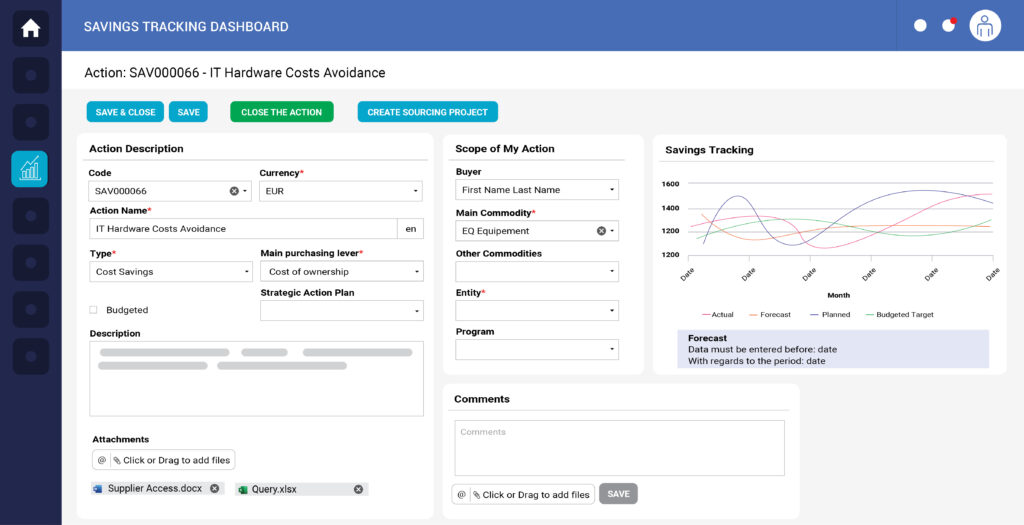
- Use a single dashboard to track project, owner, category, and status.
- Include key fields: baseline spend, projected value, timeline, realization stage.
- Assign initiative owners to drive accountability.
- Keep the dashboard connected to sourcing and contract systems.
- Track off-contract and rogue spend that cannibalize savings
- Regularly review to keep leadership informed and initiatives on track.
Stage 3: Link Savings to Sourcing and Execution Initiatives
Ensure savings are driven by real actions, not just logged in a spreadsheet:
- Tie savings to specific events like RFPs, contract renewals, or supplier switches.
- Track sourcing milestones and commercial terms (e.g., payment discounts or volume rebates).
- Use your procurement automation software to connect savings with sourcing, contracts, purchase orders and invoicing.
- Include execution details in the savings dashboard to verify realization.
- Link savings to performance reviews or business unit scorecards.
Stage 4: Forecast and Report Savings Like a CFO
Elevate procurement’s credibility by aligning savings reporting with finance expectations:
- Sync reporting cadence with quarterly and annual finance calendars.
- Show forecasted vs. realized savings with clear variance explanations.
- Flag budget impacts and timing adjustments.
- Use dynamic reports to surface strategic wins, not just one-time cuts.
- Enable finance and procurement to co-own savings validation and planning.
By building a structured procurement savings tracking framework, you can drive measurable, scalable value while strengthening alignment between procurement and finance. This maturity lays the groundwork for continuous procurement process improvement.
Common Savings Types – And How to Actually Operationalize Them
Hard savings, soft savings, cost avoidance, and cash-flow improvements are all types of savings that impact budgets and financial reporting, and they require distinct intake, measurement, and sign-off processes.
Without operational mechanisms in place, you’ll find yourself struggling to prove impact or secure cross-functional alignment.
For example, your hard savings calculation may stem from strategic sourcing initiatives with clear before-and-after pricing, while cost avoidance might involve risk mitigation through early contract renewals or better payment terms. Both are valuable, but they must be handled differently in savings trackers and budget reviews.
To operationalize each savings type, you need systems that connect sourcing, contracting, and supplier risk data.
Spend analysis plays a critical role here, helping identify and categorize opportunities, while contract management and supplier risk management tools ensure negotiated terms and risk-mitigated savings actually translate into realized value.
Tail spend management also presents hidden opportunities that can only be captured when savings categories are clearly defined and tied to sourcing actions and spend baselines.
Below is a look at different types of savings.
Hard Savings Require Clear Baselines and Validated Reductions
Hard savings are the most defensible form of procurement cost savings, but only if they’re tracked against a clear baseline.
These include negotiated price reductions, SKU rationalization, and a supplier consolidation program, all of which must be validated by comparing historical purchase orders and invoices against current spend.
Soft Savings Still Count – If You Can Measure the Impact
Soft savings, such as time saved from fewer manual steps or lower legal costs due to better contracts, are often dismissed because they’re harder to quantify.
But when tied to real outcomes such as headcount reallocation, faster cycle times, or fewer supply disruptions, they become meaningful contributors to business value.
For example, supplier risk reduction may not immediately reduce costs, but it directly impacts resilience and compliance.
Cost Avoidance Needs Proactive Sourcing and Real-Time Alerts
Cost avoidance involves preventing future price increases or unplanned spend, but you can’t prove what you never spent without the right data.
Procurement teams should use proactive strategies for procurement savings and real-time alerts based on price variance or category-level spend thresholds. These mechanisms surface when costs deviate from expectations, allowing teams to intervene before spend impacts budgets.
Working Capital (Cash Flow) Improvements Must Be Tracked Over Time
Improving working capital through extended payment terms, reduced inventory, or better Days Payable Outstanding (DPO) generates measurable benefits – however, these gains only show up over time and require coordination with finance.
Tracking the cash flow impact of payment timing, early-pay discounts, and inventory holding costs ensures these savings are fully realized and repeatable.
Use AI and Analytics to Uncover Hidden Savings
AI and advanced analytics help surface savings opportunities that humans often miss. Demand forecasting and price benchmarking can flag overpayment risks, while tail spend analytics uncover fragmented purchases ripe for consolidation.
With Ivalua’s procurement analytics capabilities, you gain real-time visibility into pricing trends, supplier performance, and spend patterns and can make more informed decisions across categories.
Tail Spend Management: A Hidden Opportunity for Cost Savings
Tail spend, which typically accounts for 20% of spend across 80% of transactions, is often unmanaged, leading to maverick purchases and inflated processing costs.
Using automation and analytics, you can classify and consolidate tail spend, reduce supplier count, enable catalogs, and automate purchase orders to lower processing costs and get better pricing, without heavy manual oversight.
From Idea to Impact: Creating a Savings Pipeline That Doesn’t Stall
Most procurement teams don’t have a shortage of savings ideas; the challenge is how to turn those ideas into measurable, realized outcomes.
Too often, initiatives get stuck between intake and execution due to a lack of clear ownership and cross-functional coordination.
Teams may log potential savings during strategic sourcing or contract negotiations, but without a structured handoff to execution teams and finance, those ideas disappear into spreadsheets or email threads.
As a result, cost reduction efforts can stall. Duplicate work occurs, and procurement’s credibility with leadership erodes. What’s missing is governance: a defined process to evaluate, prioritize, and shepherd savings initiatives from idea through realization.
A mature procurement function connects these stages through a centralized procurement savings tracking tool, where project owners, forecasted values, baselines, and status updates are visible in real time.
With the right savings pipeline and initiative tracking structure in place, procurement can move beyond reactive cuts to sustained value delivery.
Track Progress with Milestones and Reviews
To move savings from idea to impact, organizations need a structured process with defined stages and criteria. A typical savings workflow might include: Identified, Approved, In Sourcing, Realized, and Validated.
At each stage, teams should confirm key requirements. For example, “Approved” may require finance signoff and business case alignment, while “Validated” could depend on invoice comparisons or contract terms being enforced. This approach creates accountability, and ensures stakeholder engagement and alignment.
Savings Realization, Not Just Identification: Tracking What Actually Happens
It’s one thing to identify savings opportunities; it’s another to prove they actually happened.
Many procurement teams struggle with the gap between forecasted benefits and measurable outcomes. Procurement savings tracking and realization requires structured validation using real transaction data, cross-functional alignment, and clear timelines.
Finance and procurement need a shared view of realized vs. forecasted savings, grounded in what’s been executed, not just what’s been proposed.
Modern procurement systems with AI-based savings validation tools and automated alerts can track initiatives through every stage, surfacing discrepancies and documenting savings. This adds credibility across the business.
To support true procurement savings realization, make sure your team:
- Aligns on savings definitions and baselines early
- Links savings to sourcing events, contracts, and POs
- Uses a centralized procurement management system to track realization
- Validates impact with invoice and payment data
- Leverages alerts to catch missed opportunities or stalled initiatives
Finally, post-mortem reviews should assess whether projected savings were achieved, why gaps occurred, and how to improve next time. These reviews, ideally done jointly with finance, are essential for refining forecasting accuracy and surfacing risks in execution.
Learn how a unified procurement system supports savings realization.
Now let’s examine the best ways to measure – and prove – cost savings.
Aligning Procurement Cost Savings With Finance Key Performance Indicators (KPIs)
Procurement may not own a P&L, but it’s increasingly expected to report like it does. That means treating cost savings as strategic financial outcomes that must be forecasted, tracked, and validated.
A high savings realization rate (forecasted vs. actualized savings) is essential for demonstrating budget alignment and fiscal discipline. Finance leaders expect procurement to integrate into their FP&A cycles, speak in ROI terms, and use consistent forecasting models.
With the right procurement-finance collaboration model, organizations can align on expectations early, track results in real time, and report outcomes that hold up to board-level scrutiny.
A well-structured savings tracking dashboard should highlight projected savings, realization variance, timeline risk, and how savings contribute to corporate performance goals.
Below are further tips for validating cost savings.
Speak the Language of Finance: Forecast vs. Actual
Procurement teams gain credibility when they forecast like finance. Core metrics include variance from forecast, realization percentage, and impact on working capital or cost centers.
Executive-facing reports should include both summary visuals and clear annotations explaining delays, shortfalls, or accelerations. This transparency builds confidence in procurement’s ability to deliver predictable financial outcomes.
Connect Savings to P&L Impact With Shared KPIs
Aligning procurement metrics with finance KPIs like budget variance, EBITDA (Earnings Before Interest, Taxes, Depreciation, and Amortization) contribution, and ROI measurement helps move the procurement function from tactical to strategic. Instead of reporting savings in isolation, tie them to their direct impact on cost structures, capital efficiency, or margin goals.
When procurement can show how its initiatives affect the bottom line, its influence expands.
How Can AI Help Uncover Cost Savings In Procurement?
When applied effectively, AI supports three high-impact areas:
- Prediction: AI-powered procurement analytics can anticipate demand shifts, flag potential supply chain disruptions, and surface savings opportunities before costs rise.
For example, AI in sourcing workflows can forecast when certain categories may face inflationary pressure, helping teams act early on renegotiations or alternate sourcing strategies. - Classification: AI reduces the manual burden of sorting tail spend by automatically categorizing transactions, identifying rogue purchases, or consolidating fragmented vendor data.
This enables better maverick spend control and highlights cost-saving opportunities often buried in low-value, high-volume purchases. - Acceleration: AI in sourcing and procurement automates routine tasks such as comparing PO and invoice data, tracking contract compliance, or triggering real-time alerts when prices exceed benchmarks. This speeds up decision-making and frees teams to focus on strategic work.
Tools like Ivalua’s procurement platform incorporate Generative AI capabilities designed for sourcing, spend analysis, and supplier management. Generative AI features support risk summaries, and opportunity detection across the procurement lifecycle to name just a few..
Go Beyond Dashboards with Advanced Analytics
AI-powered analytics transform procurement reporting from reactive to proactive by detecting trends, anomalies, and risks before they affect budgets.
For example, demand curves can alert sourcing teams when volume thresholds are likely to trigger price breaks. Conversely, when decreased demand may jeopardize contractual obligations. Additionally, outlier detection helps to flag unusual pricing patterns across suppliers, so you can negotiate effectively.
By anticipating shifts in pricing and volume, you can take early action to prevent cost overruns and ensure consistent savings realization.
Classify and Control Tail Spend
Tail spend is notoriously difficult to manage due to its high transaction volume and low visibility. Effective, transparent, and nimble spend analysis engines streamline this challenge by categorizing unstructured spend data and identifying rogue or maverick purchases, exposing savings opportunities through supplier consolidation, catalog enablement, or policy enforcement.
With better control over tail spend, you can strengthen compliance and realize savings that may otherwise be hidden in low-value, decentralized transactions.
Speed Up Decision Cycles With Real-Time Recommendations
Rather than replacing human judgment, AI acts as a strategic assistant. Procurement teams under pressure to deliver fast results can use generative AI to accelerate critical workflows.
Real-time recommendations – for example, flagging contracts approaching renewal with higher-than-average spend – help teams respond with agility.
Next, we provide a real-world success story showcasing how Crédit Agricole realized substantial procurement cost savings using Ivalua’s AI-powered platform.
How Crédit Agricole Captured €80M in Savings Through Centralized Procurement Management
Struggling with a highly decentralized procurement process, fragmented source-to-pay and purchase-to-pay systems, inconsistent processes, and limited visibility across its 66 global entities, Crédit Agricole was looking for a better way to manage spend strategically and enforce consistent policies.
Partnering with Ivalua, the company centralized and digitized its entire procurement function, achieving 100% process digitization and automation and bringing €3 billion of spend under management.
Within the first few years, these improvements led to €80 million in savings, an increase in invoice processing efficiency of 70%, and the ability to process over 59,000 purchase orders digitally. By aligning procurement with broader financial goals and providing flexibility for each subsidiary to adopt modules at its own pace, Ivalua helped Crédit Agricole turn complexity into competitive advantage.
“With Ivalua we have achieved 100% digitization across all procurement processes and have been able to capture a tremendous amount of savings.”
– Sylvie Robin Romet, Chief Procurement Officer Crédit Agricole SA
Getting Started with Real Procurement Savings Management
True procurement savings management means building the infrastructure – governance, systems, and shared language – to turn strategy into results. Here’s how to begin building your cost savings framework:
- Assess your foundation: Do you have consistent savings definitions? Where are they documented, and are they agreed upon by finance?
- Audit your tracking: Are savings initiatives centralized in one savings tracking dashboard, with clear statuses and owners? How is realization verified?
- Evaluate your spend analysis tools: Are sourcing, contract, and invoicing data connected, or spread across multiple systems?
If your answers reveal gaps, it may be time to explore a unified source-to-pay platform that supports workflow automation, cross-functional governance, and real-time analytics.
With the right structure in place, your team can move beyond tactical wins and start delivering strategic, enterprise-wide impact.
Operationalize Savings at Scale with Ivalua’s Platform
Frequently Asked Questions About Procurement Cost Savings
Hard savings result in direct, measurable budget reductions. Soft savings improve process or risk posture but don’t always show up on the balance sheet. Both require validation frameworks to be taken seriously by finance.
Use a centralized savings dashboard with consistent definitions and initiative stage gates. Avoid Excel or isolated reports that limit visibility and ownership.
At minimum, you should generate reports quarterly. Ideally, align them with budgeting and forecasting cycles, and tie them to sourcing events, category plans, and business KPIs for credibility.
Savings initiatives may stall due to poor handoffs, lack of system support, and no validation framework. Without defined milestones and accountability, even the best ideas go by the wayside.
Integrated procurement platforms like Ivalua that centralize sourcing, tracking, forecasting, and validation are your best bet for full-cycle savings management. These platforms reduce gaps and align procurement with finance.
Further Reading
- Enterprise Spend Analysis: How to Reduce Cost and Risk
- Optimizing Your Procurement Process: Best Practices, Technologies & Strategies to Succeed
- Procurement Systems Explained: Features, Benefits & How to Choose the Right One
- What Is E-Procurement? Understanding Modern Digital Procurement Systems
- How to Build a Successful Procurement Strategy in 2025
- The Role of AI in Sourcing and Procurement: Benefits, Use Cases, and Roadmap