

Procurement automation software automates the full Procure-to-Pay lifecycle from requisition to payment. Despite technology advances and available P2P platforms, many organizations are still struggling with manual processes, disconnected systems, and limited visibility into spend.
Without effective automation software, it’s hard to control costs or increase operational efficiency. But where do you start?
This guide outlines what you should look for in a procurement automation software solution. Leveraging research from Gartner and others, we compare leading approaches and vendors, and outline how to evaluate the potential ROI of your automation solution as you modernize your P2P operations.
Key Takeaways
- Procurement automation software digitizes the full P2P cycle on a single, unified platform. It eliminates manual work and provides CPOs real-time visibility into suppliers and spend.
- The 2025 Gartner Magic Quadrant for Source-to-Pay Suites provides insights into leading vendors – SAP Ariba, Coupa, Ivalua, and Jaggaer. This guide will help you review the insights and evaluate these vendors.
- Organizations that invest in procurement digitization – “Digital Masters” – achieve their cost savings targets 96% of the time versus 80% for laggards. What’s more, AI enables 25 – 40% efficiency gains.
What Is Procurement Automation Software?
Procurement automation software digitizes and orchestrates workflows across the entire procurement lifecycle. This includes strategic sourcing and vendor onboarding, purchasing, invoicing, and payment, delivering true end-to-end procure-to-pay automation.
Unlike point solutions,which can only handle isolated tasks such as scanning invoices or generating purchase orders (POs), modern procurement software connects requisitions, approvals, invoicing, and payments on a single system. By integrating all of the processes, it eliminates manual data entry, reduces errors, and does away with data silos.
With a unified data model all processes run on a single procurement platform, giving organizations real-time visibility into spend, supplier performance, and compliance across categories.
Platforms such as Ivalua are designed around a unified data architecture, connecting all P2P processes and eliminating fragmentation.
Despite the availability of such platforms, adoption is slow. Only 60% of large organizations and 30% of small organizations have implemented true Procure-to-Pay software, even though it can reduce costs by 2 – 5%. One of the barriers to adoption is knowing what capabilities matter most in the procurement platform you choose. So, let’s take a look at the ones that separate market leading solutions from the rest.
5 Must-Have Features in Procurement Automation Software
Not all procurement automation software delivers the same level of impact. This is especially true if you’re looking to deploy end-to-end, intelligent workflows.
While you’re evaluating platforms, you need to identify capabilities that drive measurable business outcomes: cost savings, risk reduction, operational efficiency, and compliance, to name a few.
The following five features are essential for enterprise-grade Procure-to-Pay software:
- End-to-end procure-to-pay workflow automation
- Unified data model and real-time analytics
- Supplier management and risk visibility
- AI-driven insights and decision support
- Configurable workflows and scalability
Each of the following sections examines what these capabilities look like in practice and how to evaluate whether the platform you’re considering can deliver them at scale.
End-to-End Procure-to-Pay Automation
The main thing that separates a true procure-to-pay software solution from other tools is that it connects everything – purchase requisitions, approval workflows, purchase orders, goods receipt, invoice processing, and payment execution – into one continuous workflow.
While many organizations automate certain processes such as purchase requisitions and approvals, this partial automation can create bottlenecks and result in the need to perform matching manually. It also results in duplication, errors, and delayed payments.
A fully automated workflow, on the other hand, reduces cycle times and prevents duplicate payments. Plus, it creates a complete audit trail for compliance and reporting.
The financial impact is significant. Ardent Partners reports that best-in-class organizations process invoices at $2.78 each versus $12.88 for average performers – a 78% cost difference.
Leading platforms such as Ivalua connect every step on a single system, unifying processes from requisition through payment execution and eliminating handoffs between disconnected tools.
Supplier Management and Onboarding
Supplier management entails onboarding, qualifying, monitoring, and collaborating with suppliers. Effective supplier management software helps you select and onboard vendors in a standardized, scalable and meet ongoing compliance requirements – which is critical for mitigating risk.
According to Deloitte’s 2025 Global CPO Survey, 74% of CPOs say finding alternative supply sources is their top strategy, and 61% prioritize stronger supplier collaboration. The success of these tasks hinges on having a well-managed, qualified supplier base.
Without structured onboarding and visibility, organizations struggle to respond to disruptions or enforce compliance.
Modern platforms streamline supplier onboarding with self-service supplier portals, automated document collection, risk scoring, performance dashboards, and collaboration tools – and the leading solutions centralize the full supplier lifecycle.
Ivalua, for instance, provides a single repository for all supplier data, risk evaluation, performance tracking, and collaboration. The solution leverages AI-driven profile enrichment and automated improvement plans, as well.
Verallia, an Ivalua customer and global manufacturer, reduced its supplier base from over 40,000 to 8,000 while achieving 360° visibility through this unified approach.
AI-Powered Analytics and Insights
Traditional procurement software captures large volumes of data but relies on manual analysis. This means maintaining spreadsheets and performing additional data entry. By contrast, modern analytics and insights platforms use AI to surface patterns, anomalies, and opportunities automatically.
Key use cases include:
- Automated spend classification
- Contract compliance monitoring
- Supplier risk prediction
- Demand forecasting
- Autonomous sourcing workflows
The impact is measurable, organizations using advanced analytics tools report up to 20% savings potential, while AI agents can make procurement functions 25 – 40% more efficient .
Leading platforms embed AI in procurement directly into automated workflows. For example, Ivalua uses AI to highlight spend anomalies, compliance gaps, and savings opportunities across categories, with even greater accuracy enabled by its unified data model.
Contract Management and Compliance
Procurement teams often negotiate favorable contracts. However, without visibility into execution, value erodes through price creep, off-contract buying, and compliance gaps.
Effective contract lifecycle management ensures that the terms you negotiate are actually enforced – and it closes the gap between expected and realized savings.
Modern contract management platforms leverage a centralized contract repository, automated renewal alerts, clause extraction, compliance monitoring against contracted rates, and a complete audit trail for regulatory requirements. Instead of burying contracts in PDFs, they capture structured data that’s searchable, reportable, and actionable across the procurement lifecycle.
As a result, organizations experience stronger contract compliance and more savings, while reducing audit risk and exposure.
Leading solutions such as Ivalu embed these capabilities directly into workflows. Ivalua centralizes contracts with authoring tools and structured data, enhanced by AI-driven digitization, obligation extraction, natural-language search, and clause standardization. In fact, Ivalua customer Piramal Glass was able to reduce contract cycle time by 75%.
ERP and System Integration
Procurement can’t operate in isolation. It must connect seamlessly with ERP systems (such as SAP and Oracle), financial platforms, and external supplier networks. Without these integrations, even the most advanced procurement technology can become another silo, limiting visibility and creating duplicate data across systems.
Best-in-class platforms provide pre-built connectors, real-time data synchronization, and flexible APIs to support custom integrations, along with EDI and supplier network connectivity. This ensures that everything from requisitions to payments flows seamlessly across systems, without having to manually intervene or reconcile data.
Ivalua’s Integration Hub (API, ETL, EAI) and cXML/EDI connectors enable orchestration across 60+ enterprise systems while maintaining centralized visibility and control. Its customer, Chassis Brakes International, runs 25 interfaces between Ivalua and SAP as part of its deployment.
These five capabilities form the evaluation framework, but the real question is which vendors deliver on them. Fortunately, Gartner Magic Quadrant has provided its independent benchmark.
Top Procurement Automation Vendors: 2026 Gartner Leaders
The market for procurement automation software is rapidly expanding, valued at $9.82 billion in 2025 and projected to reach $15.75 billion by 2030. To that end, vendor selection is a critical decision for CPOs.
The most widely recognized benchmark is Gartner’s Magic Quadrant for Source-to-Pay Suites, which evaluates vendors based on “Completeness of Vision” and “Ability to Execute.” Leaders in this quadrant score high on both and offer a strong combination of innovation, scalability, and proven delivery.
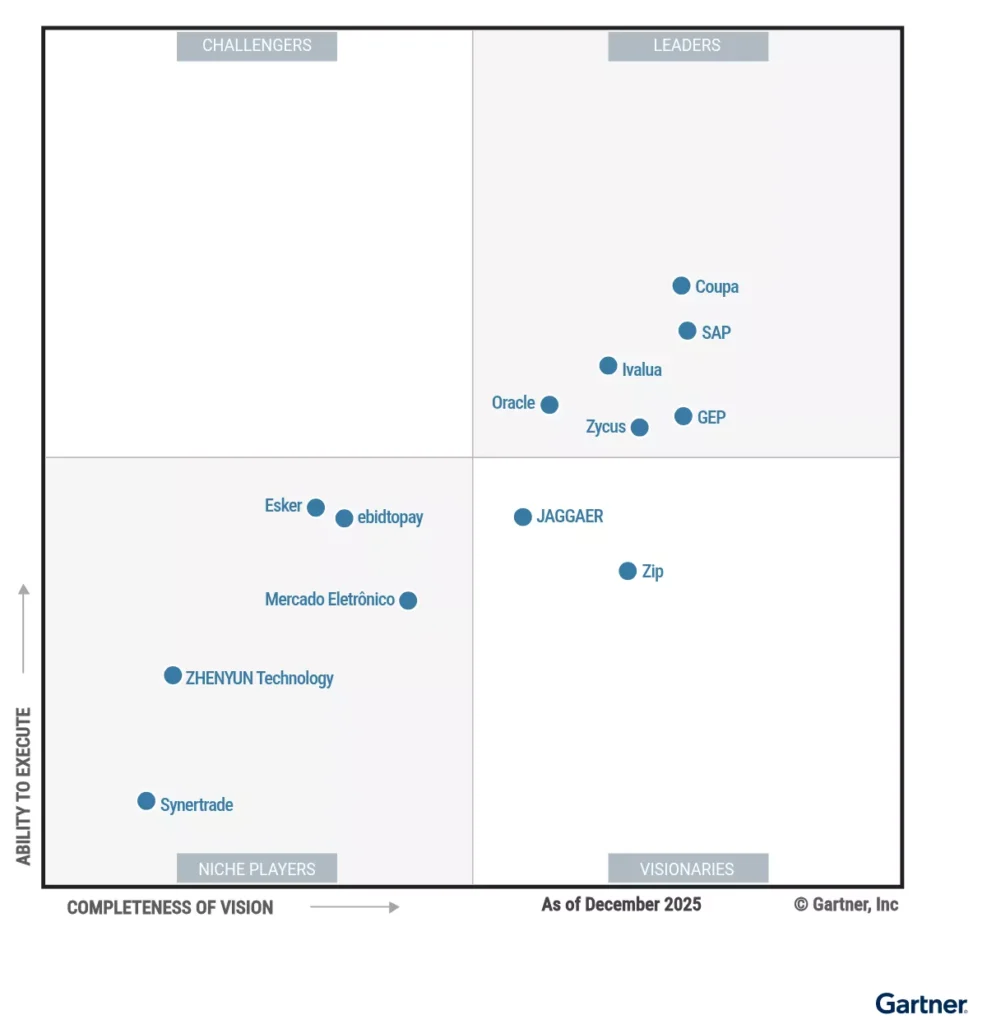
As you can see, Gartner named Ivalua, Coupa, GEP, SAP, and Oracle as leaders. Each of these organizations has a distinct approach to procurement software and source-to-pay platform capabilities. Here’s an overview:
- Ivalua is known for its unified platform and single data model, offering deep functionality across both direct and indirect spend. Organizations select it because they have complex requirements that prioritize configurability and end-to-end process coverage.
- Coupa has a strong user experience and extensive business network, with a focus on indirect spend and rapid deployment. The platform is well-suited for organizations that prioritize ease of adoption and community-driven insights.
- GEP combines procurement software with consulting services. It appeals to companies that are looking for bundled technology and advisory support in large-scale procurement initiatives.
- SAP leverages its ERP ecosystem and Ariba network to deliver procurement capabilities that are tightly integrated with finance and supply chain systems. This solution is often the default choice for organizations that are already standardized on SAP infrastructure.
- Oracle embeds procurement functionality within its broader cloud ERP suite. The focus is on financial integration and enterprise-wide data consistency.
Gartner Leaders Comparison
| Vendor | Known For | Best Fit | Consideration |
| Ivalua | Unified platform, deep configurability | Complex, global enterprises (direct + indirect spend) | Requires thoughtful implementation planning |
| Coupa | UX, business network | Indirect-focused, fast adoption | May be less flexible for highly complex use cases |
| GEP | Tech + consulting model | Transformation-led procurement initiatives | Bundled approach may not suit all buyers |
| SAP | ERP integration, Ariba network | SAP-centric enterprises | Can be complex to deploy and customize |
| Oracle | Cloud ERP integration | Finance-led digital transformation | Less specialized procurement depth in some areas |
The 2025 Gartner Magic Quadrant provides a strong starting point for building a qualified shortlist of P2P software vendors; however, choosing the right platform requires aligning a platform’s strengths with your organization’s specific requirements and long-term strategy.
How to Choose the Right Solution for Your Organization
All Leaders in the Gartner Magic Quadrant are capable procurement automation platforms. So, the decision is less about identifying the “best” tool and more about finding the right fit for your organization’s procurement strategy and transformation goals.
Start by evaluating four key dimensions:
- Spend Profile: Some platforms are stronger in direct procurement for manufacturing, while others excel in indirect spend and services.
- ERP Landscape: Integration depth with SAP, Oracle, or other systems can significantly impact time-to-value.
- Configuration vs. Customization: Platforms that offer deep configurability allow you to adapt workflows without heavy IT involvement, while others require custom development. Ivalua, for example, is known for enabling flexible configuration without custom code, which can reduce long-term dependency on IT.
- Deployment Scope: Global enterprises require multi-language, multi-currency, and regulatory support.
From there, take a structured approach:
- Define requirements across stakeholder groups (i.e. procurement, finance, IT, and suppliers) then weigh them based on strategic importance.
- Run vendor demos using real-world scenarios, not generic scripts, and validate claims through customer references.
- Align this process with broader efforts around optimizing procurement process to ensure technology decisions support long-term outcomes.
- Avoid common pitfalls, such as selecting based on polished demos alone, underestimating change management, or ignoring total cost of ownership beyond license fees.
According to Harvard Business Review, organizations often struggle because traditional implementation approaches are too slow. This finding underscores the need to assess internal change capacity alongside vendor selection.
Ultimately, choosing the right procurement platform is a strategic decision, but securing buy-in requires demonstrating how your choice can deliver financial impact and long-term ROI.
The Business Case: Measuring Procurement Automation ROI
Deloitte’s 2025 Global CPO Survey shows that “Digital Masters,” defined as organizations that invest aggressively in procurement technology and procurement transformation, exceed cost savings targets 96% of the time versus 80% for followers.
They also achieve cost avoidance at 94% vs. 75% and outperform in both internal stakeholder satisfaction (84% vs. 59%) and supplier performance (84% vs. 59%).
Efficiency is also critical. Procurement teams today manage 50% more spend per FTE than just five years ago, and AI-driven capabilities can unlock an additional 25 – 40% improvement. These gains translate directly into faster cycle times, lower processing costs, and more capacity for strategic initiatives.
For example, one industrials OEM used Ivalua to capture $370 million in cost savings in year one, by combining governance changes with digital tools and advanced analytics.
Here’s how to build a credible business case:
- Baseline your current performance: cost per purchase order, cost per invoice, and cycle times.
- Benchmark against best-in-class metrics to identify gaps.
- Model potential savings by applying typical efficiency gains and cost reductions of 2 – 5% across addressable spend.
With a quantified view of costs, gaps, and projected savings, it’s much easier to make a sound investment decision.
Making the Investment in Procurement Automation
Procurement automation software is no longer optional. Organizations without it are leaving 2 – 5% cost savings on the table, while competitors surge ahead in efficiency, visibility, and risk management.
The path forward is to evaluate platforms against the five must-have capabilities. It’s critical that you compare vendors using independent research such as Gartner, and build your business case using Digital Master performance benchmarks.
For CPOs ready to move from evaluation to action, the next step is understanding how a unified platform can deliver measurable results. Ivalua’s procurement platform supports the outcomes Digital Masters deliver, and can help you align technology with your organization’s broader procurement goals.
Compare leading procurement automation software and see how a unified platform transforms your Procure-to-Pay process.
FAQs About Procurement Automation Software
Procurement automation software pricing typically includes license cost (often per-user pricing or usage-based), implementation cost, and ongoing support. Total cost of ownership should factor in integration, configuration, and change management, which often exceed the initial subscription.
The implementation timeline for procurement software deployment typically ranges from 3–6 months for initial go-live, with full rollout phases extending to 6–12+ months depending on complexity. Strong change management and phased deployment are critical to accelerating adoption and minimizing disruption.
ERP procurement modules (such as SAP MM or Oracle Procurement Cloud) are part of broader ERP systems, while standalone procurement software provides deeper, specialized capabilities. The decision often comes down to best-of-breed vs. suite, balancing advanced functionality against native ERP integration.
Procurement software for small business and mid-market procurement teams depends more on procurement maturity than company size. SMB procurement organizations with growing spend, supplier complexity, or compliance needs often benefit from automation earlier than expected.
Cloud procurement software should meet enterprise security standards such as SOC 2, ISO 27001, and GDPR compliance to ensure data security and regulatory alignment. These certifications validate that the platform protects sensitive supplier, contract, and financial data.
Modern platforms support both direct procurement (direct materials, MRO) and indirect procurement (services procurement, operating expenses) within a unified spend management model. This enables organizations to standardize processes and gain visibility across all categories of spend.