

Procurement leaders are under more pressure than ever. They’re expected to deliver measurable savings, manage ongoing supply volatility, and support broader business strategy, all while operating with constrained budgets and lean teams.
AI procurement software is helping many leading organizations to meet that challenge. While it’s not a silver bullet, it provides a way to improve decision-making, automate routine work, and surface opportunities that may otherwise be missed.
This guide outlines what AI procurement platforms can do and what capabilities matter most in real-world environments. Plus, you’ll learn practical ways to evaluate potential ROI based on your organization’s priorities.
Key Takeaways
- AI procurement software delivers measurable ROI through automating routine tasks, improving spend visibility, and enabling faster, data-driven decisions. However, implementation must focus on data quality and change management to achieve these goals.
- The gap between leaders and laggards is widening. Top-performing procurement organizations invest heavily in AI and achieve 3X greater returns than organizations who underinvest.
- It’s important to evaluate your current procurement tech stack for gaps, then explore how AI-powered S2P platforms can address efficiency, compliance, and supplier collaboration needs.
What AI Procurement Software Actually Does (and Doesn’t)
Traditional procurement tools digitize transactions and enforce workflows across Source-to-Pay processes, if well connected. An AI procurement platform adds to that by understanding and accessing customer data, company policies and – in more advanced cases – taking action.
Most organizations operate in AI-assisted models (human-led, AI suggests) or AI-augmented models (AI-led, human approved). While agentic procurement is emerging, where systems execute multi-step workflows within defined guardrails, it’s not yet the norm.
However, McKinsey reports that procurement teams now manage 50% more spend per FTE than five years ago, underscoring the need for scalable, intelligent procurement automation.
Procurement platforms operate across three capability layers:
- Predictive analytics powers forecasting and risk scoring.
- Generative AI in procurement supports tasks like drafting RFPs and summarizing contracts.
- Agentic execution enables autonomous orchestration of routine workflows.
Equally important is architecture. One distinction is that “AI-native” platforms embed intelligence into the data model and workflows, while “AI-added” tools bolt features onto legacy systems. Platforms that are architected to accommodate a human-agent operating model enable teams to scale impact while maintaining control.
Now let’s take a look at the capabilities that separate leading platforms from traditional tools.
5 Capabilities That Define a Leading AI Procurement Platform
Today’s procurement technology varies widely, so evaluating an AI-enabled S2P procurement platform requires looking beyond feature checklists to assess how deeply intelligence is embedded.
Based on analyst research and CPO priorities, five areas consistently drive ROI:
- Intelligent intake and demand orchestration
- AI-driven sourcing and supplier discovery
- Autonomous contract intelligence and management
- Predictive spend analytics and risk management
- Orchestrated procurement automation and execution
These typically happen sequentially, as well. Let’s examine each area in greater detail.
Spend Visibility and Analytics
AI-powered spend analysis delivers true spend visibility across direct, indirect, and tail spend. Leading platforms automatically categorize transactions, normalize suppliers, and consolidate data into a unified view of spend management.
The AI layer identifies anomalies and flags duplicate payments, while surfacing contract leakage and revealing savings opportunities that may be missed during manual analysis.
McKinsey estimates organizations can unlock up to 20% savings by adopting advanced analytics. Platforms with native spend analytics capabilities maintain a single source of truth, ensuring downstream AI operates on consistent, reliable data without reconciliation gaps.
Supplier Management and Risk Monitoring
AI-driven supplier management accelerates supplier onboarding while enabling continuous, real-time risk management. Leading platforms support the full lifecycle – from supplier discovery and qualification to onboarding, performance tracking, and risk assessment.
AI enhances procurement management by automatically validating documents and monitoring external signals such as financial health, ESG data, and news sentiment. AI can also generate predictive risk scores. With AI, risk mitigation is proactive, not reactive.
According to Deloitte research, 64% of those surveyed say visibility is critical to reducing risk, closely followed by supplier information sharing at 61%. Platforms with unified supplier management software connect supplier and transactional data, which enables AI to assess performance based on real outcomes.
Strategic Sourcing with Agentic AI
Traditional strategic sourcing software is often held back by manual processes, such as creating RFPs, analyzing bids and modeling scenarios. AI in sourcing and procurement can model sourcing scenarios, and optimize award decisions based on cost, risk, and performance factors, eliminating time-consuming manual work.
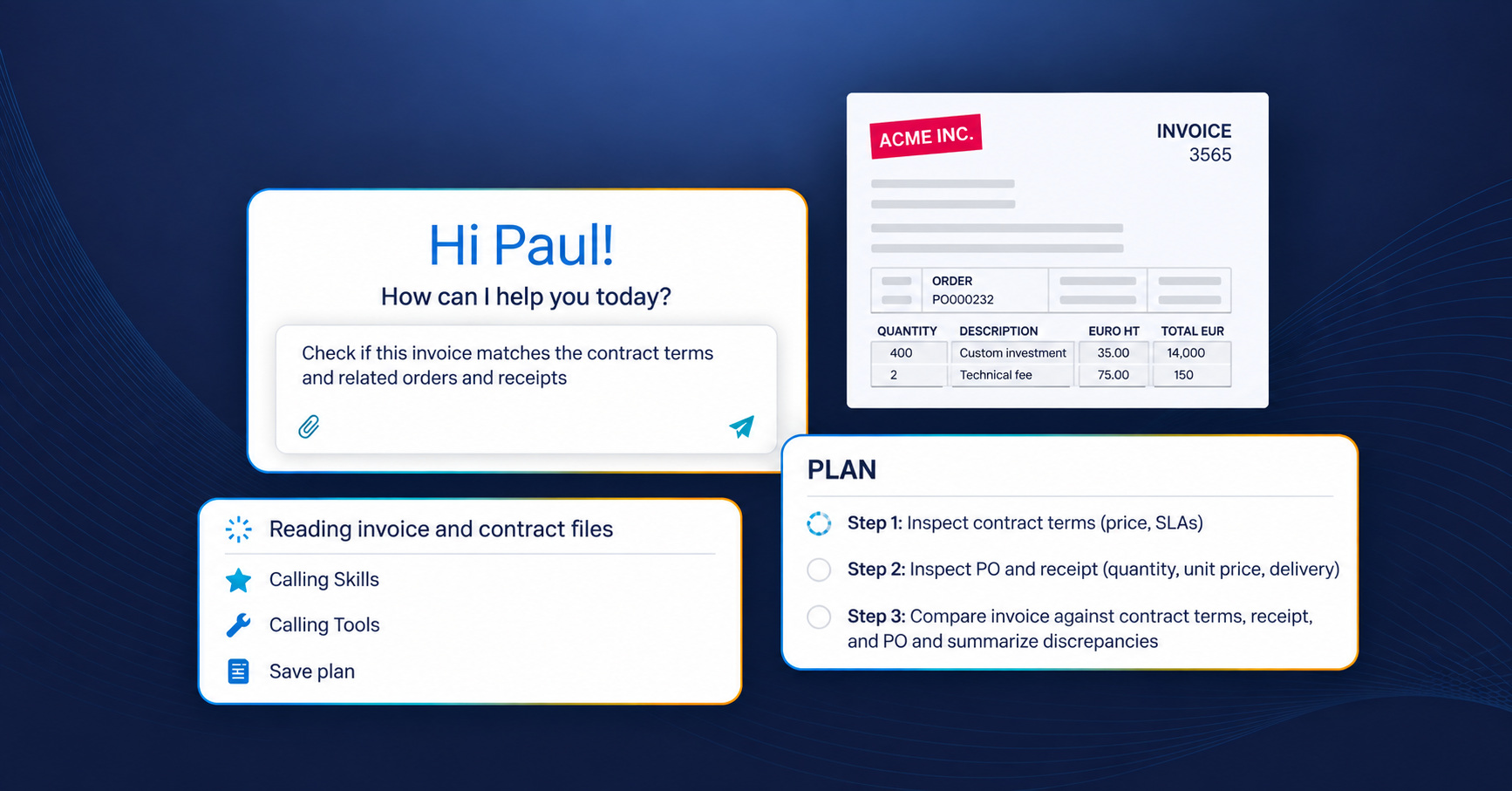
Emerging agentic AI in procurement will enable multi-step workflows that handle supplier research, policy checks, bid collection, and recommendations with minimal human intervention. For example, Ivalua’s Intelligent Virtual Assistant (IVA) already supports use cases from drafting RFPs to generating category insights with recommended actions.
Contract Management and Intake Orchestration
Contract management and Procure-to-Pay (P2P) automation both aim to close the gap between negotiated terms and actual execution. AI-powered systems extract key clauses to detect deviations from approved language and extract key obligations.
On the Intake orchestration side, AI guides users through a compliant process based on their needs. They no longer need to know the right policies or procedures, they simply interact with an intelligent virtual agent like IVA. This leads to more compliant purchasing that leverages negotiated contracts.
Still, adoption remains sluggish. Only 60% of large organizations have a Procure-to-Pay platform, despite 2 – 5% cost savings potential. Platforms that unify contract, intake and transaction data, such as a modern contract management solution within a broader procurement system, streamline compliance and enable organizations to realize more value.
Integration Architecture and Data Foundation
The effectiveness of any AI procurement platform depends on its data foundation. Most enterprises operate across multiple ERP systems and point solutions, which often results in fragmented data silos and limited visibility.
AI can’t operate effectively in such an environment. Outputs are unreliable, and people don’t trust them. Ultimately, this slows adoption.
Research shows that AI effectiveness depends heavily on a unified S2P data model. That’s why platforms built for digital procurement unify internal and external data through open APIs. Through strong data governance, and controlled access enable AI, they are able to operate securely while delivering insights that teams can trust.
Now let’s examine how the market is evolving – and how leading organizations are boosting AI adoption.
Market Landscape and Platform Selection in 2026
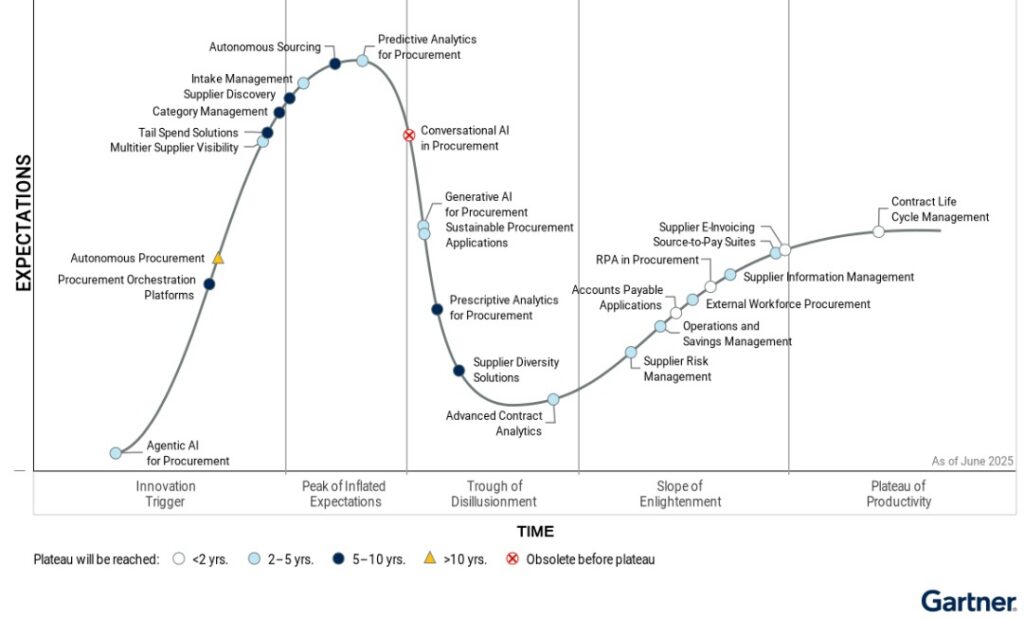
The market for AI procurement management software is entering a more realistic phase. According to Gartner, generative AI in procurement has moved into the “trough of disillusionment,” with many organizations seeing uneven ROI or falling short of early expectations.
At the same time, with agentic capabilities emerging, S2P suites are helping teams be more productive. Procurement leaders are ranking AI agents in procurement and generative AI among the most impactful technologies in the next 12 – 18 months.
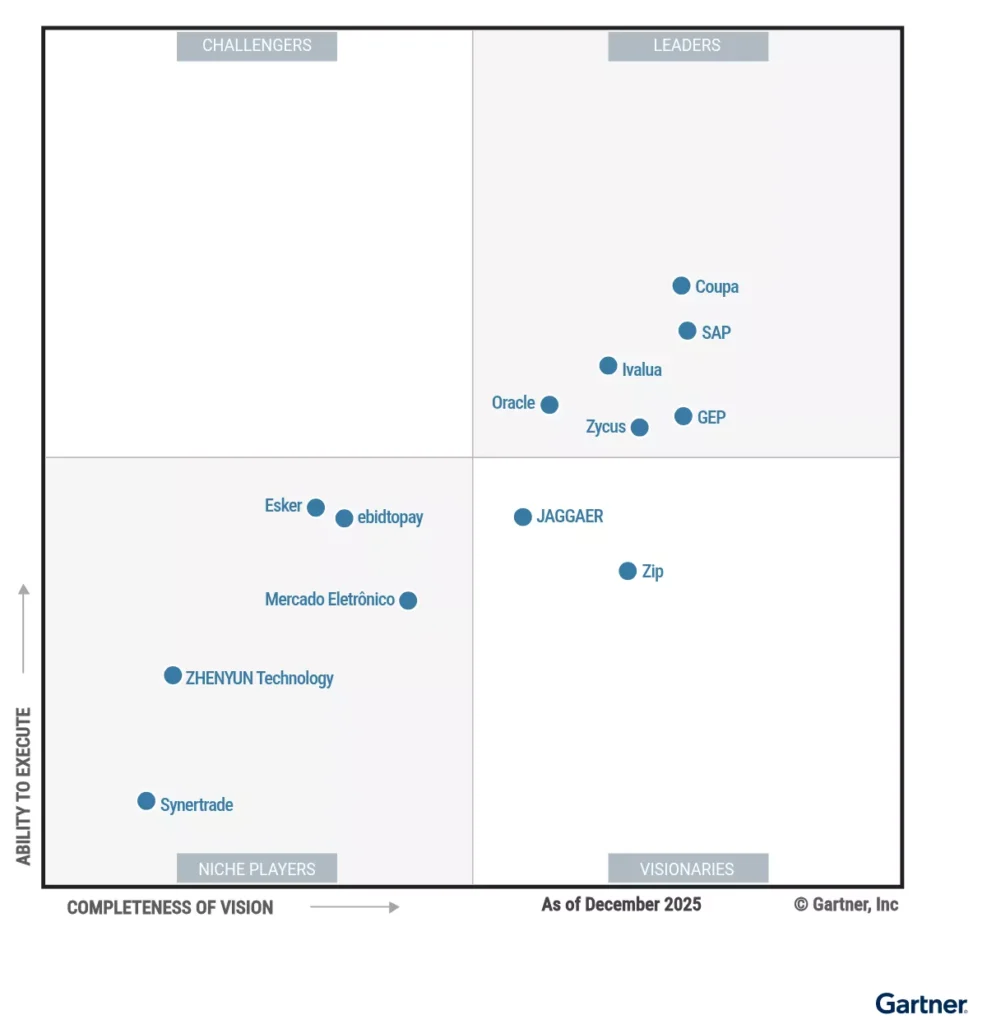
Platform choice plays a decisive role. Broadly, the market breaks down into two categories:
| Platform Category | Strengths | Tradeoffs |
| Unified S2P suites with embedded AI (e.g., Ivalua, SAP Ariba, Coupa, GEP) | End-to-end coverage, consistent data model for some, stronger foundation for AI | Requires enterprise-wide adoption to maximize value |
| Best-of-breed point solutions | Deep functionality in specific areas | Integration complexity, data fragmentation, weaker AI outcomes |
Leading organizations are prioritizing platforms architectured for AI from the ground up.
One example is Ivalua customer, Körber, which is running a successful IVA pilot focused on automation and analytics. According to Körber representative Jan Van Hueth, “We started our AI journey in 2023… what we hear most often right now is Automation type use cases and Analytics type use cases.”
Their approach includes formal AI governance and an Ethics Council, ensuring innovation doesn’t compromise trust.
Körber’s story is representative of change happening in the market. Platforms designed with a unified data layer, embedded engagement layer with AI across the e-procurement platform, and adequate governance are pulling ahead.
Once you understand the need for AI in procurement, the next step is quantifying the business case to gain support from upper management.
What CPOs Are Actually Achieving with AI Procurement Software
CPOs are seeing measurable returns from AI procurement software, but results vary widely based on how organizations implement and integrate these platforms.
The most consistent gains come from efficiency. McKinsey estimates that agentic AI can make procurement functions 25- 40% more efficient, primarily by shifting work from routine tasks to higher-value, strategic activities.
What’s more, Deloitte reports that “Digital Masters” achieve 3.2X ROI on GenAI investments, compared to just over 1.5x for less mature organizations.
This divide is accelerating as leaders invest more aggressively, with top performers allocating 24% of their budgets to procurement technology, nearly double 2023 levels. Adoption is moving quickly as well, with 40% of procurement functions already piloting or deploying GenAI.
However, these outcomes aren’t guaranteed. Realized ROI depends heavily on the quality of your data, your implementation approach, and whether the platform you choose can scale across the organization.
The goal of modern AI-powered procurement solutions is to help teams work faster by offloading admin to AI agents, work smarter by generating insights faster, scale initiatives with ease, and operate from a transparent, reliable data foundation.
But as with any new solution, things can go wrong. Next we take a look at some pitfalls to avoid as you adopt AI procurement software.
Why AI Procurement Implementations Fail (and How to Avoid It)
Stakeholder alignment and change management is the most common challenge during S2P implementation, cited by 58.7% of respondents in a survey of 31 system integrators. For a deeper look, see this Source-to-Pay implementation guide. Most AI procurement disappointments trace back to three issues.
- Data Fragmentation: Disconnected, low-quality data limits AI accuracy and trust. As Gartner reported, fragmented data and stand-alone GenAI tools often add complexity without solving the root problem.
- Organizational Barriers: Deloitte research identified siloed ways of working (57%) and competing priorities (46%) as blockers to value delivery. Without alignment, even strong platforms underperform.
- Trust and Adoption Challenges: Concerns about job security, skepticism toward AI insights, unpredictable costs, regulatory pressure, and compliance requirements can stall progress before value is realized.
Avoiding these pitfalls requires strong governance, which includes clear LLM policies, data privacy controls, human approval checkpoints, and role-based access for higher-risk decisions. Platforms with built-in governance and the ability to keep secure and isolated help organizations build trust while scaling AI safely.
Understanding these potential pitfalls will help you make smarter decisions as you move forward with your AI procurement software implementation.
Making the AI Procurement Investment Count
Selecting an AI procurement platform in 2026 is less about chasing features and more about choosing the right foundation. To see real results, you should build your strategy on three principles:
- Unified data across S2P
- Embedded AI woven into workflows
- Governance that builds trust as autonomy increases
The stakes are high – and the gap between leaders and laggards is growing. CPOs ready to move forward must evaluate how a unified platform supports a human-agent operating model. Remember that organizations achieving 3X or more returns didn’t bet on features; they chose platforms built for AI effectiveness.
Explore how Ivalua’s S2P platform and AI capabilities can help your team scale impact with control.
FAQs About AI Procurement Software
AI procurement software pricing varies based on scope, scale, and deployment model, with S2P software investment typically including licensing, implementation, and ongoing support. To evaluate true procurement platform cost, organizations should focus on total cost of ownership, factoring in integration, data management, and the ROI from automation and savings generation.
The AI procurement implementation timeline depends on complexity, but most source-to-pay deployments follow a phased rollout approach to accelerate time to value. A well-structured procurement software rollout can deliver initial capabilities in months, with continuous expansion over time.
Yes. Modern solutions support AI procurement for mid-market organizations by offering modular capabilities and scalable deployment models. With strong procurement automation scalability, even SMB procurement software can deliver enterprise-grade value without requiring large teams or budgets.
Most platforms are designed for business users, with no-code procurement platform capabilities that reduce reliance on IT. Effective AI procurement training and intuitive interfaces support user adoption and ensure procurement team enablement without deep technical expertise.
Yes. Leading platforms are built for ERP integration and can operate within a multi-ERP environment using flexible procurement software connectors. This approach ensures legacy system compatibility while enhancing capabilities without requiring full system replacement.
The key difference between spend analytics vs S2P platforms is scope: point solutions provide insight, while a unified procurement platform enables action across the full lifecycle. Unlike procurement point solutions, integrated platforms connect data, workflows, and AI to drive end-to-end value.