

Vendor management is where procurement feels the strain of complexity most—thousands of suppliers, endless documents, rising compliance pressure, and decisions slowed by fragmented data.
Effective AI vendor management is the most practical way to bring order, speed, and visibility to one of procurement’s most manual domains.
AI vendor management leverages artificial intelligence (AI) to streamline and improve vendor relationship management. It helps you unify fragmented supplier data, automate manual workflows, strengthen risk visibility, and accelerate procurement decisions.
These capabilities are critical, because vendor information is often scattered across ERPs, sourcing tools, spreadsheets, accounts payable and third-party risk systems – and that fragmentation makes compliance and governance inconsistent.
This blog offers a comprehensive overview of how AI vendor management works in real procurement environments. We outline tangible benefits and real-world use cases drawn from Ivalua deployments to demonstrate how AI can deliver substantial value when built on a unified supplier record.
Key Takeaways
- AI Vendor Management relies on a single source of truth of supplier data, no matter how many systems, to deliver consistent visibility and insights.
- AI can automate onboarding, risk checks, and performance analysis with built-in governance.
- Practical use cases already help CPOs make faster, more confident vendor decisions.
How Agentic AI Is Transforming Vendor Management
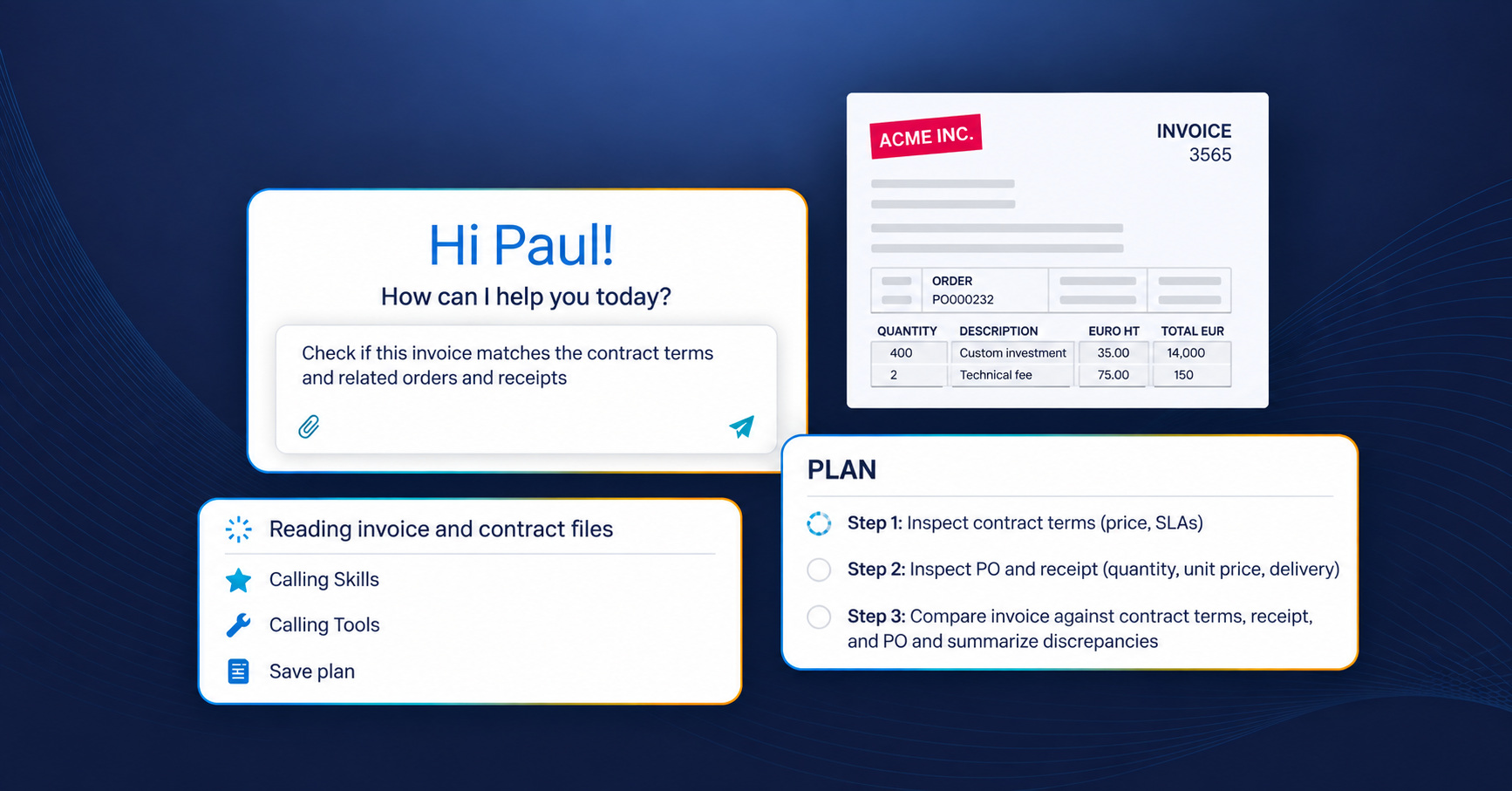
Agentic AI does more than assist you with manual tasks – it does them for you. Instead of only generating text or recommendations, Agentic AI can perform multi-step tasks autonomously, such as reasoning across data, documents, and rules to complete outcomes end-to-end.
Vendor management is an ideal domain for Agentic AI, because it depends on tightly connected workflows: supplier qualification, document verification, risk assessment, ongoing performance tracking, and continuous communication. These tasks slow teams down and introduce risk when completed manually.
Agentic AI can do a lot more than automate tasks. The right agentic AI system can cleanse and merge supplier master data, analyze documents, extract data, monitor external risk signals, and initiate workflows, such as triggering additional reviews or updating supplier status.
But here’s the catch: This level of autonomy only works when agents operate on a consistent, governed data foundation. And, according to Gartner, 74% of procurement leaders say their data isn’t AI-ready.
Ivalua enables agentic AI by unifying supplier master data, contracts, documents, performance metrics, and communications within a single platform. With all data consistent and centralized, Ivalua’s agentic AI can act on aligned, policy-compliant information across the full vendor management lifecycle.
By centralizing supplier information, platforms like Ivalua make advanced AI in procurement possible – and practical – across modern vendor management workflows.
Once your data foundation is in place, the next step is understanding how vendor-management AI matures from basic assistance to fully autonomous orchestration.
The Five Generations of Procurement AI Maturity
The Agentic AI guide outlines five generations of development to show how vendor-management capabilities mature, from basic assistance to fully autonomous execution:
- Generation 1 focuses on simple content creation, such as drafting supplier emails, onboarding messages, or follow-ups.
- Generation 2 adds context by summarizing contracts, policies, or supplier profiles and grounding insights in relevant vendor data.
- Generation 3 moves from insight to action by generating supplier improvement plans using multi-source inputs, including performance history, risk indicators, and ESG data – powered by deeper data analytics across the supply base.
- Generation 4 has AI supporting multi-step reasoning through conversational procurement. Users can ask complex questions, such as which suppliers present rising compliance risk, and receive synthesized answers that combine documents, external signals, and internal records.
- Generation 5 represents the shift to true autonomy: agents execute supplier actions with or without human intervention, launching questionnaire, updating supplier status, or triggering corrective workflows based on predictive analytics.
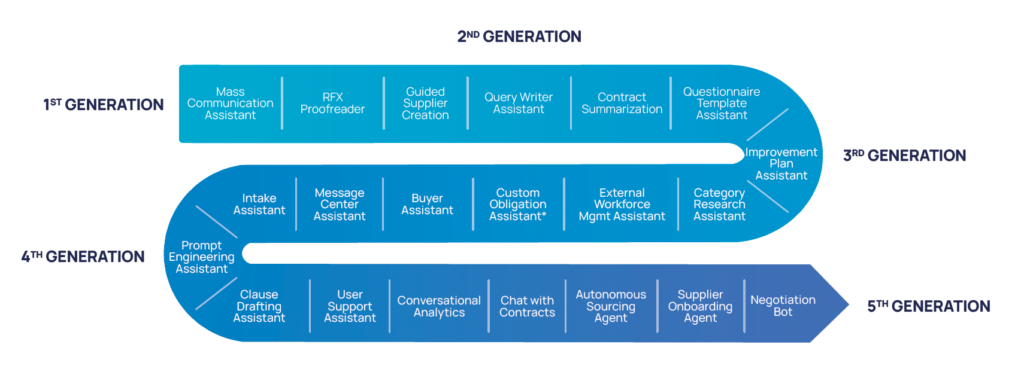
Ivalua supports all five generations within a single environment because its agent framework operates directly on unified supplier data and an AI-ready orchestration layer.
Now, let’s explore some vendor-management use cases in which Agentic AI is already delivering measurable results today.
The Most Important AI Use Cases for Vendor Management
Vendor management carries some of the highest volumes of repetitive, document-heavy, and compliance-sensitive work in procurement.
Onboarding, risk checks, document review, supplier communications – all of these workflows depend on accuracy, consistency, and speed. That’s why it’s an ideal domain for leveraging AI.
The use cases below highlight where Ivalua customers are seeing the fastest returns from AI-based supplier management – a practice that involves many structured processes and reliable supplier data and benefits from a unified vendor management platform. Frontiers reports that “AI’s applicability spans the entire procurement lifecycle,” with supplier-related workflows standing out as prime candidates for augmentation due to their structure and data intensity.
However, agentic AI in procurement can only act safely and effectively when they operate on a single, trusted supplier record, which is why Ivalua’s approach to supplier management is essential.
In the following sections, we explain how AI fits into the most critical procurement use cases.
Supplier Research & External Enrichment
Fragmented supplier data is one of the biggest barriers to visibility and confident sourcing decisions.
When supplier records are spread across different, disconnected systems or rely on manual updates, you find yourself struggling with duplicates, inaccurate data, and incomplete information to determine risk. These issues slow sourcing, purchasing and weaken vendor performance monitoring.
Research shows that AI-based solutions can support sourcing and procurement processes significantly, and supplier discovery and enrichment are proven, high-impact AI use cases in modern procurement.
Ivalua’s AI powered Advanced Supplier Information Management (ASIM) enabled the cleansing, merging, mapping and deduplication of supplier master data and is able to maintain this single source of truth across multiple EPR systems. It deduplicates vendors automatically, by matching identifiers such as tax IDs, legal names, and addresses. It also enriches Supplier Information Management (SIM) profiles with categories, capabilities, certifications, and emerging risk signals.
Because Ivalua maintains a unified supplier master record, Ivalaus AI capabilities are able to rely on accurate vendor data across any souce-to-pay process.
Once suppliers are identified and enriched, it’s time to tackle the next set of challenges – validating, qualifying, and onboarding suppliers quickly and consistently. This leads us to our next use case.
Supplier Onboarding & Document Validation
Supplier onboarding slows down most procurement teams, because it typically relies on manual review of documents, questionnaires, certifications, and compliance evidence.
During this process, teams spend time chasing missing files, validating expiration dates by hand, and reconciling questionnaire responses against policy requirements. The result is weeks of back-and-forth and higher risk of error.
This friction is especially problematic given the growing scope of due diligence and compliance monitoring, particularly around sustainability and third-party risk.
Ivalua’s AI validates documents and assists with onboarding:Extracting classifying data from uploaded PDFs, certificates, and compliance proofs
- Detecting missing, expired, or inconsistent documentation
- Validate questionnaire completeness
- Mapping each document to the correct compliance frameworks such as ESG, financial, safety, or regulatory requirements – a critical capability since procurement accounts for 92%–96% of an organization’s total climate emissions
Because Ivalua stores all supplier documents in a unified repository, onboarding agents can compare new uploads against existing records, identify changes instantly, and automatically update qualification fields within Supplier Information Management (SIM). That means supplier profiles are always accurate and, when combined with supplier portals, supplier enablement is faster, more consisten, and scalable.
While onboarding is a critical milestone, it’s only the beginning. Maintaining continuous visibility into supplier risk is the next major challenge.
Supplier Risk & Compliance Monitoring
Maintaining real-time visibility into supplier risk across financial, operational, ESG, and geopolitical dimensions isn’t easy – and traditional, periodic vendor reviews can’t keep pace with today’s rapidly changing conditions. Unfortunately, this means it’s hard to be proactive.
Ivalua’s AI-driven risk agents address this gap by continuously aggregating internal signals such as delivery performance, contract deviations, and quality issues alongside external inputs such as sanctions lists, financial indicators, ESG ratings, and global news feeds. They score suppliers against defined risk models and automatically trigger alerts, tasks, or mitigation workflows when thresholds are breached.
Rather than conducting ransom assessments, Ivalua’s risk agents enable continuous monitoring. And, because Ivalua operates on a unified supplier master record, the agents can correlate external risk signals directly with contracts, purchase orders, performance KPIs, and compliance documentation.
That context produces more accurate, actionable risk assessments—ensuring teams understand not just that a supplier is risky, but where and why the exposure matters.
As Frontiers reports, “AI can act as a bridge between high-level sustainability aspirations and operational procurement decision-making,” making it especially powerful for ESG-driven supplier risk management and third-party risk management initiatives.
The next step is turning insight into action. Risk signals must feed structured performance improvements – and AI can help.
Supplier Performance & Improvement Plan
Supplier performance management often suffers from inconsistent, manual reviews that make it difficult to take action on insights. Ivalua’s Improvement Plan Agent (IPA) addresses this by continuously analyzing performance KPIs such as on-time delivery, quality metrics, and supplier responsiveness to detect negative trends or recurring issues early.
Using predictive analytics, Ivalua’s IPA identifies where performance is deteriorating and automatically generates structured improvement plans with recommended corrective actions, owners, and timelines – all tailored to the supplier. In this way, automation brings discipline and consistency to performance review cycles that are otherwise uneven across categories or regions.
Because Ivalua consolidates vendor scorecards, transactional data, contractual obligations, and historical performance onto a single platform, it supports decision-making and reduces spend analysis headaches, enabling teams to focus on higher-value work instead of tedious, manual reporting.
It’s important to continually engage suppliers, so you can share these insights in a timely manner. That’s why communication and collaboration is the next critical use case for AI vendor management.
Supplier Engagement & Mass Communication
Supplier communication is often inconsistent across categories, regions, and teams, leading to delays and errors. Ivalua’s Mass Communication Agent (MCA) brings structure and scale to this problem by drafting personalized supplier messages automatically and sending them in bulk, where appropriate.
The agent can trigger outreach for RFx events, compliance updates, document requests, renewals, or performance follow-ups, using approved templates and multilingual support to help ensure clear, consistent, and compliant communications using generative AI. Every interaction is logged, so you maintain full traceability of who sent what, when, and why.
Because the agent works directly on the supplier master record, communications are always context-aware. Messages are informed by live contract terms, onboarding status, performance KPIs, and compliance data, reducing the risk of outdated or incorrect requests.
By embedding communication within a robust supplier relationship management foundation, Ivalua ensures that automated outreach strengthens engagement.
Leading enterprises are already using AI-driven supplier communication to streamline operations, improve responsiveness, and create the conditions for measurable impact. By embedding communication within a robust supplier relationship management solution, Ivalua ensures that automated outreach strengthens engagement.
Inside Honeywell’s Digital Procurement and Supply Chain Journey
Honeywell, a global technology leader, was facing several procurement challenges driven by its global scale and organizational complexity. With operations spanning multiple regions and business units, they needed a procurement platform that could adapt to local needs while supporting enterprise-wide consistency. Flexibility and agility were critical requirements.
Honeywell opted to validate its new approach to procurement through a pilot program, before committing to a global rollout. This would help ensure the new platform could scale effectively.
Ivalua addressed these challenges by providing a modular, Source-to-Pay solution, designed to accommodate different regions and business units. The platform enables standardized processes while providing flexibility to support different operational models.
By centralizing vendor master data, Ivalua provides Honeywell with a single source of truth for suppliers, improving ERP integration and data accuracy, while automated workflows and built-in risk management features streamline operations and enable enhance spend visibility.
Ivalua allows us to meet our ever-changing business needs across all of our organizations, and deploy solutions both on our regionality and the needs of our business users going forward.”
– Steven Velte, Senior Director of Procurement Transformation, Honeywell
Why AI Vendor Management Is Now a Procurement Priority
AI vendor management is delivering real results today through practical automation built on clean, unified supplier data. And, when coordinated agents like those from Ivalua operate across onboarding, risk, performance, and communication, long-standing CPO challenges are much easier to solve. Fragmentation, limited risk visibility, slow cycle times, and compliance pressure become manageable within a modern procurement strategy.
Ivalua makes a safe, phased deployment of AI in procurement possible by centralizing supplier records and embedding orchestrated, multi-agent capabilities directly into vendor workflows. The opportunity now is to identify where agentic workflows can deliver the fastest impact and most value.
Learn How to Accelerate AI-driven Vendor Management with Ivalua.
Frequently Asked Questions About AI Vendor Management
AI vendor management uses artificial intelligence to automate and enhance supplier management and vendor relationship management across the procurement strategy. By unifying supplier data and continuously analyzing performance, risk, and compliance signals, it gives procurement teams faster visibility and more consistent oversight at scale.
AI vendor management strengthens supplier risk management and third-party risk management by enabling real-time monitoring and predictive analytics across financial, operational, ESG, and geopolitical factors. This allows enterprises to detect issues earlier, prioritize responses, and trigger corrective workflows before risks escalate.
Common AI vendor management use cases include procurement automation for supplier onboarding, compliance monitoring, document validation, and supplier performance management. These use cases reduce manual effort while improving accuracy, cycle times, and auditability across supplier workflows.
The cost of a vendor management platform varies based on scope, implementation requirements, and the maturity of AI-driven procurement capabilities. Enterprise pricing typically reflects the breadth of automation, data integration complexity, and how deeply the software supports long-term procurement strategy.
Successful AI vendor management depends on high-quality supplier master data, supported by strong data analytics and machine learning readiness. Clean, structured supplier records, contracts, performance metrics, and compliance documents are essential to enable reliable automation and digital transformation.
AI-based supplier management integrates with sourcing, automation, and ERP environments through APIs and shared data models within a vendor management platform. This integration ensures supplier data stays synchronized across systems, enabling AI workflows to operate consistently without disrupting existing procurement processes.