

Supplier contracts are getting more complicated by the minute. Deals stall in inboxes, risk hides in dense legal language, and unfavorable terms can go unnoticed. Down the road, renewal deadlines may be overlooked, leading to compliance issues and downstream costs. Ultimately, these challenges leave organizations exposed to untapped contract value.
AI contract lifecycle management (AI-CLM) uses artificial intelligence (AI) to smooth out the process and handle complex agreements more effectively. It improves how contracts are created, negotiated, executed, and managed by combining automation with data-driven insights across the entire contract lifecycle.
And the contract lifecycle management market is evolving fast. Today, Agentic CLM leverages autonomous systems to execute multi-step workflows, without constant human intervention. Is your organization keeping up?
This article provides a practical, forward-looking guide to how AI contract lifecycle management works in real procurement environments. It synthesizes industry research, procurement AI maturity models, and real-world contract workflows to show where automation and AI deliver measurable value today – and where they are headed next.
Key Takeaways
- AI-CLM automates request intake, drafting, redlining, and approvals, so procurement teams can accelerate execution, without increasing risk.
- AI-CLM improves compliance and increases contract value with continuous monitoring, reducing financial leakage and audit risk.
- Agentic CLM boosts ROI by turning contract data into actionable insights, freeing legal and procurement teams to focus on higher-impact work.
What Is AI Contract Lifecycle Management?
AI-CLM applies AI to CLM software, embedding intelligence into every stage of the contract lifecycle. While traditional contract lifecycle management systems focus on document storage, workflow routing, and basic automation, AI-CLM adds an intelligence layer powered by machine learning (ML), natural language processing (NLP), and workflow automation. These technologies enable AI-CLM software to interpret contract language, clauses, and metadata in context.
AI-CLM applies artificial intelligence to contract management software, embedding deep contextual intelligence into every stage of the contract lifecycle. While traditional CLM systems focus primarily on document storage, static workflow routing, and basic automation, AI-CLM adds a powerful intelligence layer driven by Large Language Models (LLMs), natural language processing (NLP), and advanced machine learning (ML). By moving beyond simple keyword matching, these generative and analytical technologies enable the software to interpret complex contract language, analyze nuanced legal clauses, and extract metadata dynamically—understanding the intent and business risk of every agreement in full context.
Through intelligent data analysis, AI-CLM can help organizations reduce cycle times, enforce compliance, and realize more value over the contract lifecycle.
The most advanced implementations are evolving toward Agentic CLM, where intelligent, autonomous systems execute complex multi-step workflows with greater consistency, speed, and reduced risk across the enterprise.
How AI Improves Contract Visibility and Compliance
Let’s take a look at how AI improves contract visibility and compliance, simplifying contract management in procurement:
- AI can surface metadata, obligations, risks, and key terms from contracts – eliminating fragmentation that can undermine compliance and oversight. When contract data is captured within a single semantic layer, AI agents can reliably trigger reminders, risk flags, or compliance checks in real time.
- Through automated metadata extraction, obligation mapping, and continuous monitoring, AI enables proactive risk assessment/risk mitigation. For example, it can trigger alerts for high-risk clauses, missed obligations, and upcoming renewal dates.
- Agentic systems take this to the next level, simplifying term and obligation management following contract execution. They can continuously extract, monitor, and track contractual duties and milestones, delivering actionable intelligence instead of static reports.
In the next section, we examine how AI supports each stage of the contract lifecycle.
How AI Enhances the Contract Lifecycle
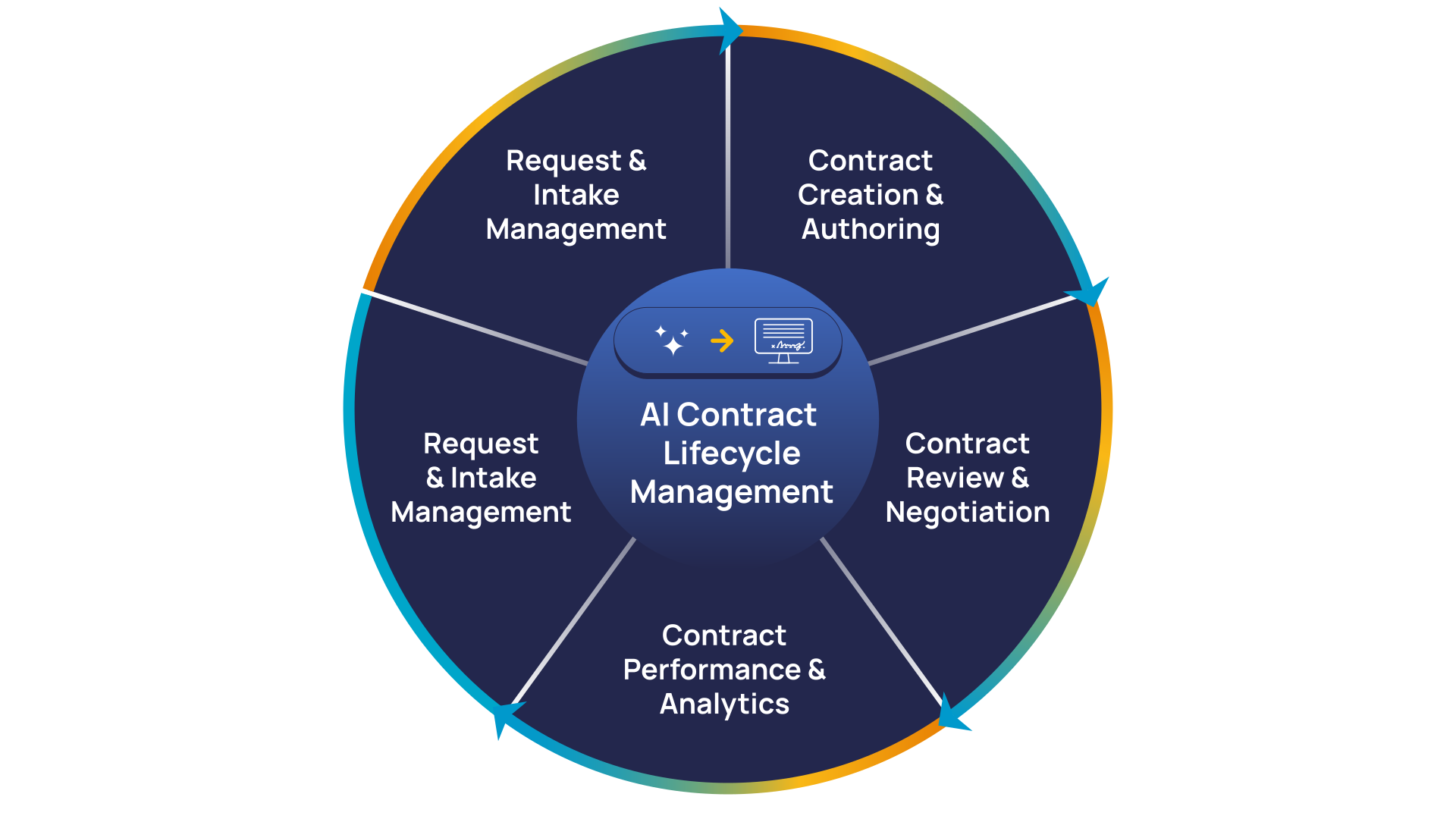
The contract lifecycle spans three core phases: pre-signature, negotiation, and post-signature. AI enhances each of these phases by combining workflow automation, reasoning, and intelligent data extraction. Here’s how.
- Pre-signature: AI accelerates intake, drafting, and clause selection by interpreting requirements and applying policy-aligned language automatically.
- Negotiation: AI supports redlining, clause validation, and risk analysis in real time, reducing delays and manual back-and-forth.
- Post-signature: AI continuously monitors obligations, milestones, and compliance to ensure contracts deliver ongoing value.
In mature implementations, agentic workflows will execute tasks. For example, autonomous systems will enable multi-step processes such as drafting, redlining, approvals, and compliance checks, escalating to humans only when judgment or exception handling is required.
Rather than forcing users into rigid templates, agentic workflows dynamically coordinate drafting suggestions, clause validation, and policy routing, which sets the stage for more advanced AI use cases.
Below we examine how AI operates in the pre-signature stage in greater detail.
Pre-Signature: Drafting, Clause Identification, and Risk Checks
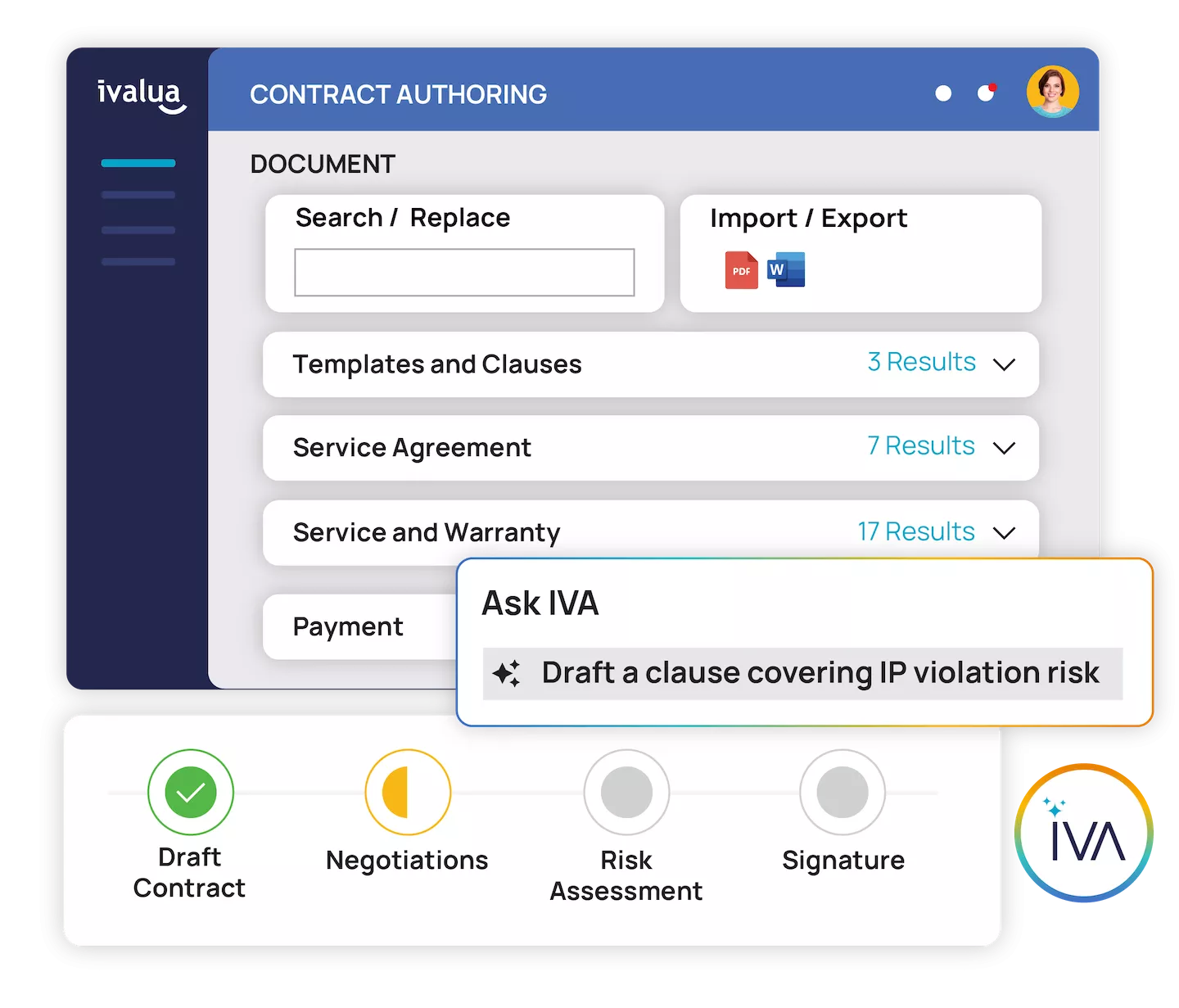
AI can help accelerate contract drafting by eliminating early-stage bottlenecks that traditionally slow down contracts before negotiation even begins. It analyzes contract intent using NLP-driven clause identification, and surfaces relevant language from an approved clause library. Next, it identifies missing or noncompliant clauses.
At the same time, automated risk scoring evaluates exposure based on things like supplier profiles, deal structure, and historical patterns, so issues can be addressed before legal review begins.
Drafting agents generate first-pass agreements that align with internal templates and rules, reducing manual legal review similar to broader procurement intelligence which can be used to optimize portfolios and sourcing decisions. These AI agents in procurement ensure contracts take supplier risk, pricing models, and category strategy into account, setting up for a successful outcome.
AI accelerates contract negotiation by pairing traditional NLP with advanced LLMs. This enables the system to compare versions instantly, surface contextual differences, and flag deviations from approved playbooks in real time.
Instead of manually reviewing redlines line by line, stakeholders see clause-level changes, risk indicators, and recommended responses in real time. This helps to shorten negotiation cycles and improve collaboration across stakeholders.
Agentic CLM extends this capability by executing redlining workflows end-to-end. For example, autonomous systems can compare proposed language against approved clause libraries or detect non-standard terms. By building negotiation, they improve consistency across contracts and help teams resolve variances faster.
Post-Signature: Obligations Tracking, Renewal Management, and Auditability
Agentic AI procurement delivers, perhaps the greatest impact in this stage. It provides continuous post-signature tracking by automatically extracting obligations, milestones, and key terms, then monitoring them throughout the life of the contract, eliminating visibility gaps of manual methods.
Autonomous agents can track performance commitments, policy requirements, and compliance thresholds, and trigger alerts or actions as obligations come due. It can also improve renewal management by forecasting upcoming renewal windows, flagging unfavorable auto-renewals, and surfacing financial exposure in advance. Meanwhile, it enforces policies and maintains a complete audit trail.
By unifying AI-powered CLM with the P2P process, organizations can transform static contract terms into active guardrails that prevent value leakage and non-compliance. AI automatically extracts metadata, such as negotiated pricing, payment terms, and delivery milestones, from signed agreements and synchronizes them with the transactional system. This ensures that every requisition and invoice is automatically validated against current contractual obligations, effectively blocking maverick spend and unauthorized price variances before they occur. Rather than relying on manual audits, this integration creates a seamless loop where “contractual truth” directly governs purchasing behavior, ensuring that the organization consistently realizes the full value of its negotiated deals.
Workflow Automation, Integrations, and Data Foundations
AI-CLM effectiveness and reliability is only maximized when it is built on unified contract data, integrated systems, and well-orchestrated workflows. However, this is no easy task – there are major barriers such as data quality issues and skill shortages that get in the way.
A modern procurement platform like Ivalua provides a unified data model that brings together sourcing events, supplier records, contract metadata, and performance data in a single, governed environment, supporting accurate data extraction from contracts to feed AI models. Role-based access controls ensure sensitive contract data is used appropriately, while deep integrations with ERP, finance, and risk tools keep insights current and actionable.
Next, we explore some real-world AI-CLM use cases that show how a strong data foundation can deliver measurable value.
Core Use Cases of AI Contract Lifecycle Management
AI-powered contract lifecycle management improves speed, accuracy, and compliance in everyday procurement workflows. Use cases for AI-CLM reduce cycle times, lower risk, and improve contract quality at scale. From a procurement perspective, these capabilities translate directly into faster time to contract, fewer legal escalations, and reduced financial leakage.
Some core applications for AI-CLM include drafting automation, clause and risk review, negotiation and redlining acceleration, post-signature obligation tracking, renewal management, and audit readiness. These are not theoretical use cases – they are AI workflows already in use among enterprise procurement teams today.
Automated Drafting and Template Governance
Using approved templates and automated clause selection, drafting agents can quickly assemble contracts from governed clause libraries. This helps to ensure consistent language, and policy compliance – without manual intervention. Drafting time is reduced, as is the need for legal involvement in standard, low-risk agreements.
AI-enabled contract management reduces manual effort while improving accuracy and consistency and freeing teams to focus on higher-risk, strategic work.
AI-Assisted Review, Compliance, and Contract Risk Assessment
AI improves contract review by automatically evaluating clauses, flagging risks, and assessing compliance before contracts reach legal teams. Review agents can analyze proposed language alongside internal policies and regulatory requirements to identify misaligned terms early on. With this essential work automated, teams can focus on negotiating better terms or strengthening supplier relationships, and handle only the high-stakes exceptions manually.
According to recent research, supply-chain resilience improves through continuous monitoring, predictive modelling, Bayesian networks, and multi-source risk analytics. These are the same techniques AI uses to assess risk and align contract obligations. What’s more, Agentic AI can surface issues prior to legal review, accelerating approvals while maintaining governance.
Intelligent Repository, Metadata Extraction, and Clause Libraries
AI transforms the contract repository/storage layer by automatically organizing contracts, extracting structured metadata, and making agreements searchable and actionable.
Rather than using manual tagging methods and inconsistent naming conventions, AI can identify key terms, clauses, obligations, pricing models, renewal conditions, and supplier risk indicators as contracts are ingested – regardless of format or origin. That way, contracts are easy to find, interpret, and act on across teams.
When combined with a unified contract repository, AI-driven metadata extraction enables you to analyze contract data in context. For example, you can link obligations to suppliers, pricing models to sourcing strategies, and renewal terms to risk and performance insights. Additionally, clause libraries and standardized metadata help improve consistency and reuse.
In short, AI in sourcing and procurement provides greater visibility and informs better supplier decisions – creating the foundation for reducing cycle-time significantly across the contract lifecycle.
Cycle-Time Reduction Across Procurement and Source-to-Contract Workflows
AI replaces manual handoffs with intelligent, automated flows. Not only does this offer speed, it allows procurement to capture early-payment discounts, reduce cost-to-contract, and bring suppliers on board sooner. Moreover, legal teams spend less time on routine reviews.
CLM systems use workflow automation to orchestrate each step of the process proactively, creating drafts, reviewing risks, and routing approvals via automatic triggers. As a result, contracts can start delivering value and impact earlier and more consistently, accelerating S2C workflows to improve business outcomes.
Next, we look at a real-world customer example that puts these gains into practice.
How Körber Transformed Its Contract Lifecycle with AI
Körber, a global technology group with more than 13,000 employees and complex business units manages more than seven ERP systems and multiple external data sources. Orchestration is particularly challenging, especially when contract, supplier, and spend data are fragmented across platforms.
To address this, Körber launched an AI pilot using Ivalua’s Intelligent Virtual Assistant (IVA), applying AI directly within procurement workflows to improve speed, consistency, and decision quality through advanced predictive analytics.
Körber’s pilot reflects the broader market initiative of deploying agentic workflows that execute multi-step processes autonomously. The initiative is about embedding intelligence into day-to-day procurement execution, to automate actions across sourcing, contracts, and supplier management.
“We started our AI journey in 2023; currently we are running a very successful pilot with Ivalua IVA… what we hear most often right now is automation type use cases and analytics type use cases.”
— Jan Van Hueth, Senior Project Manager SCM/IT, Körber
Elevating Procurement with AI Contract Lifecycle Management
AI-CLM shifts routine drafting, review, and compliance tasks from people to intelligent systems that are built for scale and consistency. Rather than increasing legal dependency, AI contract management in procurement reduces it by automating execution, strengthening governance, and ensuring obligations are reliably met. With agentic CLM, human expertise and autonomous systems will work together, speeding up the contract lifecycle while lowering risk and reducing financial leakage.
Delivering on this new promise requires a procurement platform that unifies data and orchestrates end-to-end workflows across the enterprise.
See how AI contract management can reduce cycle times, strengthen compliance, and unlock measurable procurement Ivalua.
Frequently Asked Questions About AI Contract Lifecycle Management
AI contract lifecycle management extends traditional contract lifecycle management (CLM) software by embedding automation, natural language processing (NLP), and intelligence into every stage of the contract process. Unlike traditional CLM systems that primarily store documents and route approvals, AI-CLM interprets contract language, flags risk, and executes workflows autonomously.
AI contract lifecycle management improves compliance and oversight by using metadata extraction and obligations tracking to continuously monitor contracts across the enterprise. This enables proactive risk assessment, early issue detection, and stronger compliance without manual review.
AI contract lifecycle management delivers the most value for high-volume, repeatable contracts involved in procurement workflows, such as supplier agreements, MSAs, and SOWs. These contracts benefit from automated contract drafting, faster contract negotiation, and consistent clause usage through a governed clause library.
AI contract lifecycle management supports deep integration with ERP and procurement platforms through workflow automation, enabling seamless, multi-ERP integration across sourcing, contracting, and finance. AI-driven data extraction from contracts ensures contract insights stay synchronized with downstream systems.
Effective AI contract lifecycle management solutions combine machine learning (ML) and predictive analytics to deliver high accuracy in drafting, review, and risk detection. A centralized contract repository with strong governance is essential to ensure consistency, compliance, and trust in AI-driven outcomes.
AI contract lifecycle management reduces cycle times by increasing speed through automated drafting, contract review, and approval routing using workflow automation. By surfacing issues earlier and supporting faster decision-making, AI eliminates bottlenecks that delay execution.