

Every procurement technology vendor is talking about AI agents. Fewer are talking about what those agents actually need to work. The answer is not a better model. It is a better foundation.
Procurement AI agents do not fix bad data. They amplify whatever foundation they are built on. If your supplier records are fragmented across disconnected systems, your contract data lives in one database while spend data lives in another, and your risk signals are batch-synced from a third, an AI agent will not reconcile those gaps for you. It will make decisions based on incomplete, inconsistent information and do it faster than any human could intervene.
The architecture underneath your AI is the single biggest determinant of whether those agents create trust or accelerate bad decisions. This article explains why, what a real data foundation looks like, and what happens when you get it right.
Key Takeaways
- Procurement AI agents are only as reliable as the data foundation they operate on.
- Fragmented supplier, contract, spend, and invoice data causes AI agents to amplify errors at scale.
- A unified procurement data model gives agents the context needed to reason, act, and improve.
- On the right architecture, every agent interaction can enrich data quality and improve future decisions.
The Uncomfortable Truth About Procurement AI
According to ProcureCon research, 88% of procurement teams cite integration issues and 75% cite data quality as top barriers to AI confidence. Those numbers should shape every conversation about AI agents in procurement.
The pattern is consistent. An organization purchases an AI agent, connects it to existing systems, and expects intelligent outputs. But the systems were never designed to feed a reasoning engine. Supplier records are duplicated across modules.
Contract terms sit in one system while payment history sits in another. Spend classifications follow different taxonomies depending on which team entered the data and when.
The AI model itself is usually fine. The problem is what it has to work with. When procurement data is scattered, incomplete, or inconsistent, no amount of algorithmic sophistication will produce reliable decisions. AI confidence starts with data confidence. Without it, you are not deploying intelligence. You are deploying speed on top of uncertainty.
On a Cracked Foundation, AI Makes Things Worse
This is the part most vendors skip. When you deploy AI procurement software on fragmented, inconsistent data, agents do not just underperform. They actively make things worse.
An agent that misclassifies spend because the underlying taxonomy is inconsistent does not make one mistake. It makes thousands, at machine speed, with machine confidence. An agent generating supplier recommendations based on incomplete performance histories does not just give a bad answer.
It builds an unreliable pattern into the decision record, which compounds every time another agent or analyst references that recommendation downstream.
Here is what this looks like in practice:
- Duplicate supplier records because the agent cannot reconcile IDs across sourcing, contracts, and invoicing systems. Instead of flagging the inconsistency, it treats each fragment as a distinct entity and creates new records that multiply the problem.
- Inaccurate risk scores because contract data and financial data live in separate databases with different update cadences. The agent sees a current financial signal next to a stale contract record and produces a risk assessment that looks precise but is grounded in mismatched timelines.
- Flawed supplier recommendations based on incomplete performance histories. If the agent only has visibility into sourcing outcomes but not delivery performance, quality issues, or payment disputes, its recommendations reflect a partial truth presented as a whole one.
- Spend misclassification at scale because category taxonomies vary by module, business unit, or geography. Manual misclassification is a data quality problem. Automated misclassification is a data quality crisis.
AI is an amplifier. On a cracked foundation, it amplifies the cracks. And it does so at a pace that makes manual correction nearly impossible.
Why Fragmented Architectures Break AI Agents
The root cause is architectural. Most Source-to-Pay suites were not built as unified platforms. They were assembled through acquisitions, one product for sourcing, another for contracts, another for supplier management, another for invoicing.
Each module has its own database, its own data model, and often its own definition of core entities like suppliers, categories, and cost centers.
Integration layers sit on top and move data between these systems. But integration is not unification. A middleware connector that syncs supplier records nightly is not the same as a single supplier record that every module reads and writes to in real time.
Consider an agent tasked with assessing supplier risk. To do its job well, it needs contract terms, payment history, quality scores, ESG data, financial signals, and category context in a single reasoning frame.
If those data points live in four different systems with four different supplier IDs and four different update cadences, the agent is not analyzing. It is guessing. And the guesses look authoritative, which is worse than no answer at all.
This is why AI in procurement orchestration depends on the platform underneath, not just the agent on top. Integrated systems create the appearance of connectivity. A unified data model creates the reality of it.
What a Real Data Foundation Looks Like
A procurement data foundation that supports AI agents needs specific architectural properties. Not aspirational features.
Here are the requirements of an AI-ready procurement data foundation:
- Single data model: Not integrated databases, not federated queries, not a data lake that aggregates from multiple sources. A single, native data model where sourcing, contracts, supplier management, procurement, invoicing, and spend analysis all operate on the same schema. When an agent queries a supplier record, it gets one answer, not a reconciled average of several.
- Shared supplier core: The supplier is the foundational entity in procurement. Every sourcing event, every contract, every invoice, every risk assessment, every performance evaluation connects to a supplier. If the supplier record is fractured across modules, every downstream process inherits that fracture. A shared supplier core means one record, continuously enriched by every interaction across the Source-to-Pay lifecycle.
- Semantically rich data: AI agents need more than IDs and amounts. They need classifications, hierarchies, and relationships: which category does this supplier serve, what contracts govern this relationship, and what is the historical performance trajectory. Flat data produces flat intelligence.
- Real-time accuracy: Batch-synced data means agents are reasoning on stale information. In procurement, where supplier risk can shift overnight and market pricing changes weekly, real-time data access is not a nice-to-have. It is the difference between proactive and reactive.
- Permission-aware access: Both humans and agents need access controls that reflect organizational policies. An agent operating on behalf of a category manager should see what that category manager is authorized to see, nothing more.
This is where Ivalua’s architecture becomes relevant. A single codebase and single data model means agents operating on the platform do not stitch together context from disconnected systems.
They reason from a unified, permission-aware, real-time source of truth. The architecture is the AI strategy.

Pro Tip
Download our practical guide to agentic AI in procurement to understand the platform, data, and governance requirements needed to move from AI pilots to enterprise impact.
The Supplier Core as the Foundation of Agent Intelligence
If the data model is the foundation, the supplier record is the keystone.
In procurement, nearly every meaningful AI task connects to a supplier. A sourcing agent evaluates potential suppliers. A contract agent reviews supplier agreements. A risk agent monitors supplier health.
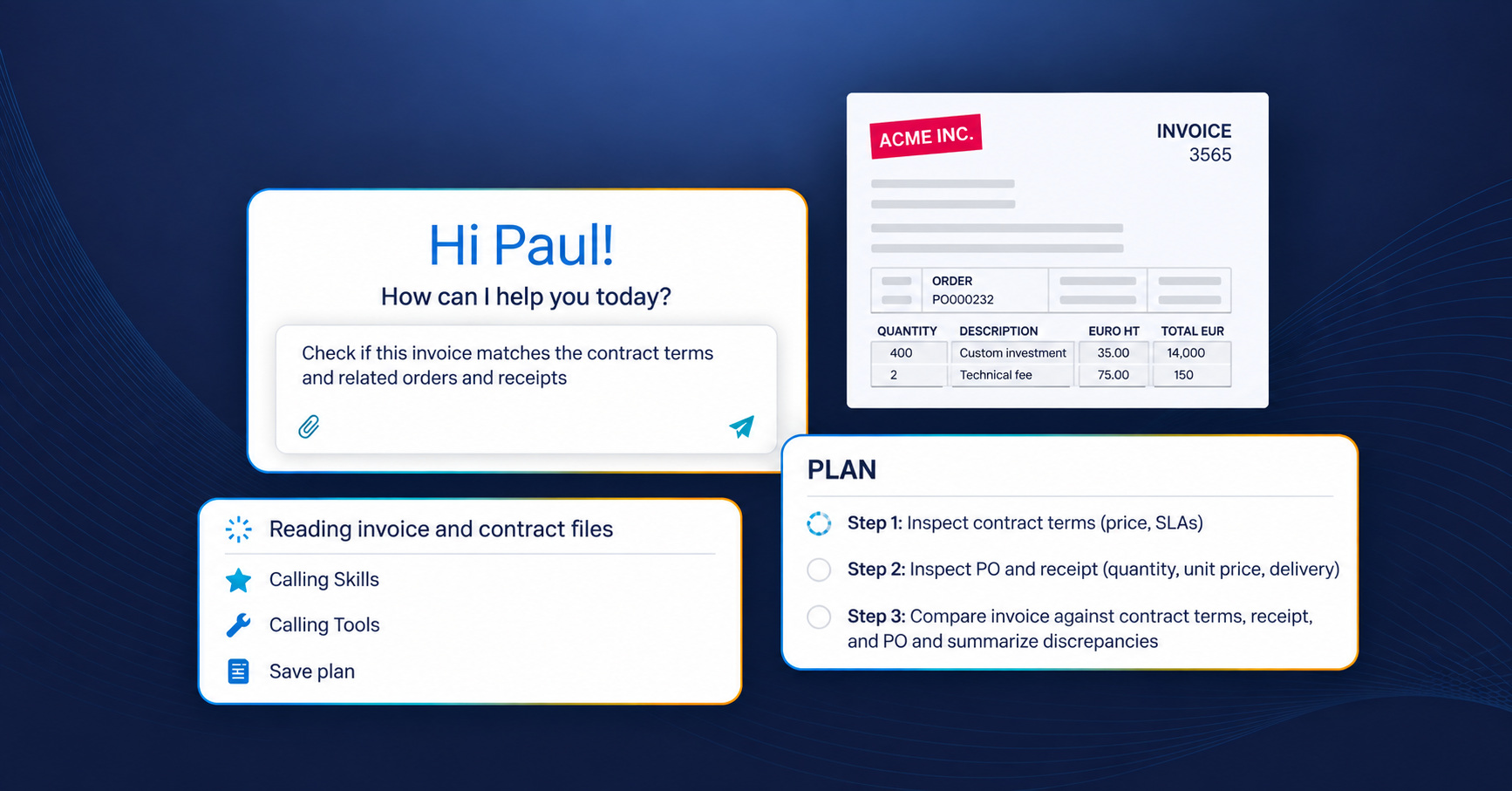
An AI vendor management agent tracks supplier performance over time. An invoicing agent matches supplier invoices against purchase orders and contracts.
When each of these functions derives from the same supplier record, something powerful happens: every interaction enriches the same entity. A sourcing event adds pricing data. A contract execution adds terms and compliance commitments.
A risk assessment adds financial and ESG signals. An invoice match adds payment behavior. The supplier record becomes a continuously enriched source of truth that gets more valuable with every transaction.
Now contrast that with the alternative. In a fragmented architecture, Agent A sees payment terms but not ESG scores. Agent B has the risk profile but not the contract history. Agent C knows the sourcing outcome but not the delivery performance.
Each agent operates on a partial view and produces a partial answer. No single agent and no human analyst can assemble the full picture without manual work, which defeats the purpose of deploying AI in the first place.
A unified supplier core is what gives AI in sourcing and every other procurement function shared context across the entire lifecycle.
When the Foundation Is Right, AI Makes Your Data Better
Here is the payoff. On a unified, trusted data foundation, AI agents do not just operate more reliably. They actively improve the data they work with. This is the dynamic that only exists when the architecture is right.
When an agent processes a sourcing event on a unified platform, it does not just execute the task. It can identify and flag duplicate supplier records that were created by different business units, recommend merges, and prevent future duplication.
When an agent analyzes invoices, it can enrich spend classifications by comparing line items against category taxonomies and correcting inconsistencies that manual entry introduced over years. When a risk agent scans supplier portfolios, it does not just flag current issues.
It detects anomalies (unusual payment terms, pricing outliers, compliance gaps) and feeds corrections back into the record, continuously improving the quality of the underlying data.
This is the compound intelligence loop. Every agent interaction makes the data richer. Richer data makes the next agent interaction more accurate. More accurate outputs build trust. Trust drives adoption. Adoption generates more interactions, and the cycle continues.
On a fragmented architecture, this loop does not exist. Agents consume data but do not improve it, because there is no single record to write back to. Improvements made in one system do not propagate to another. The data stays static while the agents run in circles.
On the right platform, the virtuous cycle is the default. And it is what elevates procurement teams from spending cycles on data cleanup and reconciliation to focusing on the judgment calls, supplier relationships, and strategic decisions that actually move the business.
That shift, from data janitor to strategic operator, is what agentic AI in procurement makes possible when the foundation is right.
Data Sovereignty in the Age of AI
There is a CIO and CISO question that deserves direct attention: who owns your procurement data when AI is involved?
Some procurement AI vendors pool customer data to improve their models. They frame it as “community intelligence” or “network effects.” But what that means in practice is that your negotiation strategies, supplier relationships, pricing patterns, and process data may be used to train models that benefit your competitors.
In procurement, where supplier leverage and category strategy are competitive assets, that is not a tradeoff most enterprises should accept.
The alternative is clear: data isolation as a design principle. No model training on customer data. No cross-tenant data sharing. Granular access controls that apply equally to human users and AI agents. Full traceability on what data was accessed, by whom (or by which agent), and for what purpose.
Procurement data governance in the age of AI requires both intelligence and isolation. Your agents should be smart. Your data boundaries should be absolute.
Pro Tip
Download the Enterprise AI solution brief to see how Ivalua supports trusted AI across Source-to-Pay.
How to Evaluate Your Data Readiness for Agentic AI
Before evaluating procurement AI agents, evaluate whether your data foundation can support them. Here are five questions that separate AI-ready organizations from those headed toward expensive pilots that stall:
1. Do you have a single supplier record across Source-to-Pay? If your sourcing module, contract system, and invoicing platform each maintain their own supplier records, your agents will reason from conflicting information. A single, shared supplier core is the starting point.
2. Can every data point be traced to its source? AI-generated decisions need to be auditable. If you cannot trace a spend classification, a risk score, or a supplier rating back to its origin, your agents cannot explain their reasoning and your compliance team cannot verify it.
3. Is your data model unified or merely integrated? Integration moves data between systems. Unification means a single data model where all functions operate natively. The difference matters because integration introduces latency, reconciliation errors, and semantic drift. Agents need a unified model to reason accurately.
4. Can you control what each AI agent can access? Permission-aware AI is not optional. If you cannot define and enforce what data each agent sees, you cannot govern AI procurement implementation at enterprise scale.
5. Is your data updated in real time or batch synced? Agents making decisions on yesterday’s data are making yesterday’s decisions. Real-time data access is the difference between proactive intelligence and reactive reporting.
If you answered “no” to two or more of these questions, start with the foundation before investing in the agent.
Case Study: How Körber Is Building on the Right Foundation
The data foundation argument is not theoretical. Organizations that get the architecture right are already seeing the results.
Körber, the global technology group, is piloting IVA on top of Ivalua’s unified platform. Their approach reflects the principle that responsible AI starts with the right foundation: rather than deploying AI capabilities top-down, they are inviting users to propose use cases and building from real operational needs.
“We started our AI journey in 2023. Currently we are running a very successful pilot with Ivalua IVA. We are primarily asking our users to propose use cases, and what we hear most often right now is automation type use cases and analytics type use cases.” – Jan Van Hueth, Senior Project Manager, Körber
The pattern is instructive. Unified data gives users confidence to propose AI use cases because they trust the data the agents will work with. That trust is what turns a pilot into an enterprise deployment.
Read the full case study: How Körber is Pioneering Responsible AI and Procurement Automation with Ivalua
Conclusion: Data Gives Agents Intelligence. Governance Gives Them Boundaries
Fragmented data creates fragmented intelligence. Agents that reason from incomplete, inconsistent, or siloed information do not just underperform. They erode trust and make the underlying problems harder to fix. Unified data creates trusted intelligence.
Agents that operate on a single source of truth, reason from complete context, and improve the data they work with, creating a compound intelligence loop that gets more valuable over time.
The architecture is the strategy. Before asking what your AI agents can do, ask what your data foundation lets them do.Data gives agents intelligence. Governance gives them boundaries.
The next article in this series explains how enterprise procurement teams can govern AI agents without limiting their value, why human accountability must be baked into the architecture, and what it takes to build trust at enterprise scale.
See How Agentic AI Performs Better With a Unified Data Foundation
FAQs
Procurement AI agents need a unified data model where supplier, contract, spend, invoice, and risk data all exist within a single schema. This means one supplier record shared across all Source-to-Pay functions, real-time data accuracy, semantically rich classifications, and permission-aware access controls that apply to both humans and agents.
AI agents amplify whatever data foundation they operate on. On high-quality, unified data, agents produce reliable insights, accurate recommendations, and auditable decisions. On fragmented or inconsistent data, agents propagate errors at machine speed, creating duplicate records, inaccurate risk scores, and spend misclassifications faster than manual teams can correct.
A unified supplier data model is an architecture where every procurement function, sourcing, contracts, supplier management, invoicing, risk, and spend analysis, reads from and writes to a single supplier record. This contrasts with integrated architectures where separate systems maintain their own supplier records and sync data through middleware, which introduces latency, duplication, and inconsistency.
Fragmented data forces AI agents to reason from incomplete context. An agent assessing supplier risk in a fragmented environment might have access to financial data but not contract terms, or payment history but not quality scores. The result is partial analysis presented as complete recommendations, which erodes trust and can lead to flawed sourcing decisions, missed risks, and compliance gaps.
Yes, but only on the right architecture. On a unified data model, AI agents can identify duplicate supplier records, enrich spend classifications, detect anomalies, and flag data quality issues as they process transactions. Each agent interaction improves the underlying data, creating a virtuous cycle. On fragmented architectures, this cycle does not exist because agents have no single record to write improvements back to.
Start with five questions: Do you have a single supplier record across S2P? Can every data point be traced to its source? Is your data model unified or merely integrated? Can you control what each AI agent accesses? Is your data updated in real time? If two or more answers are “no,” focus on the data foundation before investing in AI agents.