

As procurement takes on a more strategic role, organizations are increasingly evaluating platforms based on their ability to unify Source-to-Pay processes, and deliver measurable business outcomes.
But the best procurement software for your organization should align with established processes and business goals, while meeting the needs of your users.
In this guide, we look at the capabilities of leading procurement software to help you evaluate solutions across the entire Source-to-Pay lifecycle.
Key Takeaways
Key Takeaways
- The best procurement software supports the full Source-to-Pay lifecycle on a unified platform rather than through disconnected point solutions.
- It’s critical to prioritize adoption, integration, configurability, and supplier collaboration in addition to platform capabilities.
- Leading platforms leverage AI to automate work and improve decision-making, extending beyond simple chatbot features.
- Use Gartner’s Magic Quadrant to evaluate solutions on your sourcelist in terms of capabilities, execution, and long-term vision.
What Counts as “Procurement Software” in 2026
Gartner defines modern Source-to-Pay (S2P) software as an integrated set of solutions that supports the full procurement lifecycle. This includes sourcing and contracting, requesting, purchasing, receiving, invoicing, and payments.
Adopting a Source-to-Pay platform can be accomplished by implementing capabilities in phases and activating the modules that address your most pressing needs first.
The best procurement software integrates seamlessly with existing ERP, finance, and operational systems, enabling a modular approach that allows procurement teams to modernize processes without ripping and replacing infrastructure.
And that’s important, because most organizations have multiple ERP systems, finance platforms, and business applications deployed. A unified platform can span across all of those systems, enabling consistent processes, data, and visibility, and preserving your existing technology investments.
What a Modern Procurement Platform Should Deliver
Leading enterprise AI procurement platforms offer a few key capabilities:
- Trusted System of Record: A unified data model that provides trustworthy supplier, spend, contract, and transaction data for users, AI agents, and connected systems, eliminating fragmented records common with disconnected point solutions.
- Intelligent Workflows and Process Orchestration: Connects sourcing, supplier management, purchasing, invoicing, and payment activities, and leverages automation with human oversight.
- Adaptive Governance: Provides enterprise-grade controls, transparency, auditability, and policy enforcement across the Source-to-Pay lifecycle.
In addition to these capabilities, leading platforms are introducing AI-powered features.
The Next Evolution: Agentic Procurement
Today’s most advanced procurement platforms embed AI into procurement workflows, helping to automate repetitive work and accelerate decision-making.
For example, Ivalua’s procurement platform includes IVA, the first complete Source-to-Pay agent, that helps people and AI work together across all S2P processes.
AI in procurement helps organizations improve efficiency, governance, supplier collaboration, and decision-making across the entire Source-to-Pay process.
Why Procurement Leaders Are Now Re-evaluating Tools
Procurement leaders are expected to reduce costs, strengthen compliance, and mitigate supplier and operational risk, while at the same time improving the experience for stakeholders and suppliers. This requires a solid operating model with repeatable processes and a strong data foundation.
According to Deloitte’s 2025 Global Chief Procurement Officer Survey, procurement leaders consistently outperform followers on key business outcomes.
- 96% of leaders met or exceeded their cost savings targets compared to 80% of followers
- 94% met or exceeded cost avoidance goals versus 75% of followers
- Leaders outperformed on stakeholder satisfaction, supplier performance, and innovation enablement
These findings suggest that maturity, adoption, and data-driven processes matter as much as software functionality.
When evaluating procurement technology, procurement leaders are seeking comprehensive procurement systems that connect data, workflows, controls, and stakeholders across the business.
Rather than disconnected point solutions or traditional automation, they need solutions that offer agility, strong governance, and better business outcomes.
The Enterprise Problems Integrated Procurement Software Should Solve
As you evaluate procurement platforms, focus on the operational challenges that limit visibility, slow decision-making, increase risk, or create unnecessary manual work.
Then, for each challenge, identify what’s broken, how you can fix it, and how to assess whether a solution has the right capabilities.
Let’s examine some common issues and how to determine whether a solution that can address them.
Fragmented Data Across ERPs and Teams Blocks Real Spend Visibility
Problem: Multiple ERP systems, business units, and procurement applications, each containing different versions of supplier, contract, and spend data. The result is limited visibility, duplicate records, inconsistent reporting, and difficulty understanding where money is being spent.
Capabilities That Fix It: A unified data model across the Source-to-Pay lifecycle, connecting sourcing events, contracts, purchase orders, receipts, invoices, and supplier records so you can follow transactions and decisions from beginning to end.
What to Prioritize: Cross-module traceability and a single source of truth for procurement data. Ask vendors to show how a user can move seamlessly throughout the S2P process.
Slow Sourcing Cycles Limit Savings and Agility
Problem: Manual sourcing processes that slow decision-making and make it harder to capture savings.
Capabilities That Fix It: Source-to-Pay tools with built-in sourcing workflows, supplier collaboration, bid evaluation, and sourcing optimization capabilities.
What to Prioritize: Solutions that streamline sourcing, making it easier to launch events, compare supplier responses, collaborate with stakeholders, and apply scoring or optimization tools.
Contract Blind Spots Create Compliance Leakage
Problem: When contracts are disconnected from purchasing processes, organizations lose visibility into negotiated terms, increasing compliance risks and off-contract spending.
Capabilities That Fix It: Procurement software that connects contract lifecycle management (CLM) to suppliers, catalogs, pricing, purchase orders, and approval workflows to enforce negotiated terms.
What to Prioritize: Solutions that embed contracts directly into purchasing processes. Ask vendors to demonstrate how the platform enforces pricing, supplier agreements, and buying policies at the point of purchase.
Maverick Spend Happens When Buying Feels Hard
Problem: Employees bypass slow or difficult purchasing processes, creating maverick spend and compliance issues.
Capabilities That Fix It: Procurement software with guided buying, intuitive catalogs, intelligent intake, and automated approval workflows.
What to Prioritize: Evaluate how quickly users can find approved suppliers, submit requests, and complete purchases with minimal training.
Manual Invoice Handling Drains Capacity and Increases Error Risk
Problem: Manual invoice processing that creates unnecessary administrative work for procurement and accounts payable teams.
Capabilities That Fix It: Invoice automation, matching, validation, approval routing, and exception management capabilities that streamline the path to “OK-to-pay.”
What to Prioritize: AP Automation Solutions that automate matching and exception handling. Ask vendors to show how it matches invoices, routes exceptions, and identifies bottlenecks.
Weak Supplier Onboarding and Collaboration Stalls Outcomes
Problem: Manual onboarding and fragmented communication that slows supplier activation, reduces data quality, and complicates supplier management.
Capabilities That Fix It: eProcurement software with supplier portals, onboarding workflows, document management, validation rules, and collaboration tools.
What to Prioritize: Solutions that make it easy for suppliers to onboard, maintain records, and collaborate. Adoption is critical to data quality, compliance, and process efficiency.
Risk and Compliance Controls Kick in Too Late
Problem: Supplier risks and compliance issues are often discovered too late, after contracts are signed or audits begin.
Capabilities That Fix It: Purchasing software that embeds supplier risk management, policy controls, and audit trails directly into sourcing, onboarding, contracting, and purchasing workflows.
What to Prioritize: Solutions that identify risks early. Ask vendors to demonstrate how the solution integrates risk assessments, policy checks, approvals, and compliance documentation into everyday procurement processes.
Procurement Software Features That Matter Most in 2026
Supplier Management
Supplier management helps organizations maintain accurate supplier data, improve collaboration, and reduce risk across the supplier lifecycle.
Key Capabilities
- Supplier onboarding
- Supplier master data management
- Performance management
- Risk monitoring
- Supplier portals
- Document management
Why It’s Crucial
Strong supplier management improves efficiency, transparency, and supplier relationships.
What to Prioritize
Look for a single supplier profile that connects onboarding, risk, performance, contracts, and transactions. Also evaluate the supplier experience because adoption directly impacts data quality and process effectiveness.
Sustainability and ESG Management
Sustainability and ESG management helps organizations track supplier performance, meet reporting requirements, and align procurement decisions with corporate goals.
Key Capabilities
- ESG data collection and validation
- Sustainability assessments
- Carbon tracking
- Supplier diversity reporting
- ESG risk monitoring
- ESG-enabled sourcing evaluations
- Audit-ready reporting
Why It’s Crucial
Procurement teams need visibility into sustainability performance at the point of sourcing and purchasing decisions.
What to Prioritize
Look for solutions that embed ESG data and workflows directly into supplier management, sourcing, and purchasing processes. The best platforms make sustainability part of everyday procurement.
Strategic Sourcing
Strategic sourcing helps organizations identify the best suppliers, negotiate stronger terms, and capture savings opportunities.
Key Capabilities
- RFI, RFP, RFQ, and auction management
- Supplier collaboration
- Bid evaluation and scoring
- Negotiation management
- Scenario analysis
- Sourcing optimization
- Sourcing analytics
Why It’s Crucial
Effective sourcing processes help organizations respond faster to market changes and create more value from supplier relationships.
What to Prioritize
Look for solutions that support the full sourcing lifecycle and connect sourcing outcomes to contracts, suppliers, and purchasing processes. Advanced analytics and optimization capabilities can provide additional value for complex or high-spend categories.
Direct Materials Sourcing and Supply Chain Collaboration
Manufacturers need procurement software that connects sourcing decisions directly to product costs, supplier capacity, and supply chain performance.
Key Capabilities
- BOM-driven sourcing
- Supplier collaboration portals
- New product introduction (NPI) support
- Cost analysis and optimization
- Engineering change management
- Supply risk visibility
Why It’s Crucial
Direct materials often represent the largest share of product costs. Procurement teams need visibility into how supplier decisions affect cost, quality, and supply continuity throughout the product lifecycle.
What to Prioritize
Look for solutions that connect sourcing workflows to BOMs, product specifications, and supplier collaboration processes. Strong platforms enable real-time coordination between procurement, engineering, suppliers, and operations.
Contract Management
Contract lifecycle management helps organizations control supplier agreements from creation through renewal while ensuring negotiated terms are consistently enforced.
Key Capabilities
- Contract authoring and templates
- Approval workflows
- Clause libraries
- Obligation tracking
- Version control
- Renewal and expiration management
- Contract search and reporting
Why It’s Crucial
Contracts define pricing, service levels, compliance requirements, and supplier obligations.
What to Prioritize
The best platforms help organizations manage obligations, track key dates, and enforce contract terms throughout the procurement lifecycle.
Embedded Collaboration
Embedded collaboration keeps procurement teams, business stakeholders, and suppliers aligned without relying on disconnected emails or spreadsheets.
Key Capabilities
- In-platform messaging and discussions
- Stakeholder reviews and approvals
- Supplier collaboration workspaces
- Document sharing and version control
- Task assignments and notifications
- Audit trails and activity tracking
Why It’s Crucial
Procurement processes involve multiple stakeholders and suppliers, and embedded collaboration improves transparency and creates a complete record of decisions and actions.
What to Prioritize
Solutions that embed collaboration directly into workflows make it easy to communicate and resolve issues without leaving the procurement process.
eProcurement
eProcurement helps organizations control purchasing activity through streamlined requisitioning, approvals, catalogs, and purchase order management.
Key Capabilities
- Requisition management
- Catalog management
- Guided buying
- Approval workflows
- Purchase order management
- Budget controls
- Policy enforcement
Why It’s Crucial
A well-designed eProcurement process improves compliance and spend visibility, reduces maverick spend, and helps employees purchase goods and services more efficiently.
What to Prioritize
Look for intuitive user experiences, guided buying, and automated workflows that connect various processes throughout the S2P lifecycle.
AP Automation
Accounts payable automation helps organizations process invoices faster, reduce manual effort, and improve payment accuracy while maintaining compliance and financial controls.
Key Capabilities
- Invoice capture and validation
- AI-driven invoice processing
- Automated matching
- Approval routing
- Exception management
- Payment readiness (“OK-to-pay”)
- Global tax and compliance support
Why It’s Crucial
AP automation improves efficiency, accelerates approvals, and provides better visibility into invoice status and cash flow.
What to Prioritize
Solutions with automated matching, approvals, and exception handling, as well as support for global compliance requirements and visibility into invoice processing workflows are preferable.
Payments
Payments capabilities help organizations execute supplier payments securely, maintain financial controls, and improve visibility into cash flow and payment status.
Key Capabilities
- Multiple payment methods
- Payment approvals and controls
- Payment scheduling
- Reconciliation and reporting
- Fraud detection and prevention
- Supplier payment visibility
- Global payment support
Why It’s Crucial
Modern payment solutions help organizations improve accuracy, strengthen controls, and streamline reconciliation.
What to Prioritize
Look for strong payment controls, automated reconciliation, and fraud prevention capabilities. The platform should connect payments to invoices and purchase orders, for end-to-end visibility.
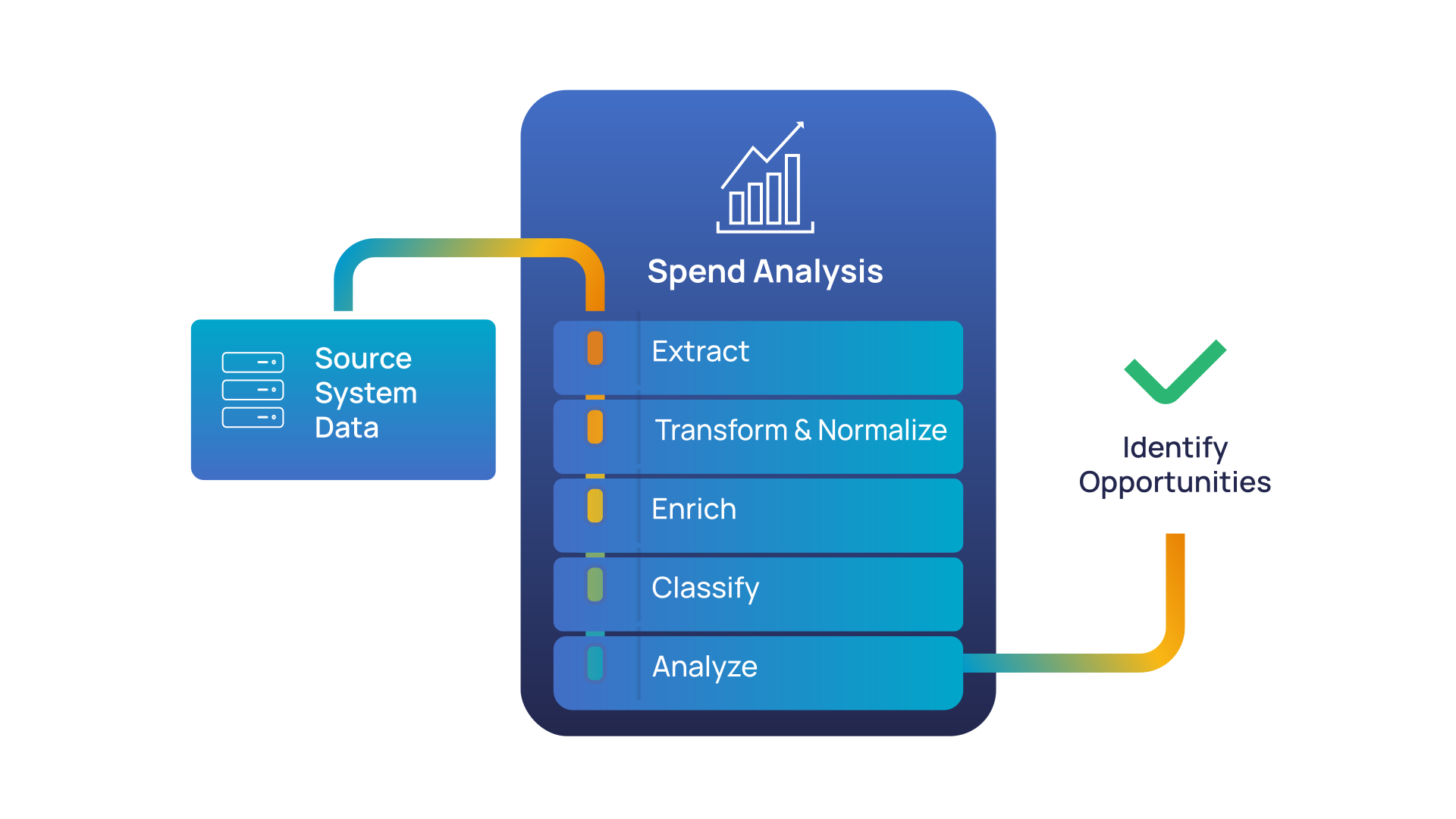
Spend Analysis + Reporting
Spend analysis helps organizations understand where money is being spent, identify savings opportunities, and measure procurement performance.
Key Capabilities
- Spend classification
- Real-time dashboards
- Savings tracking
- Spend visibility by supplier and category
- Compliance reporting
- Exception and trend analysis
- Custom reporting
Why It’s Crucial
Accurate spend data helps to identify opportunities and track performance, and supports better business decisions.
What to Prioritize
Look for real-time, cross-process analytics rather than standalone reports. Your platform should connect spend, suppliers, contracts, sourcing, and purchasing data to deliver actionable insights.
Intake + Orchestration
Intake and orchestration simplify how employees request goods and services while ensuring requests follow the right process from the start.
Key Capabilities
- Guided intake forms
- Intelligent request routing
- Workflow orchestration
- SLA tracking
- Approval automation
- Cross-functional process coordination
- Two-way system integrations
Why It’s Crucial
Effective intake and orchestration help users get what they need faster while ensuring requests follow compliant, standardized workflows.
What to Prioritize
Prioritize intelligent request routing, coordinated workflows and two-way integrations, to keep data and processes synchronized at all times across systems.
Ivalua brings these feature areas together on a unified Source-to-Pay platform, so supplier data, sourcing events, contracts, requisitions, POs, invoices, payments, and spend analytics operate on one connected foundation.
That means decisions made upstream — supplier qualification, negotiated pricing, and contract terms, for example — carry through into guided buying, invoice matching/exception handling, and reporting. Policy and compliance are enforced through automated workflows, without relying on reminders.
AI in Procurement Software: What’s Real, What’s Hype, and What to Demand
AI is rapidly becoming a key differentiator in procurement, but organizations should look beyond generic AI claims and focus on measurable business outcomes.
BCG reports that AI and generative AI can deliver up to 15% savings in some spend categories, while AI-assisted sourcing and negotiations can unlock even greater value. AI can automate routine tasks, freeing procurement teams to focus on strategic work, as well.
The greatest value comes from embedding AI directly into procurement workflows rather than treating it as a standalone chatbot. Capabilities such as opportunity identification, real-time analytics, scenario modeling, sourcing assistance, and workflow orchestration help teams make faster, better-informed decisions.
This evolution is giving rise to agentic AI, where intelligent agents can coordinate processes, manage exceptions and escalate decisions using predefined business rules.
When evaluating procurement software, choose a platform that grounds AI in a trusted data foundation with strong governance. Reliable data, transparency, and human oversight are essential for ensuring AI-driven decisions benefit your business.
How to Choose the Best Procurement Software for Your Company
Use Gartner’s Magic Quadrant as a decision framework to pressure-test your shortlist and validate whether your preferred vendors can meet your S2P solution requirements.
- Step 1: Validate category fit: Confirm you’re evaluating Source-to-Pay suites, not point tools (Gartner defines suites as covering source, contract, request, procure, receive, pay).
- Step 2: Check table stakes vs differentiators: Use Gartner’s “mandatory features” as non-negotiables, then score vendors against “common features” as practical differentiators (supplier management, P2P, supplier portal, spend analytics, intake, supplier risk, etc.).
- Step 3: Pressure-test real-world readiness: Use Gartner’s buying guidance as your shortlist filters: integrations/APIs, UX/adoption, AI cost model clarity, supplier-facing capability, global e-invoicing readiness, implementation model, deployment model.
- Step 4: Avoid false confidence: State clearly that MQ placement does not replace your internal requirements (multi-ERP reality, workflows, controls, adoption plan).
If you follow those steps, you’ll see why Ivalua is named a leader in the 2026 Magic Quadrant for Source-to-Pay Suites:
- Configurability without sacrificing upgrades: Gartner says Ivalua runs on a highly configurable platform that supports customization and the ability to take standard upgrades.
- Enterprise operational readiness: Gartner notes Ivalua’s support for EU data privacy regulations and multiple deployment models.
- Customer experience + AI seriousness: Ivalua had the shortest average time open for support tickets (well under one day) and the highest average contract retention rate in this research, plus significant AI investment.
As you compare procurement software vendors, consider using the following checklist:
- Does the platform offer deep integrations and robust APIs? Gartner identifies robust APIs and deep integration capabilities as critical selection criteria because disconnected systems create manual work, fragmented data, and reporting gaps.
- Can business users configure workflows without IT? No-code and low-code configurability allows procurement teams to adapt approval workflows, intake forms, sourcing processes, supplier onboarding, and business rules without creating IT bottlenecks.
- Can it scale across a global enterprise? The platform should support growth without requiring multiple disconnected systems.
- Does it support compliance, controls, and audit readiness? PwC reports 77% of organizations report that compliance complexity negatively impacts business performance, while 82% are increasing investment in compliance technology. The best procurement software helps organizations achieve the outcomes compliance leaders care about most, such as risk visibility, faster issue response and improved reporting.
- Will Employees Actually Use It? If the user experience is complex or frustrating, employees will find workarounds that may not be compliant.
- Does the Platform Match Your Procurement Maturity? The best procurement software is the platform that supports both your current needs and future goals. Use this simple maturity framework: Stabilize → Standardize → Automate → Optimize.
For additional guidance, see our resources on Implementing Procurement Technology, Procurement Technology Adoption, and Procurement Software Best Practices.
What “Best” Should Deliver: ROI, Payback, and Operational Outcomes
Here are the outcomes and benefits you can expect from using a unified procurement platform:
- Cost Savings: Unified procurement platforms help reduce costs by improving sourcing decisions and contract compliance, and increasing spend visibility. With AI-powered workflows, those savings can increase.
- Improved Compliance: Built-in controls and policy enforcement help reduce risk and maintain compliance across procurement processes. (According to PwC, compliance technologies improve risk visibility, reporting, and response times while boosting productivity.)
- Faster Procurement Cycles: Automation streamlines sourcing, approvals, onboarding, purchasing, invoicing, and payment processes, reducing manual work and accelerating decision-making.
- Higher Stakeholder Satisfaction: Deloitte reports that procurement leaders outperform followers in stakeholder satisfaction. Features like intuitive workflows and guided buying make procurement easier for everyone.
- Better Supplier Performance: A unified platform improves supplier collaboration, and risk and performance monitoring, enabling greater visibility and engagement, and strengthening supplier relationships.
- AI-Driven Productivity: According to BCG, AI-enabled procurement use cases can deliver up to 15% savings and significantly increase procurement capacity. The greatest value comes from AI embedded directly into workflows.
Forrester’s Total Economic Impact™ study of Ivalua found a 393% ROI, $25.5 million NPV, and payback in less than six months, underscoring the value of a unified procurement platform in reducing fragmentation and delivering measurable savings.
Customer Story: How UPL Achieved 100% PR-to-PO Adoption Globally with One Unified Procurement Platform
UPL, a global manufacturing company with approximately 12,000 employees, was being held back by fragmented regional procurement processes and legacy systems that limited visibility into spend, suppliers, and compliance.
They needed a more cohesive approach to strategic sourcing, stronger control over direct spend, and better supply chain transparency across regions.
With Ivalua, the company established a global source of truth for procurement, centralizing sourcing and purchasing activities while supporting a shared services model. They increased visibility and efficiency, and boosted user adoption.
In fact, they experienced 100% PR-to-PO adoption in India. UPL also integrated Ivalua with multiple SAP environments, enabling real-time budget checks, pricing condition management, and seamless connectivity across a complex, multi-system enterprise landscape. According to Sylesh Gopan Global ERP Head at UPL, “The biggest benefit is having a single source of truth in one centralized platform. With strategic sourcing and transactional procurement on one platform globally, we benefitted from scale and efficiency.”
Choosing the Right Procurement Software for Long-Term Success
The best procurement software isn’t defined by the number of features it offers, but by its ability to unify processes, data, suppliers, and stakeholders across the entire Source-to-Pay lifecycle.
As you evaluate solutions, focus on platforms that can deliver measurable business outcomes, support AI-driven innovation, integrate with your existing technology landscape, and scale with your organization’s needs.
Unlock More Value From Every Procurement Decision
FAQs About Best Procurement Software
FAQs
The best procurement software for large enterprises is a unified Source-to-Pay platform that combines sourcing, supplier management, contract management, purchasing, invoicing, and payments within a single environment. Enterprise buyers should prioritize scalability, integration capabilities, configurability, AI innovation, and global support rather than focusing solely on feature counts.
The most important procurement management software capabilities include supplier management, strategic sourcing, contract management, eProcurement, invoice automation, spend analysis, and workflow orchestration. Organizations should also evaluate user experience, supplier adoption, analytics, and AI capabilities to ensure long-term value and adoption.
Procure-to-Pay (P2P) focuses on the transactional purchasing process, including requisitions, purchase orders, invoice processing, and payments. Source-to-Pay suites extend that scope by adding strategic sourcing, supplier management, contract management, and spend analysis, creating a more comprehensive procurement operating model.
When evaluating invoice automation, look beyond invoice capture and assess matching, exception handling, approval routing, and visibility into invoice status. The best solutions automate routine work while maintaining strong financial controls and providing clear audit trails.
Modern procurement platforms should provide compliance tracking through policy enforcement, approval controls, audit trails, segregation of duties, supplier risk monitoring, and automated documentation. These capabilities help organizations reduce risk, improve reporting, and maintain audit readiness across the procurement lifecycle.
Successful procurement technology adoption depends on intuitive user experiences, guided workflows, supplier-friendly collaboration tools, and strong change management. Organizations should prioritize platforms that make compliant processes easier than manual workarounds, encouraging both employee and supplier participation.