


Rising software costs, lack of procurement oversight, compliance headaches, and clunky vendor management. Sound familiar?
You’re not alone. Without clear procurement software best practices, costs spiral, risks multiply, and efficiency stalls.
At Ivalua, we’ve helped some of the world’s most complex organizations transform their procurement operations, giving us deep expertise in what works and what doesn’t.
In this post, we’ll break down proven strategies to help you streamline processes, improve visibility, and take back control of your procurement stack.
Learn How Ivalua Can Help You Put Procurement Software Best Practices In Your Organization
What Is Procurement Software?
Procurement software is the technology that manages the full scope of the Source-to-Pay (S2P) process – the end-to-end workflow spanning supplier management, sourcing, contract lifecycle management (CLM), purchasing, invoicing, payments and spend analytics.
Modern procurement automation software streamlines repetitive tasks, improves cross-team collaboration, and increases visibility across every stage of the buying cycle.
When evaluating procurement software requirements, look for modular capabilities that can be deployed separately but work well together. Modules can include e-sourcing, contract management, supplier management, invoice management, procure-to-pay (P2P), and advanced spend analytics.
Selecting the best procurement software sets the foundation for long-term efficiency, transparency, and resilience across the entire source-to-pay process. The real return comes from pairing it with the best practices outlined below.
8 Key Procurement Software Best Practices for 2026
These eight best procurement software practices help you optimize the procurement process, get more out of your procurement platform, and build a more agile, compliant procurement environment.
1. Establish Clear Procurement Policies and Compliance Standards
Clearly defined policies and standards are the backbone of strong procurement management. Without clearly defined policies and standards, procurement processes become inconsistent and error-prone. Building policies directly into your procurement workflows h enforces them automatically and at scale.
Start by defining rules for purchasing thresholds, approval workflows, preferred suppliers, and contract terms. Then, automate those rules across sourcing, contracting, and purchasing activities.
Look for solutions with embedded policy engines, automated audit trails, and risk detection that flags exceptions before they become compliance issues.
Platforms like Ivalua let teams configure automated workflows that enforce compliance management based on spend category, supplier risk scores, or regional regulations.
With built-in analytics that surface outliers and contract deviations in real time, you can proactively manage risk without losing agility.
2. Centralize Procurement Workflow Automation
Siloed tools and fragmented processes make visibility, control, and consistency across operations hard to maintain. Centralizing your procurement workflows with an integrated source-to-pay (S2P) platform improves efficiency and reduces risk by bringing sourcing, contract management, purchasing, invoicing, and analytics into a single system where data flows from one stage to another.
This foundation lets you standardize workflows, enforce policies, and enable real-time collaboration across departments and regions.
OnIvalua’s platform, teams manage the entire lifecycle of a purchase, from the initial request to the final payment, in one place. Built-in workflow automation routes approvals to the right people instantly, eliminating manual handoffs that lead to delays or errors.
Integrated dashboards give users visibility into status and spend at every step, helping teams stay aligned and accountable.
3. Build a Strategic Vendor Management Framework
A strategic, scalable vendor management framework helps you evaluate and onboard suppliers efficiently, monitor performance over time, and unlock cost savings through stronger partnerships.
A strong vendor management framework is standardized, repeatable, and embedded into your procurement technology. Focus on four components:
- Centralized Supplier Information Management: A single source of truth for supplier data. Ivalua’s Supplier Information Management solution keeps records accurate with automated validations, configurable onboarding workflows, and self-service supplier portals.
- Performance Evaluations & Scorecards: Regular reviews tied to clear KPIs. Ivalua’s supplier performance management tools make it easy to build scorecards for quality, delivery, cost, and adherence to commitments, allowing teams to track trends over time to guide renewal or exit decisions.
- Integrated Risk Management: Continuous monitoring and real-time alerts. Ivalua’s Risk Center automates risk assessments across ESG criteria and geopolitical risk and triggers workflows and alerts when thresholds are exceeded.
- Contract Lifecycle Automation: Contract lifecycle management software that supports collaborative negotiation and dynamic contract terms, so your processes adjust to align with evolving performance and risk profiles.
Together, these elements implemented in a digital procurement platform help you move from reactive to proactive vendor management and unlock more value from every partnership.
4. Leverage Agentic AI and Automation for Procurement Efficiency
Automation has long been a pillar of efficient procurement, but agentic AI is redefining what’s possible. The shift is toward a human-agent model. For example, Ivalua’s Intelligent Virtual Agent, IVA, handles the repetitive machine work like approvals, exception flags, RFP drafts, and record updates, so procurement teams can focus on strategy and negotiation.
Here’s what AI-powered procurement looks like in practice:
- Conversational Intake: As procurement’s reach continues to extend further into organizations, employees describe what they need in plain language, and IVA turns that request into a compliant procurement workflow, bringing more spend under management.
- Contract Lifecycle Management: Legal and contract teams draft faster because IVA proposes compliant, lower-risk language drawn from approved templates, previously agreed contracts, and the organization’s own clause library.
- Governed Autonomy Across Source to Pay: Procurement leaders define what IVA can do on its own and what requires a human decision. Within those bounds, IVA handles the tactical work, like onboarding suppliers, chasing missing details, and running simple tail-spend sourcing events end-to-end. Teams get their time back for category strategy and supplier negotiation, while compliance and spend coverage improve.
For a closer look at what IVA can do, explore Ivalua’s Agentic AI for Procurement capabilities, embedded across the platform, from sourcing to supplier collaboration. Körber, for example, has 12 generative AI use cases live inside the platform (eight built by Ivalua, four developed internally), with four more deploying, covering tasks like drag-and-drop NDA ingestion and instant historical RFQ lookup by part number.

Pro Tip
Want to see where AI is headed next? Download our Generative AI in Procurement Roadmap for emerging use cases and practical implementation tips.
5. Enhance Spend Visibility and Cost Control
Effective spend management in procurement starts with visibility. Disconnected systems and delayed reporting make it hard to track where money is going, identify savings opportunities, or catch off-contract or out-of-policy spend. Staying ahead requires dynamic tools that surface clear, actionable insights across the entire organization.
Modern procurement software platforms should deliver:
- Real-Time Spend Analytics: Break down spend by category, supplier, region, or business unit. Ivalua’s Spend Analysis solution automates data cleansing and enrichment, so you get accurate insights without heavy manual effort.
- Collaborative Forecasting: Bridge internal demand forecasting with supplier capacity to keep sourcing plans realistic, confirm suppliers can deliver, and avoid costly supply disruptions.
Better visibility means tighter cost control and fewer budget surprises. For a closer look, check out our blog on Business Spend Management.
6. Automate and Optimize Contract Lifecycle Management (CLM)
Automation transforms contract lifecycle management by cutting manual effort and speeding up key stages.
Automated contract authoring lets teams generate agreements from pre-approved templates and clause libraries, ensuring compliance and consistency while minimizing legal review time.
Intelligent approval workflows route contracts to the right stakeholders based on value, risk, or contract type.
Automation also supports ongoing contract management.
Contract lifecycle management (CLM) software with built-in alerts and dashboards keeps you ahead of renewals and obligations, while your contract owners work with IVA, Ivalua’s Intelligent Virtual Agent, to flag off-template clauses, auto-renewal windows, and price-escalation terms as they surface.
Pro Tip
Want to assess where your CLM strategy stands? Download the Contract Lifecycle Management Checklist to identify gaps and improvement opportunities.
7. Align Cross-functional Procurement Workflows
Procurement doesn’t operate in a vacuum. It has to work in lockstep with IT, finance, legal, and other key stakeholders. But siloed systems and disconnected workflows make that kind of collaboration slow and inconsistent.
The solution is shared, transparent workflows that align teams around the same data and processes.
This starts with intake management, a centralized, standardized request process that captures the right information upfront and routes it to the appropriate teams based on business rules.
With tools like Ivalua’s Intake Management software, you can:
- Collect structured intake requests across departments
- Automatically assign tasks and approvals based on project scope or spend thresholds
- Give stakeholders real-time visibility into request status and responsibilities
- Build accountability with shared dashboards and audit trails
Connecting procurement, finance, and IT workflows through a common platform reduces delays, cuts redundant work, and keeps procurement aligned with broader business goals.
8. Measure Procurement Performance with Key Metrics and Benchmarks
High-performing procurement teams track KPIs that reflect both operational efficiency and strategic impact. But too often, performance metrics are scattered across spreadsheets or outdated dashboards, making it hard to see what’s working.
Modern procurement platforms automate data collection and deliver real-time metrics for faster, data-driven decisions.
Ivalua’s procurement Analytics and Insights tool tracks performance against internal goals and industry benchmarks with minimal manual effort.
- The KPIs that matter most fall into five categories:Visibility: Procurement’s overall reach. Metrics include Spend Under Management and Spend Under Contract.
- Cost Savings: Raw savings across S2P. Metrics include Savings from Sourcing and Contracted Savings.
- Cycle Time: Operational efficiency. Metrics include Supplier Onboarding Cycle Time and Purchase Requisition to Purchase Order (PR to PO) Cycle Time.
- Compliance: Risk and policy adherence. Metrics include Percent of Suppliers Assessed for Risk, Percent of Spend Without a Contract, or Percent of Invoices with an Anomaly.
- Adoption: Software usage enablement. Metrics include the Number of Monthly Users or the Number of Active Suppliers.
Tracked in an automated, centralized dashboard, these KPIs give you the insights to refine your procurement strategy and demonstrate results.
Pro Tip
Download Ivalua’s Spend Analysis Datasheet to see how advanced analytics can uncover savings opportunities and improve spend visibility.
Common Procurement Software Pitfalls to Avoid
Software alone won’t fix procurement issues. Procurement software has to be used to its full potential, and business transformation needs to go hand-in-hand with digital transformation. Here are the biggest mistakes to avoid when using technology to transform procurement
Lack of Standardized Procurement Processes
Inconsistent or ad hoc processes lead to approval delays, data entry errors, and missed compliance requirements. Standardized workflows create clarity, enforce policy adherence, and improve accountability, resulting in a more efficient, scalable procurement strategy.
Poor Visibility Into Software Adoption
Procurement software only drives change when it’s actually used. The best workflows and automation can’t impact spend that never enters the system. Clear adoption KPIs, strong change management and a stakeholder support framework are essential to make software adoption successful.
Overlooking Compliance and Security Risks
Managing contracts and vendors in spreadsheets or fragmented systems makes it easy to miss regulatory obligations, security requirements, or renewal clauses. Automated compliance tracking and alerts improve audit readiness, reduce legal exposure, and strengthen risk posture across the procurement lifecycle.
Ineffective Vendor Negotiation and Contract Management
When procurement lacks historical performance data or real-time contract visibility, negotiation leverage disappears. Centralized CLM systems bring transparency, ensure obligations are met, and surface cost-saving opportunities, strengthening vendor relationships while cutting risk and administrative overhead.
Siloed Decision-Making Between Departments
Procurement outcomes suffer when IT, finance, and operations act independently. Misaligned priorities delay purchases, inflate budgets, or introduce security risks. Collaborative workflows and unified data across departments break down silos, enabling faster decisions and more strategic, organization-wide procurement planning.
Failure to Leverage Data and Analytics for Procurement Decisions
Procurement teams often rely on intuition or outdated reports instead of real-time analytics, leading to missed savings and increased risk. Embedded dashboards and intelligent reporting provide the insights needed to forecast demand, identify trends, and support more strategic sourcing, budgeting, and vendor selection.
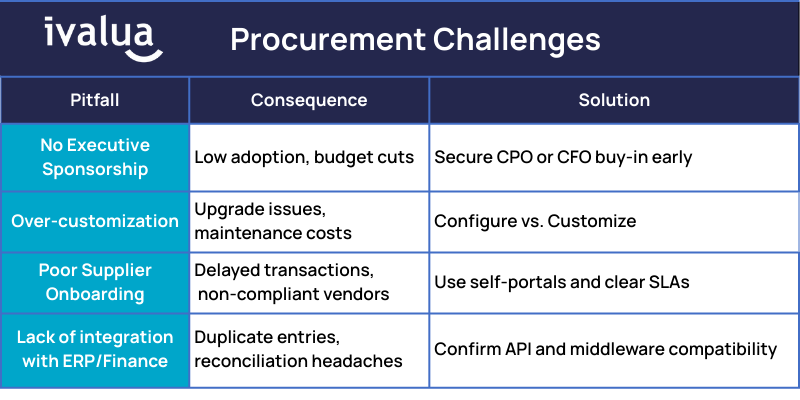
Pitfalls That Software Can’t Fix
Beyond the pitfalls above, the table below highlights common traps that need attention beyond the procurement platform itself. Stay aware of these challenges and take proactive steps to mitigate them.
Pro Tip
Our guide on How to Choose the Right Procurement Software covers which features to prioritize, which to avoid, and how to make the right call for your organization.
Procurement Best Practices that Drive Efficiency and Control
Procurement software best practices are about building smarter, more connected processes, not just installing the right technology.
Each best practice improves processes to help reduce costs, boost compliance, and empower your team to make faster, data-driven decisions.
That’s why leading organizations turn to Ivalua. Our unified platform brings supplier management, contract lifecycle management, and spend analysis together in one place, so your organization stays agile and in control of costs across the full procurement lifecycle.
Ivalua was named a Leader in the 2026 Gartner Magic Quadrant for Source-to-Pay Suites, and the 2025 Forrester Total Economic Impact study found a 393% ROI with payback.
Enhance Efficiency, Reduce Risk, And Empower Teams with Ivalua
Procurement Software FAQs
Focus on centralizing workflows, automating compliance, leveraging data-driven insights, and tracking performance with real-time analytics. Standardized processes and strong cross-functional collaboration are also key to maximizing value.
Opt for intuitive tools, align workflows with user needs, and offer targeted training. Building cross-functional buy-in early is essential. Learn more in our S2P Buyer’s Guide.
Track metrics like cost savings, procurement cycle time, contract compliance, user adoption, and procurement ROI. These KPIs help measure efficiency, effectiveness, and the strategic impact of procurement.
Implementation timelines vary based on complexity but typically range from a few months to a year. See our S2P Implementation Guide for planning and rollout tips.
A procure-to-pay (P2P) solution covers purchasing through payment, while source-to-pay (S2P) includes sourcing, contracting, and supplier management as well. Read our blog, “Source-to-Pay vs. Procure-to-Pay: Understanding the Differences,” to learn more.