




Choosing contract lifecycle management software is no longer just a feature comparison exercise. The real decision is whether a standalone CLM tool or an S2P-embedded platform will best support your contracting, procurement, and AI strategy.
But not all CLM platforms take the same approach. This guide compares leading CLM software and explores one of the key decisions facing buyers: choosing between a standalone CLM solution and CLM embedded within a broader Source-to-Pay (S2P) platform.
Key Takeaways
- The best CLM platforms connect contracts to sourcing, procure-to-pay, suppliers, and spend to maximize business value.
- The most important CLM decision goes beyond features to consider how effectively the platform connects contracts with the end-to-end procurement process.
- Ivalua combines native Source-to-Pay integration with agentic AI to help organizations prevent contract value leakage and turn contracts into a strategic procurement asset.
What is Contract Lifecycle Management Software?
CLM software is used to manage contracts from initial request and authoring through negotiation, execution, post-award obligation tracking, renewal, and compliance monitoring. A modern CLM platform helps with Contract Management by standardizing contract processes and reducing risk, while managing contractual commitments throughout the life of the agreement.
Unlike basic document repositories or eSignature tools, Contract Lifecycle Management software captures and structures contract documents and data. It automates workflows, tracks obligations and milestones, and provides visibility into contract risk and performance.
While Legal sets governance standards, CLM platforms power decisions across the entire enterprise. Procurement sits at the center—managing supplier agreements, monitoring commercial terms, tracking obligations, and holding vendors accountable across Source-to-Pay. Meanwhile, Finance gains visibility and audit control, and operational stakeholders ensure daily execution matches negotiated terms.
Using Ivalua’s Contract Lifecycle Management solution, organizations have reduced contract cycle time by up to 40% and administration costs by up to 30%, while achieving 85% best-in-class contract compliance (Aberdeen Group). Ivalua delivers contract management as a native component of its unified Source-to-Pay suite, connecting contracts directly to sourcing, supplier management, procurement, risk, and spend processes.
Why Contract Value Leakage is the Real CLM Problem
The biggest contract lifecycle management challenge has to do with what happens after the contract is signed. WorldCC research found that companies lose an average of 11% of contract value through post-signature leakage. For a company managing a $500 million annual spend base, that’s about $55 million in preventable losses each year.
Why does value leakage occur post-signature? Because legacy contract tools isolate the contract from daily operations. Once terms are finalized, the negotiated ruleset becomes trapped in a PDF. As a result, Procurement struggles to enforce compliance across downstream spend, and operational teams are left managing vendors without clear visibility into negotiated obligations and incentives.
The value of the contract slowly erodes thanks to missed opportunities and unmanaged risks. To make matters worse, many organizations still treat contracts as static documents. In reality, contract lifecycle management is a critical component of broader procurement process improvement, helping to keep commercial commitments visible and enforceable.
When the CLM platform is embedded within the Source-to-Contract and Source-to-Pay environment procurement already uses, organizations can monitor compliance continuously, identify leakage risks earlier, and begin to recover lost value.
How to Choose the Right CLM Tool: The Five-Component Selection Matrix
Most CLM software evaluations focus on features, user interfaces, and AI capabilities yet overlook whether the solution is a standalone tool or part of a broader Source-to-Pay platform.
When evaluating contract value leakage, buyers should look beyond the traditional best-of-breed vs. suite debate and assess how effectively contract data connects to downstream procurement processes.
It’s important to assess vendors across the five dimensions outlined in the table below, as each one addresses a common source of contract value leakage.
| Evaluation Criteria | What to Consider | Why It Matters |
|---|---|---|
| Deployment Context | Are you replacing a standalone legal tool or addressing a broader Source-to-Pay need—or both? | Understanding where CLM fits within your technology landscape helps prevent additional silos and unnecessary complexity. |
| Integration Depth | How well does CLM connect with sourcing, supplier management, purchasing, and AP processes? | Connected data and processes maintain continuity from sourcing and contract creation through execution and payment. |
| AI Capabilities | Does AI primarily assist with drafting and review, or can it also support obligation management, risk identification, and ongoing contract analysis? | Practical AI capabilities create value throughout the contract lifecycle, not just during contract creation. |
| Governance & Configuration | Can procurement and legal teams configure workflows, approvals, policies, and controls to meet their requirements? | Flexible governance maintains appropriate controls without creating unnecessary approval bottlenecks. |
| Value Realization | Does the solution primarily improve contract creation and time-to-sign, or can it also manage value and obligations after execution? | Contract value extends well beyond signature. Visibility into obligations, compliance, renewals, and performance helps organizations realize more value throughout the contract lifecycle. |
Now, let’s look at the top five solutions for CLM, and how they will meet the requirements of procurement organizations in 2027.
Best Contract Lifecycle Management Software in 2026
The contract lifecycle management software market is highly fragmented, with the seven largest vendors collectively accounting for just over 30% of total market share. Rather than ranking vendors solely on features, we evaluated each solution using the 5-component framework outlined above.
| Tool | Deployment Context | Integration Depth | Key AI Use-Cases | Governance Model | Value Realization Stage |
|---|---|---|---|---|---|
| Ivalua | Native S2P integration, with standalone CLM possible | Sourcing-to-contract flip, supplier view, AP compliance linkage, supplier risk & performance link | Agentic — IVA autonomously digitizes, drafts, and monitors contracts and natively enforces P2P compliance, reducing leakage and improving value capture. | Built-in Governance, strong & flexible workflows no code/low code | Post-execution — ROI from obligation tracking, leakage prevention |
| Ironclad | Standalone legal tool, not S2P-connected | Limited sourcing/supplier/AP connection | Multiple agents for Drafting assistant — contract generation and negotiation support. MCP integration to other tools needed for enforcement into P2P. | Strong workflow automation for legal teams | Pre-execution — value concentrated in creation and negotiation |
| DocuSign CLM | Standalone legal tool, extension of eSignature, not an S2P platform | Lacks sourcing/procurement connections | Multiple agents for Drafting assistant — AI-assisted drafting and document support. MCP integration to other tools needed for enforcement into P2P. | Workflow automation and approvals | Pre-execution — strengths concentrated at signature. |
| Icertis | Deep Microsoft/SAP integration, not native S2P | Moderate procurement integration | Multiple agents for Compliance-oriented — standardization and obligation tracking. MCP integration to other tools needed for enforcement into P2P. | Strong governance and compliance oversight | Post-execution — compliance and obligation monitoring. Not linked to P2P transactions without integration. |
| Agiloft | Standalone CLM, not native to an S2P suite | Large integration ecosystem, not native S2P | Multiple agents for Limited — less mature than enterprise CLM/procurement platforms. MCP integration to other tools needed for enforcement into P2P. | Strong governance and workflow flexibility | Post-execution — solid tracking and governance when configured. Not linked to P2P transactions without integration |
This approach will help you assess how well a platform manages contracts, and whether it can prevent value leakage and support broader business objectives over time.
Let’s take a closer look at the top five solutions in greater detail.
1. Ivalua
Overview: Ivalua’s CLM solution manages the full contract lifecycle from request, authoring, negotiation, execution, amendment, renewal, and termination. It is also natively embedded in Ivalua’s Source-to-Pay suite rather than bolted on as a separate module or integration. Sourcing awards convert directly into contracts without manual re-entry, and post-signature contract pricing terms, conditions, and obligations are tracked with the same data model used across the platform throughout the P2P execution process.
Best for: Enterprises with revenues of $1B+ that need strong CLM pre and post signature mainly for supplier contracts and to connect these to their full procurement process (sourcing, supplier management, procurement, and AP).
Key Features:
- Accelerate Collaborative Contract Authoring: From intake to e-signature, streamline clause drafting, negotiation, and approvals using AI-assisted redlining and pre-approved clauses and templates to cut cycle times.
- AI Contract Digitization & Ingestion: Automate legacy and third-party contract onboarding using AI to extract key metadata, map obligations, and flag non-standard clause language at scale.
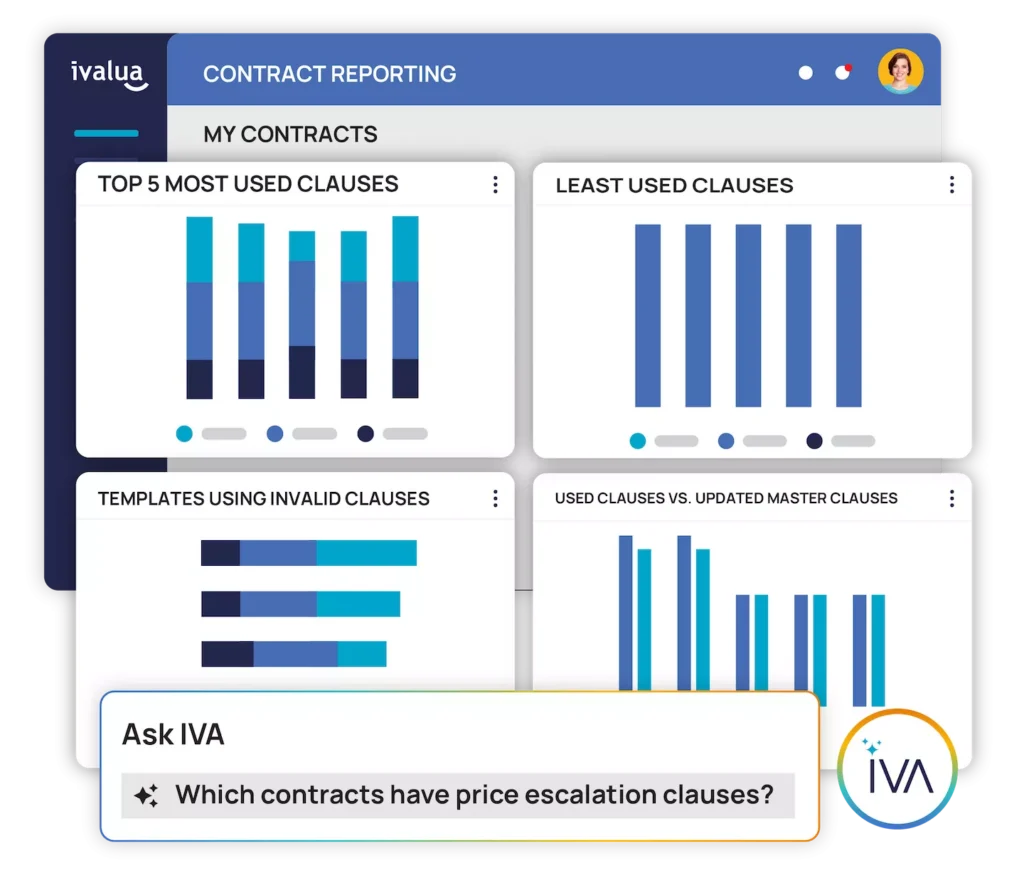
- Unified Contract 360 & AI Search: Centralize your entire contract estate into a single source of truth, leveraging conversational AI and smart search for instant, portfolio-wide visibility.
- Connected S2P Analytics & Performance: Monitor contract health, track supplier commitments, and eliminate value leakage by natively syncing contract terms with downstream spend metrics.
- Enterprise Governance & Audit Safeguards: Uphold legal and procurement standards across the entire lifecycle with automated approval workflows, AI risk scoring, and complete audit trails.
AI Approach: Ivalua’s Agentic AI – IVA (Intelligent Virtual Agent) helps in drafting and reviewing contracts from your organizations or third-party paper, flags risky clauses against playbooks and/or the master clause library, and autonomously tracks obligations, renewals, and compliance. Allowing for easy collaboration internally and externally throughout. It also extends beyond the contract itself by validating invoices against negotiated contract terms across the Source-to-Pay platform.
Implementation: Implementation scope varies depending on whether CLM is deployed independently or as part of a broader Source-to-Pay transformation, with the benefit of contracts, sourcing, supplier, and AP processes operating on a shared data model.
What to Watch For: If looking for fast time-to-value Ivalua CLM with Supplier information management or Sourcing can be a great first phase, and implementation is not difficult or lengthy. Allowing you to address any pain points around cycle time for contract draft to signature, or actively managing contracts throughout their lifecycle and not missing basics like auto-renewals. Because Ivalua is often deployed enterprise-wide rather than as a narrow legal tool, implementation may take longer than lightweight standalone CLM products. Teams prioritizing fast, narrow rollouts should weigh that against the platform-wide integration they’d be giving up.
Access our on-demand demo library to see Ivalua’s CLM solution in action:
2. Ironclad
Overview: Ironclad is a contract lifecycle management platform, known for its intuitive user experience, no-code workflow automation, and strong Salesforce integration. Popular for high-volume sell-side contracting process management, the solution offers rapid deployment, fast adoption for legal users, and streamlined contract creation and approval workflows.
Best For: Legal-led organizations that need fast user adoption, configurable workflows, and efficient management of commercial contracts.
Key Features:
- No-code workflow configuration for legal teams
- Salesforce integration for sell-side contracting
- Contract creation, approval, and execution workflows
- Workflow automation for contract management
AI Approach: Ironclad’s AI capabilities are concentrated in pre-signature drafting and contract generation rather than post-signature obligation monitoring or cross-system data.
Implementation: Legal-led rollouts — deployment and adoption are quicker than platform-wide procurement rollouts, reflecting its narrower scope.
What to Watch For: Because Ironclad operates outside the S2P environment, it has limited integration depth with sourcing, supplier, and AP data. Post-signature obligation management, supplier performance oversight, and broader procurement process integration require additional work to connect back to procurement systems.
3. DocuSign CLM
Overview: DocuSign CLM offers contract workflow automation, document routing, approvals, and repository capabilities. If you’ve already invested in the DocuSign ecosystem, you’ll have a familiar user experience and a relatively straightforward path from electronic signature management to CLM.
Best For: Organizations that already use DocuSign eSignature and want to add workflow automation, document management, and contract storage without introducing a completely new contracting platform.
Key Features:
- Familiar workflow for existing DocuSign eSignature customers
- Contract workflow automation, document routing, and approvals
- Strong brand recognition and rapid user adoption
- AI-assisted drafting and document support during contract creation
AI Approach: DocuSign’s AI capabilities focus on accelerating contract creation, review, and drafting prior to signature, with limited AI support for post-signature obligation management or contract performance monitoring.
Implementation: Straightforward for organizations already using DocuSign eSignature, since it extends an existing ecosystem rather than introducing a new platform.
What to Watch For: Although strong during the execution phase, DocuSign CLM does not provide adequate sourcing, supplier, and post-signature governance capabilities. Additionally, integration depth is limited outside the DocuSign ecosystem.
4. Icertis
Overview: Icertis is an enterprise CLM platform focused on contract standardization, compliance, obligation tracking, and governance. It integrates with Microsoft and SAP environments but is not a native Source-to-Pay platform.
Best For: Large, compliance-focused organizations in industries such as healthcare, financial services, manufacturing, and life sciences.
Key Features:
- Integrates with Microsoft and SAP environments
- Contract templates, standardization, and compliance workflows
- Obligation tracking and post-execution contract monitoring
- Configurable governance, approvals, and policy controls
AI Approach: Icertis emphasizes compliance-oriented AI for standardization and obligation tracking rather than broad, cross-platform agentic capability spanning sourcing and procurement.
Implementation: Suitable for large, complex enterprise rollouts already invested in Microsoft or SAP ecosystems. Dedicated IT involvement is typically required for configuring deep system integrations.
What to Watch For: Icertis offers only moderate procurement integration for sourcing, supplier management, and procurement workflows. For procurement-led transformation initiatives, it’s less natively connected to end-to-end S2P processes than integrated procurement platforms.
5. Agiloft
Overview: Agiloft is a no-code CLM platform that supports configurable workflows, data models, approvals, and business rules. It also integrates with a range of enterprise systems to connect CLM with other business processes.
Best For: Organizations that prioritize deep no-code customization and have the internal resources to configure, govern, and continuously optimize contract management workflows over time.
Key Features:
- No-code configuration for workflows, data models, approvals, and business rules
- Enterprise integrations for connecting contract data
- Governance controls and configurable approval workflows
- Obligation tracking, renewals, and post-signature contract monitoring
AI Approach: Agiloft’s AI capabilities are less mature than enterprise-focused CLM and procurement platforms, with functionality concentrated in configuration and workflow automation rather than agentic obligation management.
Implementation: Requires dedicated internal administrative ownership to configure and continuously optimize workflows, data models, and business rules over time.
What to Watch For: Offers moderate deployment context and integration depth as a standalone CLM solution. Organizations need the internal resources to maintain configuration and governance without native connections to sourcing, supplier, and spend data.
What Spend Matters Found When They Evaluated Ivalua’s Platform
Well-known for reporting on procurement and supply chain technology, Spend Matters Source-to-Contract (S2C) Vendor Analysis is particularly relevant for procurement leaders looking to purchase SLM software.
The report sees CLM as part of the broader Sourcing-to-Contract process – and that’s important because contracts are created from sourcing events, connected to suppliers, and ultimately govern procurement execution.
This analysis provides third-party validation of how Ivalua’s CLM capabilities support a connected procurement operating model, particularly across AI, integration, governance, and post-signature value realization.
Finding 1: A Single Data Model is the Foundation for AI
AI Maturity: According to Spend Matters, “if you want real AI, you will need a single-workflow-driven platform that works on a single data store because no advanced technology works without sufficient good, clean and harmonized data.” Ivalua’s unified architecture as a key differentiator, positioning the platform to support more advanced AI and agentic workflows than solutions built on fragmented data models.
Finding 2: AI Converts Contracts into Managed Obligations
Value Realization Stage: Spend Matters highlights that Ivalua uses OCR and AI technologies to digitize contracts, extract key clauses, and identify contractual obligations, which then trigger tasks, notifications, and workflows based on obligation type. This approach helps govern post-signature contract management effectively, eliminating manual work and reducing contract value leakage.
Finding 3: AI Monitors Risk at the Clause Level
Governance Model: Spend Matters notes that Ivalua tracks risk at the clause level and uses AI to identify potentially problematic language during contract authoring and negotiation. The platform can recommend alternative clauses to mitigate risk and initiate third-party risk assessments directly from the contract workflow. It creates contract-level risk scorecards that support stronger governance and compliance oversight.
Finding 4: Customers Rated Ivalua Highest in Four Critical Categories
Platform Validation: The Spend Matters SolutionMap, which incorporates feedback from surveyed customers, scores Ivalua above benchmark across all categories. Ivalua topped the list for Business Value, Innovation, Configurability, and Systems Integration.
Finding 5: Sourcing Awards Convert Directly into Contracts
Integration Depth: Ivalua’s ability to convert sourcing awards into contracts within a single platform eliminates manual handoffs between sourcing, legal, and administrative teams. By maintaining continuity between sourcing decisions and contract execution, Ivalua helps to close operational gaps that can contribute to post-signature value leakage.
Finding 6: One of the Most Comprehensive Supplier Views in the Market
Integration Depth and Deployment Context: Spend Matters describes Ivalua’s supplier view as “one of the most comprehensive we have reviewed in any S2C/S2P solution.” Ivalua consolidates supplier contracts, purchase orders, invoices, scorecards, risk profiles, and performance information into a single view, strengthening the connection between CLM, Supplier Lifecycle Management, and Supplier Performance Management. Procurement teams gain the context they need to manage supplier relationships and contract outcomes effectively.

Pro Tip
Download the Spend Matters Source-to-Contract Vendor Analysis Report
How an Entertainment Provider Cut Vendor Risk Assessment from 5 Days to 3 Hours With Ivalua
A public sector entertainment organization was managing nearly 1,000 contracts annually through a fragmented process and in need of procurement transformation. While contract requests originated in ServiceNow, negotiations and document management occurred across email, SharePoint, and other disconnected systems, leading to version-control problems that required about 12/week to fix manually.
The company also lacked visibility into contract milestones, increasing the risk of unwanted auto-renewals with an estimated value loss of $250,000. Not only that, but vendor risk assessments were slow and difficult to manage, and financial reporting was managed via separate SAP integrations that restricted visibility and control.
With Ivalua, the company centralized contract and vendor management with a single repository and streamlined supplier risk management through Ivalua’s Risk Center. Vendor risk assessment times dropped from five days to just three hours, while procurement teams identified and mitigated three critical supplier risks within the first six months. Other benefits included:
- Increased user satisfaction scores from 60% to 95%
- 15% increase in procurement team capacity through automation
- 25% reduction in contract lifecycle times via workflow automation
“We shouldn’t have to dig through emails on vacation to find contract status. We need one place to see where contracts stand and who’s responsible. With Ivalua, mitigating roadblocks like this is simple.”
– Senior Inventory Analyst, entertainment company
Read the full case study.
For Buy-Side Contracts, Stop Evaluating CLM as a Legal Tool, But Rather a Procurement Asset.
The CLM market is increasingly moving toward integrated Source-to-Pay platforms that connect contracts to operational execution. Organizations that continue treating contract lifecycle management software as a legal tool rather than a procurement platform will likely find themselves addressing the same contract value leakage challenges years from now.
As you evaluate CLM solutions, look for a platform that seamlessly integrates sourcing, contracting, procurement, suppliers, and payments processes while enabling continuous insights into post-signature obligations to prevent value leakage.
For procurement leaders, the evaluation should ultimately focus on the five components that drive long-term outcomes:
- Pre-signature Efficiency & Automation
- Post-signature governance
- Data and process integration
- AI maturity
- Total cost of ownership
These factors determine whether your CLM solution will be a strategic asset for procurement over the long term.
Unlock More Value From Every Contract With Ivalua
FAQs
The terms are often used interchangeably, but contract lifecycle management software typically refers to platforms that manage the entire contract lifecycle—from authoring and negotiation through obligation tracking, renewals, and compliance monitoring. Basic contract management software may focus primarily on document storage, search, and administration.
CLM software pricing varies widely based on deployment model, user count, contract volume, integrations, and AI capabilities. Organizations should evaluate total cost of ownership—including implementation, integrations, administration, and future expansion costs—rather than focusing solely on software licensing fees.
The right answer depends on how closely contracts need to connect with sourcing, supplier management, procurement, risk, and spend processes. Organizations seeking end-to-end visibility and post-signature value management often benefit from an S2P-integrated CLM, while standalone CLM tools may be appropriate for narrower legal-focused use cases.
Beyond authoring and repository capabilities, procurement leaders should prioritize obligation management, compliance monitoring, supplier collaboration, workflow automation, analytics, AI-powered contract intelligence, and integration with procurement and ERP systems. The most valuable capabilities help prevent contract value leakage after execution.
Agentic AI expands CLM from document management to proactive contract management. AI agents can extract key terms, monitor obligations, identify compliance risks, recommend actions, surface renewal opportunities, and automate routine contract workflows, reducing administrative effort while improving oversight.
Implementation timelines depend on contract volume, process complexity, integration requirements, and organizational readiness. While some deployments can be completed in a few months, enterprise-wide CLM implementations often take longer when extensive data migration, workflow redesign, and cross-functional adoption are required.