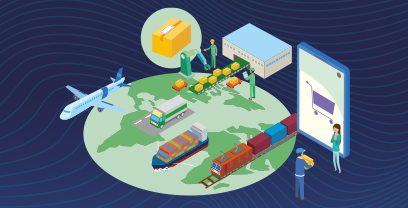



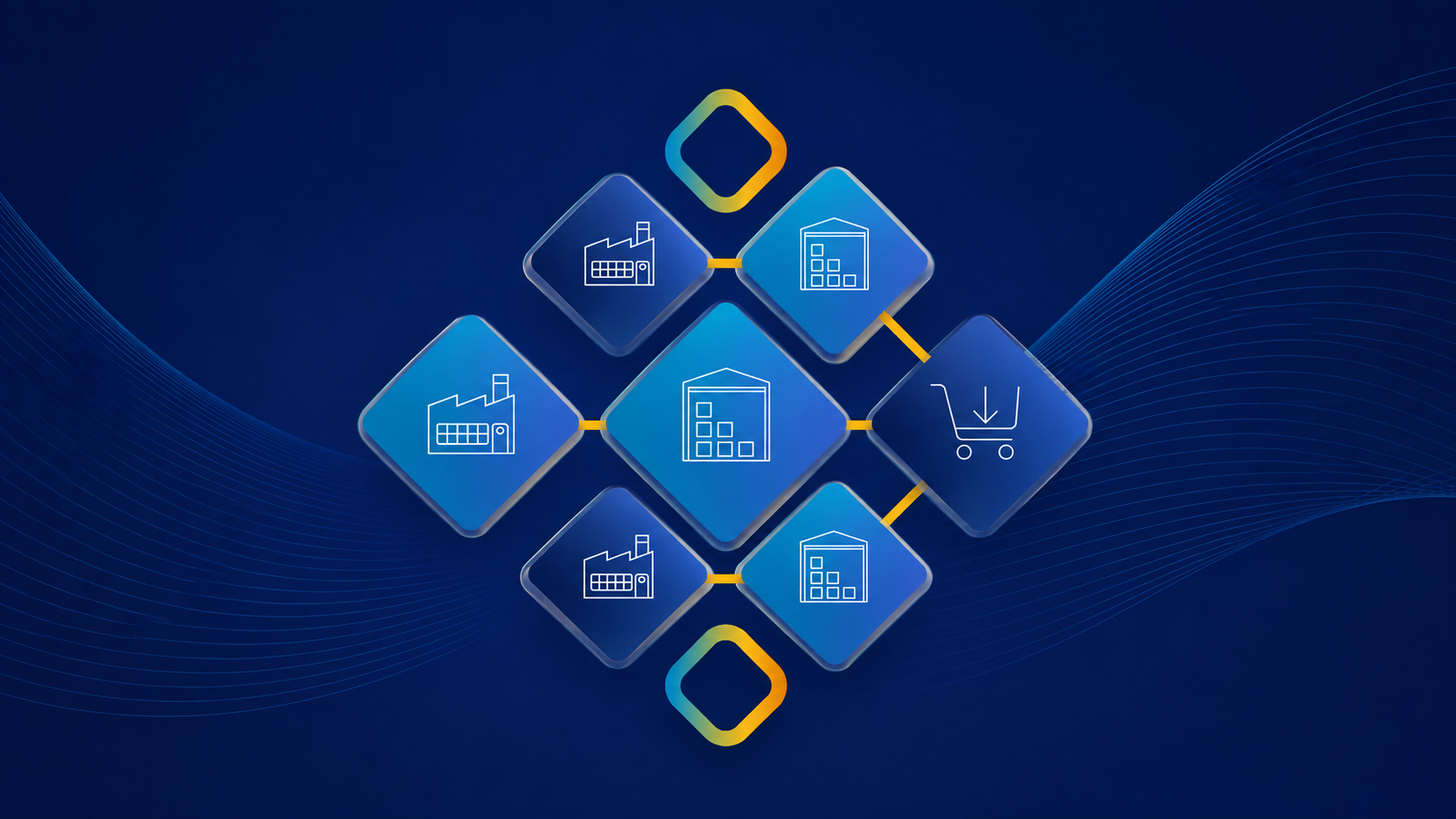
Direct sourcing covers the materials and components that will be part of the finished product. It comprises spend associated with your Cost of Goods Sold (COGS). By contrast, indirect sourcing covers all of the other things your business needs to operate, such as IT and services, office supplies, and maintenance costs.
Understanding the differences of direct vs. indirect sourcing is important when you work at the enterprise level, because these spend categories operate very differently. For example, since direct spend is tightly tied to production, supplier reliability, and margin, it requires building long-term partnerships and planning for demand.
On the other hand, indirect spend varies more and requires flexibility and policy control. Each type of spending calls for distinct sourcing and risk management strategies, as well as different supplier models.
In this guide, we dive into the key differences and explore some real-world use cases for each type of spend. We also compare processes and challenges, and outline our recommended best practices for managing both spend categories effectively.
Key Takeaways
- In direct sourcing, small cost or supply changes may have an immediate impact on production and profitability.
- Indirect sourcing requires strong governance and processes to manage fragmented and variable spend.
- According to McKinsey & Company, tariffs have had a major impact on direct sourcing risks.
- A unified platform like Ivalua can help manage both spend categories with accurate data and streamlined workflows.
Direct vs. Indirect Sourcing: At a Glance
To help you quickly distinguish between these two categories, the table below provides a side-by-side breakdown of their core characteristics, risks, and strategic priorities.
| Category | Direct Sourcing | Indirect Sourcing |
|---|---|---|
| What is purchased | Raw materials, components, production inputs | Services, IT, MRO, office and operational supplies |
| Business impact | Directly affects product cost, quality, and revenue | Impacts efficiency, cost control, and employee productivity |
| Primary risk | Supply disruption, quality issues, tariff exposure | Maverick spend, compliance gaps, supplier fragmentation |
| AI priority | Demand forecasting, supplier risk, cost modeling | Spend classification, intake automation, policy enforcement |
What Is Direct Sourcing?
Direct sourcing involves procuring materials that are physically incorporated into a finished product. As a result, it is inseparable from product quality and production continuity, not to mention margins.
Some direct sourcing examples include raw steel, semiconductor chips, and packaging. Often called “raw materials sourcing,” direct sourcing is tightly coupled to manufacturing.
Cost reductions in the direct sourcing process flow straight to gross margin, while supply disruptions can halt production entirely.
It’s highly cross-functional: Engineering defines the bill of materials (BOM), operations manages the production schedule, quality oversees Advanced Product Quality Planning (APQP) and Production Part Approval Process (PPAP) requirements, and finance sets cost targets.
Procurement sits at the center, orchestrating supplier selection, negotiations, and performance across all stakeholders.
Modern direct sourcing strategies prioritize resilience and agility, as well as cost reduction, so ongoing collaboration between procurement, engineering, and quality teams is essential for effective direct spend management.
Modern direct procurement platforms embed AI across the product lifecycle – from BOM analysis to supplier quality management – supporting collaboration with a single source of truth.
Now let’s look at indirect sourcing and how it’s different.
What Is Indirect Sourcing?
Indirect sourcing includes the goods and services your business needs to operate but are not associated with physical parts of the finished product.
Indirect sourcing examples include things like IT software, facilities management, marketing services, travel, professional services. Visibility and control over how money is spent for this category is essential..
Whey? Because purchasing is often decentralized across departments, leading to maverick spend and low contract compliance.
However, building a consistent category management strategy across business units is complex, since each function has different priorities and budgets. These are the most persistent indirect sourcing challenges.
Key indirect sourcing challenges include cost leakage, but they don’t cause production to stop. The impact is less visible initially.
During the Procure-to-Pay process, platforms such as Ivalua provide AI-driven control and efficiency, along with Intelligent Guided Buying to improve category management and encourage using preferred suppliers and compliant purchasing paths.
Invoice Anomaly Detection is used to flag duplicates or mismatches, and route exceptions for review while pushing clean invoices through automatically.
With a solid understanding of each type of spend, we can now compare them directly and see how they differ.
Direct Sourcing vs. Indirect Sourcing: Key Differences
Direct sourcing vs. indirect sourcing are different in a number of ways: risk exposure, supplier relationship depth, technology requirements, and organizational ownership, to name a few.
While direct sourcing is tightly coupled to production and revenue, indirect sourcing operates in a more distributed environment. Here, the primary risk is uncontrolled spend and low compliance.
In short, direct sourcing requires long-term supplier collaboration and coordinated supply continuity strategies, while indirect sourcing requires strong governance and standardized processes. The technology stack, performance metrics, and operating models are fundamentally different.
Impact on Business Performance
Problems in direct and indirect sourcing have very different impacts on business performance. A delayed semiconductor shipment (direct sourcing) can shut down a production line or delay time-to-revenue, whereas a delayed office supply order (indirect sourcing) can be frustrating but won’t shut the business down.
It’s the same with costs. When direct materials prices rise, margins shrink immediately. Deloitte reports that manufacturers expect input costs on raw materials and components to increase by an average of 5.4% due to ongoing tariff and trade volatility. That’s why in supply chain management, cost control is a high priority.
Direct sourcing requires more advanced monitoring, dual sourcing strategies, and real-time cost modeling within the procurement process.
Platforms like Ivalua apply predictive analytics to supplier lead times, logistics data, and production schedules to help teams anticipate delays or stock-outs before they impact the production line.
Supplier Relationship Structure
Direct sourcing requires deep, long-term, and highly collaborative supplier relationships, while indirect sourcing typically relies on a broader, more transactional supplier base.
That’s because direct suppliers often act as co-developers, participating in APQP processes and delivering PPAP documentation. Without close collaboration, quality issues, delays, and costly redesigns are likely.
Indirect suppliers are usually evaluated on price, SLA performance, and compliance – and they can be replaced without breaking the bank.
However, when a direct supplier fails, it’s challenging to find a replacement vendor with the right tooling and qualifications.
According to RapidRatings, 81% of procurement professionals have experienced supplier disruption recently, and 68% expect risks to escalate. As a result, structured supplier relationship management is of paramount importance.
Platforms like Ivalua operate on a single data model and leverage AI to assess sourcing performance, contracts, transactions, third-party risk, and ESG data simultaneously and in one view. This is more efficient than siloed systems that often miss critical cross-signal insights.
Risk Profile and Resilience Requirements
Direct sourcing carries concentration risk, production dependency risk, and multi-tier supply chain exposure that indirect sourcing simply does not.
A single-source component failure can halt production across multiple product lines at once, especially in complex raw materials sourcing environments where upstream dependencies aren’t always visible.
Indirect sourcing failures such as a contract lapse or compliance issue can be disruptive but are easier to recover from. They are rarely business-critical.
That’s why 39% of companies have dual sourcing strategies for components and raw materials, while 33% invest in nearshoring to reduce exposure, according to McKinsey & Company.
These approaches require more advanced sourcing optimization capabilities, including real-time visibility into supplier performance and risk.
Ivalua’s Intelligent Virtual Assistant (IVA) applies machine learning across thousands of data points including supplier performance trends, payment history, and third-party risk signals, to generate predictive risk scores. This enables teams to anticipate disruptions before they occur.
Technology and Data Requirements
Direct and indirect sourcing require different but overlapping technology capabilities:
- Direct sourcing software must support BOM integration, APQP workflow management, multi-tier supplier visibility, should-cost modeling, and real-time tariff impact analysis.
- Indirect sourcing software, on the other hand, focuses on catalog management, approval workflows, spend analysis, and end-to-end P2P automation.
Managing these two sets of capabilities on separate platforms is not ideal, because data fragmentation limits enterprise-wide visibility and makes it nearly impossible to compare trade-offs across categories.
The answer is to deploy a unified procurement management platform with a single codebase and data model that enables consistent insights and coordinated action. A modern platform like Ivalua can manage direct materials sourcing, indirect goods, and complex services without customization.
The table below outlines the key differences in direct sourcing vs. indirect sourcing.
| Dimension | Direct Sourcing | Indirect Sourcing |
|---|---|---|
| Master data foundation | BOM-driven item master, supplier-item relationships, version control, cost breakdown structures | Supplier master, category taxonomy, contract and catalog data, GL alignment |
| Sourcing workflow | Engineering-integrated sourcing, RFQs tied to BOM, APQP/PPAP processes, long-term agreements | Guided buying, RFPs/RFIs for services, standardized approvals, spot buying controls |
| Supplier management | Strategic, long-term partnerships, quality management, performance tracking across lifecycle, multi-tier visibility | Broad supplier base, onboarding and compliance, SLA tracking, preferred vendor management |
| Invoice processing | 3-way match with PO and goods receipt, tolerance handling, integration with production data | High-volume invoice automation, 2/3-way match, exception routing, touchless processing |
| AI use cases | Should-cost modeling, demand forecasting, supply risk prediction, tariff impact analysis | Spend classification, anomaly detection, guided buying recommendations, contract compliance monitoring |
Now that you understand the key differences, let’s turn to what effective management looks like in practice and how to execute effectively across both categories.
Best Practices for Direct Sourcing Strategy
Procurement teams need clear, actionable frameworks to operationalize direct sourcing at scale. Each best practice below ties directly to how direct sourcing actually works in the business.
Should-Cost Modeling as a Negotiation Foundation
Should-cost modeling is one of the most powerful levers in direct sourcing. Basically, it’s an estimate of what a part should cost based on inputs such as raw materials, manufacturing processes, supplier margin, logistics, and tariffs. It helps teams pinpoint excess margin and negotiate from a position of data-backed strength.
Today, AI is making should-cost modeling scalable. Deloitte reports that agentic AI is being used to recalculate should-cost models when tariffs shift, identifying alternative suppliers, and initiating negotiation workflows with human oversight.
Platforms like Ivalua embed this capability natively, enabling teams to analyze historical bids and commodity pricing, and break down supplier costs to generate predictive should-cost models. This gives sourcing teams a sustained negotiation advantage.
BOM Management as the Backbone of Direct Sourcing
New Product Introduction (NPI) moves from design intent through sourcing, supplier qualification, and production launch. It relies on actionable BOM data.
In practice, BOM management within the direct sourcing process means using component-level data to evaluate supplier scenarios, model cost impacts of design changes, and manage supplier engagement across the lifecycle.
Early in NPI, procurement must assess multiple supplier options against cost, risk, and quality. In production, teams must manage resourcing without losing alignment to the original BOM.
When BOM data lives only in PLM, ERP, or spreadsheets, silos emerge. This leads to the need for manual analysis and can result in misalignment with engineering, causing timelines to slip and costs to rise.
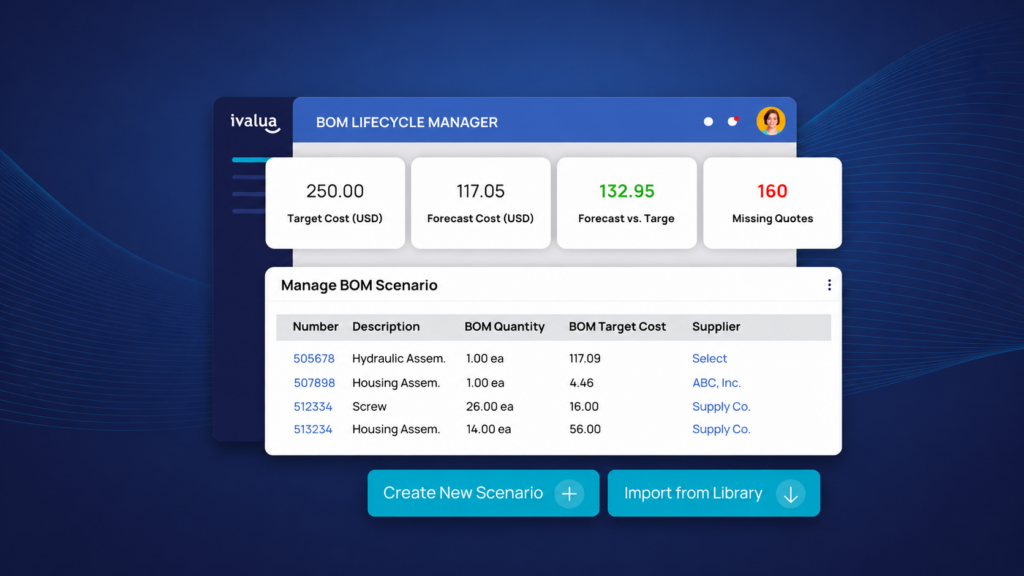
Ivalua’s BOM Lifecycle Manager provides better visibility and cost tracking, and the ability to launch sourcing, quality, and purchasing workflows directly from a single view for scalable direct materials procurement.
Supplier Quality Management: APQP and Beyond
In direct sourcing, especially in complex industries like automotive, aerospace, or industrial manufacturing, supplier quality management is a formal discipline that requires structured cross-functional collaboration.
APQP is a multi-phase framework (typically five phases from planning through production) that validates whether a component manufacturing process meets requirements. PPAP submissions prove that execution is successful.
Enterprises also run PPAP, 8D, Supplier Corrective Action Request (SCAR), and Corrective and Preventive Action (CAPA) processes (often concurrently and across the same suppliers). Managing all of this manually creates documentation gaps and quality risks that don’t surface until production.
AI is now changing that by identifying anomalies in APQP and PPAP submissions and detecting defect trends early, and Ivalua’s unified Product Quality solution supports APQP, PPAP, 8D, SCAR, and CAPA in one platform.
The Biggest Challenges in Direct Sourcing
Direct sourcing is operationally demanding, and most organizations face a predictable set of pitfalls. Here we take a look at those potential pitfalls in greater detail.
Multi-Tier Supply Chain Visibility
Direct materials supply chains are inherently multi-tiered, yet most organizations have limited visibility beyond tier one. As a result, disruptions can happen without warning.
A shortage rarely starts with the tier-one supplier; it begins upstream when a sub-supplier fails, cascading into missed shipments that you may only discover once production is already at risk.
McKinsey & Company report that only 42% of companies have visibility into tier-two or deeper risks – and even fewer maintain direct relationships at that level.
What’s more, regulatory pressure such as tariff compliance requires organizations to track component origin across multiple tiers. This adds complexity to supply chain management and the broader procurement process.
Ivalua’s IVA continuously monitors news, legal filings, and financial data to surface risk signals early as actionable summaries with recommended next steps.
Responding to Supplier Risk Before It Becomes a Disruption
Most procurement organizations still manage supplier risk with periodic scorecards. By the time procurement detects an issue, options are limited and costs are higher, and disruption may have already occurred.
Nearly two-thirds of companies are late in responding to supplier risk events because they don’t have continuous monitoring frameworks in place.
Procurement teams should graduate from static assessments to real-time, alert-driven visibility to enable early intervention. Ivalua IVA provides this level of anomaly detection, continuously monitoring supplier performance KPIs and flagging notable deviations. This enables teams to investigate and act on problems before they escalate.
The challenges above are compounded when direct and indirect sourcing run on separate platforms – which is why the better option is a unified approach.
Managing Direct and Indirect Sourcing on a Unified Platform
The best approach is to manage both direct and indirect sourcing on a unified platform that supports the differences in each process, without creating silos. Managing them separately fragments data and limits visibility, while a unified platform enables better decisions, faster response, and true enterprise-wide alignment.
Why Separate Systems Create Compounding Risk
Organizations running direct and indirect sourcing on separate platforms pay a hidden tax in fragmented data and constant integration work. That tax compounds as spend increases.
Direct materials data often lives in ERP and PLM systems, while indirect spend sits in a separate P2P tool, so there’s no unified view of total spend or supplier risk. This limits effective spend analysis and strategic sourcing.
In this scenario, sourcing decisions in one category can’t be informed by data from the other. While “Suite-in-a-box” vendors only replicate the same problem under a single brand, unified platforms like Ivalua are built on a single codebase and data model, enabling true cross-category visibility and AI-driven decisions.
What a Unified Direct and Indirect Sourcing Platform Actually Looks Like
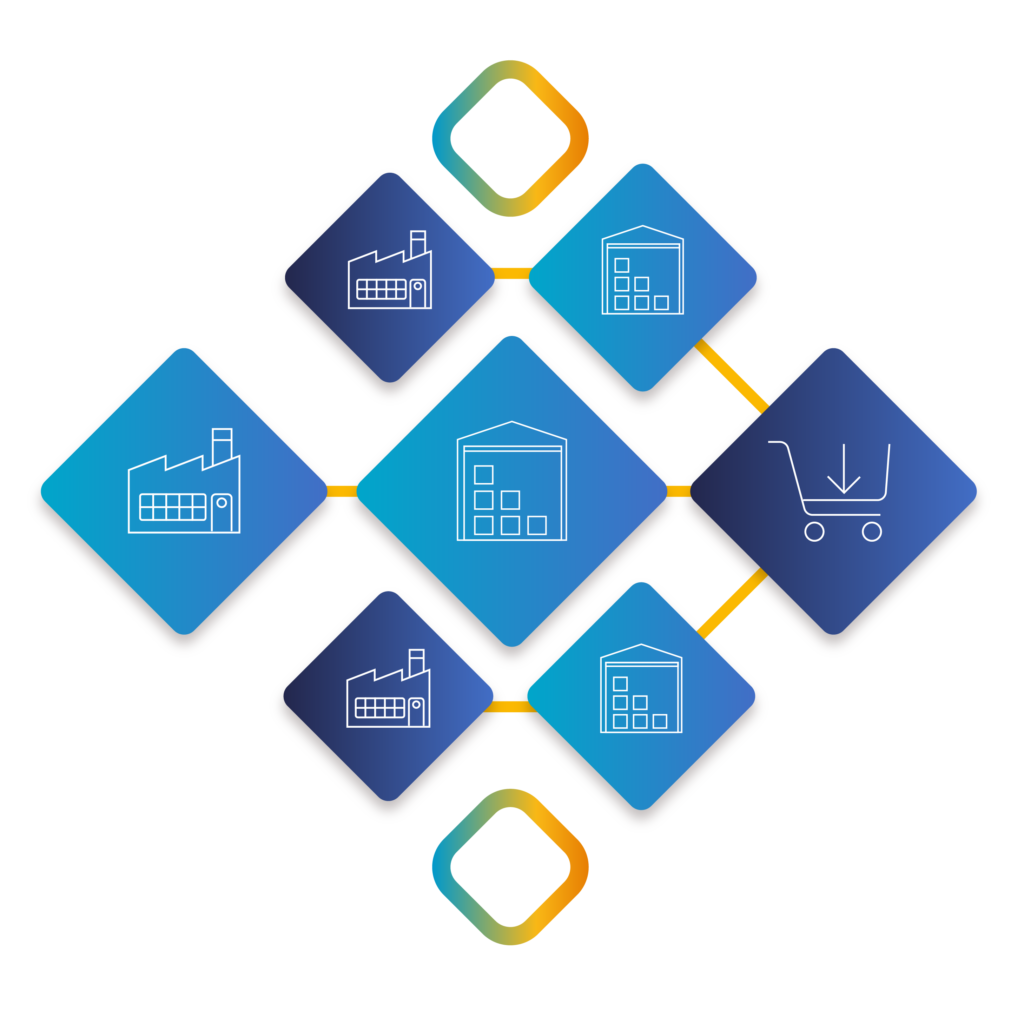
A true unified platform isn’t a bundle of acquired tools sharing a login. It has a single codebase and data model that gives every procurement management function access to the same supplier, spend, and risk data in real time.
In practice, this means BOM data flows directly into sourcing events, APQP workflows run alongside contract management, and supplier risk scores inform both direct component decisions and indirect service renewals.
Additionally, invoice automation spans both categories. AI can code, match, allocate, and process payments for direct material invoices and indirect POs, with fraud detection and deduplication acting as guardrails.
This is further strengthened by e-invoicing, where structured XML data reduces errors and improves processing accuracy.
Ask yourself, is the platform you’re evaluating built on a single codebase? Can it manage direct materials, indirect goods, and complex services without customization? Are AI and analytics embedded into workflows, or bolted on?
Ivalua for Manufacturing offers native integrations with ERP, MRP, and PLM systems, connecting engineering, production, and procurement in one environment.
Direct vs. Indirect Sourcing: Quick-Reference Comparison
This table provides a fast, scannable reference of the key operational differences between direct vs. indirect sourcing covered in this guide.
| Dimension | Direct Sourcing | Indirect Sourcing |
|---|---|---|
| What is purchased | Raw materials, components, and inputs embedded in the product | Goods and services that support operations (IT, MRO, marketing, travel) |
| Business impact | Directly affects production, revenue, and gross margin | Impacts efficiency, cost control, and employee productivity |
| Supplier relationships | Deep, long-term partnerships; suppliers act as co-developers in product lifecycle | Broad, transactional supplier base evaluated on price, SLA, and compliance |
| Risk profile | High: supply disruption can halt production; multi-tier dependencies and tariff exposure | Moderate: maverick spend, compliance gaps, and inefficiency are primary risks |
| Governance approach | Cross-functional (engineering, operations, quality, finance); tightly controlled and collaborative | Policy-driven; standardized processes to manage decentralized purchasing behavior |
| Technology needs | BOM integration, APQP workflows, multi-tier visibility, should-cost modeling, tariff analysis | Catalogs, guided buying, approval workflows, spend analytics, P2P automation |
| AI use cases | Demand forecasting, supplier risk prediction, should-cost modeling, disruption alerts | Spend classification, anomaly detection, guided buying, compliance monitoring |
Building a Sourcing Strategy That Covers All Spend, All Suppliers
The differences between direct sourcing and indirect sourcing aren’t justification for splitting procurement into separate systems. Rather, it’s the reason to build a unified sourcing strategy on a robust procurement management platform.
While direct sourcing requires COGS-level precision and multi-tier cross-functional visibility, indirect sourcing demands strong governance, and process compliance along with control over decentralized spend.
A unified platform can address all of these requirements without the hidden tax of fragmented systems, disconnected data, and inconsistent processes. With a single codebase and data model – and a streamlined user experience – Ivalua delivers best-of-breed capabilities for both direct and indirect sourcing, without compromise.
To see how this applies in practice, download the Ivalua for Manufacturing datasheet.
See how a single platform can connect direct and indirect sourcing into one unified, data-driven strategy.
FAQs
In direct sourcing vs indirect sourcing, direct sourcing covers direct materials that go into the product and directly impact COGS and production continuity, while indirect sourcing covers goods and services that support operations. In manufacturing procurement, this distinction matters because direct failures stop production, while indirect issues typically affect efficiency rather than output.
Modern direct sourcing software connects with ERP, MRP, and PLM systems to synchronize BOM data, production plans, and supplier information in real time. This system integration ensures the procurement platform operates on the same data as engineering and manufacturing, eliminating silos and improving decision accuracy.
Key procurement KPIs for direct sourcing performance include on-time delivery, cost variance against should-cost, supplier quality metrics, and supply continuity. These supplier performance metrics are central to effective direct spend management because they tie directly to production outcomes and margin.
Tariffs and trade volatility primarily impact direct sourcing strategy by increasing costs in raw materials sourcing and forcing rapid supplier or design changes. This makes tools like should-cost modeling and dual sourcing essential for managing cost exposure and maintaining supply continuity.
In direct sourcing, supplier collaboration is critical during a new product launch, as suppliers contribute to design validation, quality planning, and production readiness. Frameworks like APQP and PPAP ensure alignment across the product lifecycle, reducing risk before full-scale production begins.
In large enterprises, indirect sourcing (or indirect procurement) is often managed through a mix of centralized category management and decentralized procurement across business units. This structure creates challenges like maverick spend and unmanaged tail spend, making governance, standardization, and visibility critical for controlling costs and ensuring compliance.