



In Procurement, every sourcing decision begins with the bill of materials (BOM) – a structured list of every raw material, component, sub-assembly, and quantity required to manufacture a finished product.
It’s the document that serves as a product blueprint and a procurement planning tool simultaneously, connecting design intent with sourcing and product development.
Typically, engineering teams create the BOM, and its impact extends across manufacturing, and supply chain operations, directly influencing how organizations estimate costs and plan for inventory.
This guide explains the different types of BOMs and their key components. You’ll also learn how a BOM is created and how you can manage BOMs effectively to improve direct materials sourcing.
Key Takeaways
- By connecting product design to procurement, the BOM enables teams to accurately estimate costs and plan inventory.
- Managing a BOM effectively requires strong data governance and real-time collaboration across engineering and procurement teams. Integrated systems are also essential.
- When a BOM is inaccurate or outdated, risk of production delays, cost overruns, and supply chain inefficiencies increases.
Why a Bill of Materials Matters for Procurement
In direct materials procurement, BOM errors have a cascading effect. They can result in incorrect orders or excess inventory, production delays, and cost overruns. That’s because BOMs drive procurement planning and cost estimates.
If quantities, part numbers, or approved vendors are incorrect, you’ll likely source the wrong materials – and in today’s volatile environment, that’s a big problem. Nearly 90% of operations leaders expect material costs to rise sharply. This is compounded by tariff disruptions and a lack of visibility beyond tier one suppliers.
Strategies such as dual sourcing and nearshoring depend on current, reliable BOM data, especially as 39% of companies are leaning on dual sourcing models to combat the impact of tariffs.
Platforms such as Ivalua offer a modern approach to direct spend management and direct materials sourcing that helps to ensure BOM data flows directly into procurement workflows – without manual re-entry or version drift.
In the next section, we dissect the different BOM structures and how to apply them in practice.
Types of Bill of Materials
There are several different BOM structures. The one you use depends on what stage of the product lifecycle you’re in.
The BOM type you choose will shape your sourcing decisions, supplier engagement, and materials management, so it’s important to have a solid understanding of each type:
- Engineering BOM (EBOM): Defines the product as designed, including all components and specifications
- Manufacturing BOM (MBOM): Translates design into how the product is built within the manufacturing process
- Multi-level BOM (indented BOM): Breaks down the full assembly hierarchy into parent-child relationships across all levels
- Single-level BOM: Lists only the immediate components required for a specific assembly level
Let’s examine each of these types of BOMs in greater depth.
Engineering BOM (EBOM) vs. Manufacturing BOM (MBOM)
The EBOM represents the product from the designer’s perspective. Typically generated by CAD or EDA tools, it’s organized around functional relationships and captures design intent (i.e. what the product is and how the various components fit together). However, the EBOM does not account for how the product will be built.
Packaging, consumables, or manufacturing sequence are usually not included in the EBOM, even though they are essential for procurement and production. This is especially true for complex electronic components and assemblies.
The MBOM takes the EBOM and aligns the requirements with the manufacturing process, reflecting how the product will be produced on the shop floor.
It contains assembly steps, any additional needed materials, and integration points with ERP and MES systems. This is the version that ultimately drives purchasing decisions.
One of the biggest challenges is translating the EBOM to the MBOM. If the alignment between the two breaks down, procurement will be working from outdated data. This leads to incorrect quantities and can potentially stall production.
Research from the World Journal of Advanced Engineering Technology and Sciences shows that ineffective EBOM-to-MBOM translation contributes to 32–41% of new product introduction delays in electronics, while strong alignment can improve time-to-market by up to 30%.
Platforms like Ivalua connect procurement directly to the MBOM, ensuring sourcing decisions are based on the manufacturing-ready version rather than disconnected exports.
Single-Level, Multi-Level, and Configurable BOMs
Single-level BOMs are flat lists of materials that have no hierarchy. These are often used for simple products, where relationships between parts are minimal. Multi-level (or indented) BOMs show the full parent-child hierarchy across raw materials, intermediate assemblies, and finished goods.
They are usually structured as a master BOM or reusable BOM template and are essential in complex manufacturing environments, where procurement must understand dependencies across every level.
Configurable BOMs take this a step further by supporting product variations. You don’t have to create separate BOMs when there’s a product variation, because these allow for alternative parts and flexibility.
In the enterprise, multi-level BOMs enable component-level cost analysis and supplier risk evaluation across the entire supply chain.
Next, we go into detail about what data fields belong in a well-structured BOM.
Key Components of a Bill of Materials
A bill of materials is only as useful if the data it contains is accurate. Missing or inconsistent fields create blind spots that can impact the entire product structure.
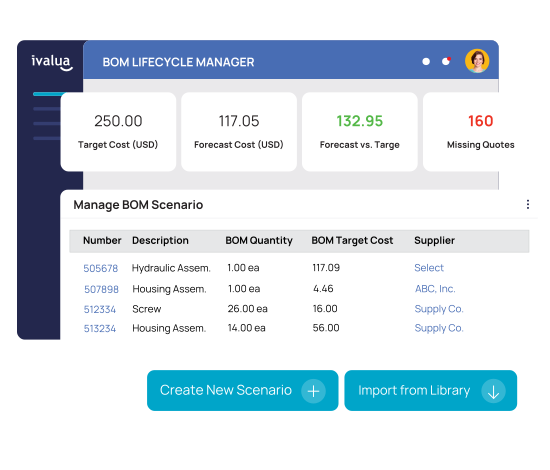
At a minimum, every BOM should include core identifiers and planning data that directly support sourcing and execution. Here are some other key components:
- Part numbers: Unique identifiers for each item, enabling accurate ordering and system alignment.
- Part name/description: Must be clear enough for sourcing teams to understand what’s being purchased.
- Quantity required (per unit): How many parts need to be ordered drives MRP calculations
- Unit of measure: Ensures consistency in how materials are planned and ordered
- BOM level: Defines where each component sits within the hierarchy of sub-assemblies, enabling traceability across the full structure
- Approved suppliers and lead times: Enables procurement to evaluate sourcing options and respond to disruptions
- Part revision and lifecycle status: Prevents teams from ordering obsolete or superseded components, especially important in environments with frequent engineering changes
- Reference designators (for electronics): Maps components to specific locations in a design, ensuring correct sourcing and assembly
Frameworks such as National Institute of Standards and Technology’s supply chain traceability guidance reinforce that standardized, component-level data is essential to preventing fraud, counterfeits, and disruption. Platforms like Ivalua centralize this through master data management, synchronizing BOM data across teams.
Next, we explain how to create a solid BOM with all of the necessary components.
How to Create a Bill of Materials
Creating a bill of materials is a cross-functional, iterative endeavor. The final BOM will determine how smoothly procurement operates downstream.
The first step is to define the full product structure and hierarchy, and map every component from the finished goods down to raw materials and sub-assemblies.
Procurement should be involved at this stage, so they can flag single-source risks or long-lead-time components and other constraints that may have an impact on the direct sourcing strategy. It’s important to flag those risks before the design is final.
Next, each component should be assigned a standardized part number and quantities per unit, along with detailed specifications.
This step underpins BOM management and document management practices by eliminating any ambiguity. If the data is inconsistent or incomplete, ordering errors and production delays are likely to occur.
Once this is complete, you can embed sourcing data such as approved suppliers and alternative parts so the BOM can be used as a procurement planning tool. This enables more informed decision-making and supports proactive planning.
Finally, you should validate and formally release the BOM by sending it out for cross-functional review. Engineering, procurement, quality, and manufacturing should confirm that all components exist in the system and that suppliers are qualified.
Structured frameworks such as APQP help by breaking the review process into defined steps, with documented validation and controlled updates as changes occur.
Creating the BOM is only the starting point. The real challenge is maintaining it as products, suppliers, and market conditions evolve.
BOM Management: Maintaining Accuracy Over Time
A bill of materials is not a static document. It evolves over time, and without disciplined BOM management, it can degrade rapidly, introducing direct procurement risk. The challenge is to maintain accuracy as the design evolves or supplier changes.
There are three pillars of effective BOM management: change control, version management, and system integration.
Change Control
Change control helps to ensure that every engineering change flows into procurement without version conflicts. If this fails, you may be working to source parts with outdated data.
Version management is critical to ensuring that all stakeholders are working from a correct and up-to-date version, with full traceability of what changed and why. Otherwise, discrepancies can multiply across systems.
System integration is necessary for keeping BOM data synchronized across PLM, ERP, and procurement platforms. But according to PwC, 92% of operations leaders cite at least one reason technology investments underdeliver, with integration complexity (47%) and data issues (44%) leading the list.
These gaps undermine everything from spend analysis to broader direct vs indirect procurement strategies. A unified platform closes this gap by synchronizing BOM-level master data across systems without manual intervention.
As Gartner notes, technologies like agentic AI depend on real-time, trusted data to optimize inventory and sourcing decisions. With accurate data in place, AI can be used to perform should-cost modeling that highlights cost anomalies, while predictive analytics identifies component-level supply risks before they disrupt production.
Ultimately, BOM visibility is foundational to supply chain resilience.
How Antolin Streamlined Direct Materials Procurement Across 150 Factories
Antolin,is a global automotive interior manufacturer operating 150 factories across 26 countries, faced a major direct materials challenge.
Its legacy systems could not integrate with their PLM (Teamcenter), and data had to be entered manually at every procurement stage. This left buyers with no visibility into BOM status, supplier risk, or compliance.
After implementing Ivalua, Antolin’s BOMs are automatically loaded through integrations. Now, stakeholders have real-time visibility into components, investments, and POs – and procurement now collaborates with engineering and suppliers from the beginning of the product lifecycle.
What’s more, Ivalua has enabled the company to manage approximately 40,000 suppliers and 1,200+ contracts on a single platform.
With Ivalua, our organization has improved collaboration both internally and externally with suppliers, automated processes and greatly improved our visibility across the end-to-end direct materials procurement process.
– Beatriz Jimenez Benito, Control and Systems Purchasing Director, Antolin
How BOM Visibility Strengthens Supply Chain Resilience
Without full visibility into which components and parts come from which suppliers in which regions, it’s impossible to build a resilient supply chain.
Visibility starts with the BOM, which links every component in finished products to its source. This creates a foundation for understanding multi-tier risk in direct procurement.
Unfortunately, most organizations still only see tier one. McKinsey’s January 2026 research disaggregated BOM components for more than 200 finished-product types and mapped supplier concentration across tiers and countries using 188 KPIs.
Their survey found that most companies understand supply chain risks only up to tier one, and that tier-two visibility actually declined in 2023 and 2024 as pandemic urgency faded.
BOM visibility enables three critical resilience capabilities.
- Dual sourcing: knowing which components require qualified alternatives before disruption hits.
- Nearshoring evaluation: identifying geographic dependencies at the component level to support shifting supply chain strategies.
- Tariff impact assessment: calculating how trade policy changes affect cost at the individual component level, not just in aggregate.
These capabilities are becoming more urgent as 43% of companies plan to shift supply chain footprint and compliance requirements drive deeper supplier transparency.
Ivalua connects BOM-level data to supplier risk profiles and geographic intelligence, enabling scenario analysis directly from the product structure.
This enables procurement teams to model disruptions and evaluate sourcing alternatives, strengthening their direct materials procurement strategy.
Building a BOM Strategy That Drives Procurement Performance
As supply chain complexity increases, extending visibility beyond tier one is no longer optional – it’s essential for supply chain resilience.
The BOM provides the foundational data structure that drives procurement accuracy, cost control, and supplier risk management.
In an environment defined by a host of challenges – rising material costs, tariff disruption, and limited multi-tier visibility, to name a few – investing in accurate, well-managed, and digitally connected BOMs is essential.
Ivalua unifies BOM data across engineering, procurement, quality, and supply chain, improving direct spend management and enabling smarter, faster sourcing decisions.
Make Better Direct Spend Decisions With BOM Data
FAQs
Effective BOM management typically relies on integrated systems like ERP and PLM, which connect engineering data with procurement planning and production workflows. These platforms also support master data management, ensuring that part definitions, suppliers, and specifications remain consistent across the organization.
An inaccurate BOM can lead to significant issues, including production delays, incorrect cost estimation, and mismatched part numbers that disrupt manufacturing. It also creates downstream problems in inventory management, such as stock shortages or excess inventory, ultimately increasing operational risk and cost.
A well-managed bill of materials enables end-to-end traceability of components, which is critical for meeting regulatory requirements and supporting audits. By linking materials to document management, enforcing change control processes, and maintaining detailed records, the BOM becomes a central source of truth for compliance.
BOM management should be continuous, with updates triggered by engineering change events, part revisions, or shifts in the product lifecycle. Strong version control ensures that teams always work from the latest approved BOM while preserving historical records for traceability and audit purposes.
A bill of materials is foundational to accurate cost estimation because it defines all required raw materials, components, and quantities needed to produce a product. It also supports procurement planning by aligning sourcing decisions with demand forecasts, while enabling should-cost analysis to benchmark supplier pricing and identify opportunities for cost optimization.