



For many enterprises, traditional procurement processes work well for high-value, strategic purchases—but they quickly break down when applied to small, ad-hoc buys where a Purchasing Card would be more efficient. For instance, the time and effort required to issue a purchase order for a $50 software license or office supply order can outweigh the value of the item itself.
These low-value, high-volume transactions often fall into the realm of tail spend, where delays, off-system buys, and unclear policies make it hard to track and control costs.
As a result, accounts payable teams spend hours chasing receipts, procurement gets bogged down reapproving minor expenses, and employees default to personal credit cards. These inefficiencies also create compliance gaps and erode spend visibility.
Traditional systems simply aren’t built for this fragmented, tactical spend. Corporate procurement cards (P-Cards) bridge that gap, offering a faster, more controlled way to handle everyday purchases without bypassing oversight.
In this blog, we explore what purchasing cards (P-Cards) are, how it works, and why it’s becoming a vital tool for enterprises seeking efficiency without sacrificing procurement compliance.
Key Takeaways
- Corporate procurement credit cards fill the gap between traditional POs and expense reimbursements, enabling faster, controlled payments for low-value, high-frequency, and time-sensitive purchases.
- A well-designed P-card program combines clear spend boundaries, role-based controls, and full integration with ERP/P2P systems to ensure visibility, compliance, and audit readiness.
- Integrating corporate P-Cards into a unified procurement platform like Ivalua’s maximizes control and reduces friction, while providing additional financial benefits such as cash-back rebates and improved working capital.
What Are Payment Cards?
Payment Cards are financial tools issued by a business to authorized employees, allowing them to make approved purchases without relying on personal funds or lengthy reimbursement processes. They come in various forms ( e.g. credit, debit, or prepaid) and are often tailored for specific business needs such as travel, office supplies, or vendor payments.
Unlike personal cards, business payment cards are linked to company accounts and equipped with controls that track real-time spending, set limits, and enforce policies in real time. This combination of flexibility and oversight makes them a powerful tool for managing day-to-day expenses efficiently.
Download the payment cards datasheet.
Key Differences Between P-Card, V-Card
While both procurement or Purchasing Cards (P-Cards) and Virtual Cards (V-Cards) streamline business payments, they serve different purposes in enterprise procurement. Understanding how they differ helps teams choose the right tool for each transaction.
Below is a checklist that shows which card offers various features:
In addition, the two types of cards differ in form factor, use and flexibility, security and fraud monitoring and control, and governance, as seen in the following table.
| Feature | P-Card (Purchasing Card) | V-Card (Virtual Card) |
|---|---|---|
| Form Factor | Physical plastic card issued to a user, with predefined limits and CVV. | 100% digital, generated via expanse management software software with dynamic details. |
| Use & Flexibility | Ideal for recurring small purchases where suppliers are stable; manual reconciliation required. | Best for one-off or ad-hoc purchases; supports dynamic spend control limits and automation. |
| Security & Fraud Control | Limited fraud protection; static details make unauthorized use easier. | Superior security – each transaction can use a unique CVV and expiration. |
| Reconciliation & Governance | Manual and prone to delays or errors. | Built-in automated reconciliation, real-time audit, and policy enforcement. |
In short, P-Cards offer a familiar, hands-on option for basic business expenses, while V-Cards deliver enhanced oversight, flexibility, and security, especially for changing procurement needs.
Now let’s take a look at how corporate Procurement credit cards provide a critical role for taking care of small or urgent purchases.
The Missing Middle Layer: Where Corporate Purchasing Cards Fit
Corporate purchasing cards cover expenses that are too small or urgent for a formal purchase order, but too frequent to run through personal expense reimbursements. They’re ideal for tactical, time-sensitive expenses that still require oversight.
For example, field teams can use them to quickly source materials onsite without waiting for PO approval. Marketing or IT teams can purchase SaaS subscriptions under a set limit, while staying within corporate contracts and tracking spend centrally.
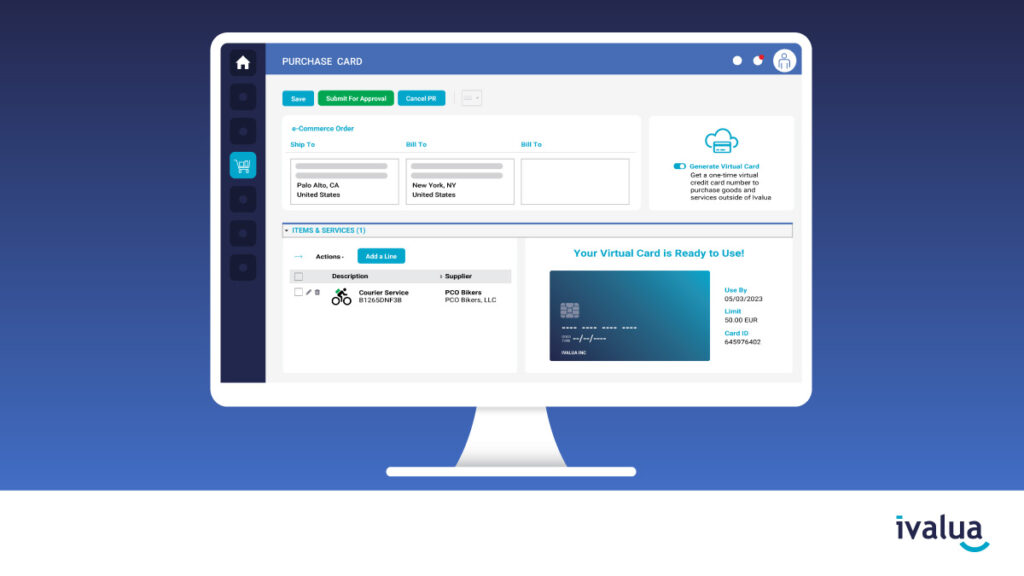
Travel-related expenses, like conference registrations or last-minute transport, can also be handled efficiently without triggering a full requisition workflow.
What happens when employees can’t use a purchasing card? They may resort to using personal credit cards or informal buying, creating reconciliation headaches for finance and policy blind spots for procurement.
By implementing defined controls such as merchant category restrictions, transaction limits, and real-time monitoring, corporate procurement cards give enterprises the agility to handle everyday spend while maintaining compliance.
This fills the operational gap between structured purchasing processes and unregulated ad hoc buys, reducing policy exceptions and freeing procurement and AP from chasing down low-value transactions.
In short, P-Cards aren’t a replacement for POs but an essential bridge that keeps tactical spend visible and accountable.
When P-Cards Outperform Purchase Orders
There are times when routing a purchase through a full PO workflow adds unnecessary delays. For example, a $500 replacement part needed to keep operations running, a one-off payment to a local vendor for an on-site event, or a last-minute SaaS subscription upgrade to meet a project deadline.
In each of these scenarios, the time spent generating, approving, and processing a formal PO can outweigh the value of the purchase itself. Corporate procurement cards allow employees to complete these transactions quickly, while still enforcing spending limits, merchant restrictions, and automated reporting.
Why Expense Reimbursements Don’t Scale
Relying on expense reimbursements forces employees to front personal funds, creates delays in repayment, and leaves finance chasing receipts. It also introduces audit risk and obscures real-time spend visibility, making it harder to enforce policy or manage budgets proactively.
Purchasing Cards vs. Virtual Cards: Where They Intersect
V-cards are single-use or limited-use digital card numbers that provide an extra layer of security for specific transactions. They are often used online or with short-term vendors.
While corporate procurement cards are better for recurring or in-person tactical spend, V-cards complement them by offering more granular financial control over one-off payments, vendor-specific purchases, or high-risk categories.
Now let’s examine how to build a P-card program with just enough flexibility and financial control.
Designing a P-Card Program that won’t Backfire
A corporate procurement card program can be a powerful tool—but only if it’s designed to balance accessibility with accountability. Too little control, and you risk budget overruns, policy violations, and compliance issues. Too much friction, and employees will revert to workarounds like personal cards or off-system purchases, negating the benefits entirely.
Successful P-Card programs start with clear policies, flexible controls, and strong integration with existing procurement and finance systems. This ensures that cards empower employees to make necessary purchases without creating blind spots for Accounts Payable or Procurement.
When designed right, a P-Card program becomes a trusted middle layer for tactical spend, capturing every transaction in a way that’s fast for the user and fully visible to the business.
Define Spend Boundaries Before You Launch
Establish limits by role, department, or geography to reflect actual purchasing needs. For example, a field technician might need higher limits for urgent parts, while an administrative role could have tighter caps. Avoid static, one-size-fits-all rules—they’re too restrictive for some teams and too permissive for others, leading to inefficiencies in risk management and risk exposure.
Control Where the Card Can Be Used
Use Merchant Category Code (MCC) blocks and preferred merchant lists to restrict purchases to approved categories and suppliers. This prevents misuse while reinforcing your sourcing policy. Tailor these controls to the cardholder’s role, so restrictions don’t slow down legitimate, business-critical buys.
Enforce Real-Time Oversight and Auditability
Set strict reconciliation timelines—such as requiring receipts within 48 hours—and make compliance easy with mobile upload options.
Maintain a complete audit trail by logging purchase details, merchant info, and approval workflows in one place. This ensures that every transaction is reviewable and traceable when audit season arrives.
Sync Every Transaction With Your Source System
Integrate payment cards data directly with your ERP or P2P platform for real-time budget tracking and visibility, and accurate reporting. When spend is captured automatically, Procurement and Finance can monitor compliance, flag anomalies, and make informed sourcing decisions.

Pro Tip
Learn more about Ivalua’s payment cards solution.
P-Card Use Cases Across Spend Categories
Corporate procurement cards can play a strategic role across multiple business units when backed by the right controls and oversight.
By providing quick access to approved funds, they empower teams to act on urgent needs, manage low-value, high-frequency spend, and reduce the friction of traditional purchasing processes.
Used wisely, they can be a key tool in a broader tail spend management strategy.
Below we explain several use cases for P-Cards in the enterprise.
IT & SaaS Spend
P-Cards allow IT teams to quickly purchase licenses, renewals, or trial subscriptions without waiting on lengthy PO approvals. This is especially valuable for small, specialized tools that don’t warrant a full sourcing event but are essential to project delivery.
Marketing & Events
Event planning often involves short lead times and one-off vendors. P-Cards enable marketing teams to pay for booth rentals, promotional items, and other time-sensitive expenses while keeping costs visible and compliant.
Facilities, Field Work & Site Ops
From replacement parts to safety equipment, field and site teams often need immediate access to supplies. P-Cards reduce downtime by enabling authorized staff to make necessary purchases on-site and on-demand.
Supplier Onboarding and One-Off Payments
When working with new suppliers who aren’t yet set up in your ERP, P-Cards offer a fast, controlled payment method. This helps maintain operational momentum while ensuring every transaction is tracked and reconciled.
Integration Isn’t Optional: Syncing P-Cards With Core Procurement Systems
P-Cards deliver speed and flexibility, but without integration into your core procurement and finance systems, they can just as easily become a source of shadow spend.
Standalone card tools might make it easy to pay, but they also make it easy for transactions to slip through without proper coding, categorization, or compliance checks. That lack of visibility can lead to budget overruns and policy violations, not to mention headaches for both procurement and AP when it’s time to reconcile.
To avoid these pitfalls, P-card activity must flow directly into your ERP or P2P platform (ideally in real time) so that every charge is tracked against the correct budget, tied to the right supplier, and available for reporting and audit.
Integration can help you maintain a single source of truth for all spend, ensuring you keep the agility of P-Cards without losing the governance and oversight that protect the business.
Below are the key benefits of integrating P-card functionality with your ERP and P2P systems.
Real-Time Coding and GL Mapping
When P-card transactions are coded only after the fact, budgets can quickly drift off track. This is especially true if managers don’t see the spend until weeks later.
With mapped cards, every charge is automatically classified to the correct GL account as it happens, giving finance and procurement instant visibility. This real-time coding eliminates delays, reduces errors, and ensures leaders can make timely, data-driven decisions about spend.
Supplier and Category-Level Alignment
Integration ensures that P-card transactions inherit the same supplier IDs, category codes, and policy rules you already use for purchase orders. That means even small or one-off purchases maintain the same level of policy compliance and reporting accuracy as your larger sourcing events.
Reconciliation That Doesn’t Rely on AP Manual Work
Without integration, month-end reconciliation can turn into a scavenger hunt, as you chase down receipts, match them to statements, and manually enter the data.
By syncing P-card transactions directly into your invoice-to-pay process, you reduce manual workload and improve accuracy, while freeing up AP teams to focus on exceptions.
Audit Trail and Policy Enforcement at Scale
Effective fraud prevention requires continuous transaction oversight backed by detailed audit logs. Integrated P-card systems capture every charge, adjustment, and approval in real time, creating a complete, searchable record for compliance teams.
Additionally, built-in policy enforcement rules flag exceptions automatically, whether it’s a spend outside an approved category or a purchase above a role-based limit.
This proactive monitoring reduces the risk of misuse while ensuring consistent policy enforcement across the entire procurement, no matter how many cards are in circulation.
While both corporate procurement cards and virtual cards serve the same core purpose to enable controlled, trackable business spend, their formats and ideal use cases differ. In the next section, we explain how.
Physical vs. Virtual Cards: Choosing the Right Tool for the Transaction
Physical cards are tangible and swipeable, making them useful in in-person transactions, while virtual cards are generated digitally, often for single-use or category-specific purposes.
The right approach isn’t about choosing one over the other, but about aligning each to the transaction type, spend category, and security needs.
When Physical Cards Still Matter
For field teams, job sites, and facilities purchases, a swipeable card can be the fastest and most practical payment method. These scenarios often involve point-of-sale transactions with local vendors, where digital payment options may be limited.
Physical cards also offer flexibility when traveling or working in areas without reliable online access, ensuring employees can make the purchases they need without delays.
The Rise (and Limits) of Virtual Cards
Virtual cards are ideal for SaaS subscriptions, remote teams, and single-use transactions. They have built-in fraud controls through pre-set limits, merchant restrictions, and expiration dates, and they reduce the risk of card number theft since each card is unique to a transaction or vendor.
However, the utility of V-cards is limited for on-the-ground purchasing, and they still require careful approval logic to prevent misuse.
One Program, Two Tracks
The most effective organizations run physical and virtual cards under a single program, with unified policy enforcement, approval workflows, and reconciliation processes. This ensures that no matter the card format, spend is tracked consistently, budgets are visible in real time, and policy compliance is maintained across all transactions.
By strategically using both physical and virtual cards within a unified program, organizations can improve control and flexibility, while opening the door to valuable rebate opportunities tied to P-card spend.
Rebates Aren’t the Only Financial Lever
While rebate earnings are a well-known perk of corporate procurement cards, they’re only part of the value story. A well-designed P-card program can also support broader working capital goals by delaying cash outflows, consolidating payments, and reducing invoice processing fees.
By routing tactical purchases through cards instead of generating individual POs and invoices – and with invoice automation – organizations can cut transaction and invoice processing costs and free accounts payable from low-value workload.
These benefits extend beyond cost savings to deliver tangible liquidity advantages, especially when payments are strategically timed within the billing cycle. The result is a procurement function that not only enables operational agility but also strengthens financial health.
Read our blog to learn more about the financial benefits of payment cards.
How Rebates Actually Work
Rebate programs reward organizations with cash-back based on total spend volume, with higher tiers unlocking better rates. However, not all programs are equal—differences in eligible spend categories, payout schedules, and rate structures can significantly impact the net value.
Working Capital Impact Across Payment Cycles
P-Cards allow payment deferral until the statement due date, giving organizations extra days or weeks of liquidity. This delay, combined with consolidated monthly settlements, reduces invoice backlog, optimizes cash flow, and improves budget predictability without sacrificing control.
Now that you have a solid understanding of P-Cards and their potential uses, let’s dive into some pitfalls you’ll want to avoid.
Common P-Card Pitfalls That Kill Program Adoption
Even the best-intentioned corporate procurement card programs can stall, or fail entirely, if they create more friction than value. Without the right balance of control and usability, cardholders work around the system, AP pushes back on reconciliation, and procurement loses the visibility it needs to enforce policy.
When this happens, non-compliant spend, frustrated teams, and a program that quietly withers instead of scaling.
If your P-card program is to succeed, be careful to avoid these common pitfalls:
- No governance = misuse: Without clear ownership and oversight, card abuse and policy violations become inevitable.
- Inconsistent policy enforcement across regions = compliance gaps: Uneven rules undermine global programs and create loopholes.
- Manual processes = AP resistance: Paper receipts and spreadsheet tracking erode efficiency and goodwill.
- Siloed data = no visibility: Disconnected systems hide spend patterns and block proactive control.
- Overly rigid rules = poor adoption: Too many restrictions push employees back to personal cards or rogue spend.
Left unchecked, these pitfalls slow adoption and can turn a promising P-card program into another abandoned initiative.
So, what’s the difference between failure and long-term value? Let’s look at how leaders operationalize P-Cards by embedding them into everyday purchasing – without sacrificing oversight.
Real-World Enterprise Playbook: How Leaders Operationalize P-Cards
Bell, one of Canada’s largest telecommunications providers, transformed its expense management processes by fully operationalizing corporate procurement cards within Ivalua’s Expense module.
The challenge was significant: manage high-volume out-of-pocket and P-card (Visa/Mastercard) expenses across 55,000 employees and 250+ sites, all while maintaining security, compliance, and user adoption.
Partnering with OJC Consulting, Bell deployed a company purchasing card solution that integrated seamlessly with ERP systems, streamlined approvals, ensured tax compliance, and simplified P-card workflows.
Configurable business rules, secure interfaces, and role-based controls allowed expenses to be validated, allocated, and reimbursed in real time, either to employees for personal spend or directly to financial institutions for P-Cards.
The rollout was executed in three smooth waves with zero critical issues, achieving 100% of expense reports submitted through Ivalua and full user satisfaction.
Receipts are captured instantly via 1,750 onsite scanners, while integrated reconciliation eliminates manual AP work. This approach embedded corporate P-Cards into daily operations, enabling faster transactions, stronger oversight, and scalable governance.
“The interface is so simple that we haven’t had any questions from our users”
— Jean Ratelle, Associate Director of e-Sourcing, Bell
How to Scale Without Losing Control
A mature virtual purchasing card program runs on clearly defined policy logic, role-based rules, and tight system integration. These characteristics help to ensure that every transaction is compliant and visible.
Instead of patching together card tools and spreadsheets, leading organizations are creating a unified, end-to-end framework for issuing, using, and reconciling cards, so that as spend volume grows, oversight and efficiency scale accordingly.
Ivalua’s Procurement Platform reinvents the way companies manage their spend and reward programs by integrating corporate purchasing cards into its purchasing platform.
Our customers have access to both traditional P-Cards as well as more dynamic V-cards in any stage of the equation – from sourcing goods, to paying for a subscription, or one-time costs. This new approach gives clients total control over expenditures, creating greater value with less hassle.
Role-Based Access and Approval Logic
Best-in-class business purchasing card programs configure approvals and spending limits based on user role, department, or geography. This ensures low-risk purchases are fast-tracked, while higher-risk transactions get additional review automatically.
Embedded Prompts and Policy Checks
With policy reminders, alerts, and required documentation fields built into the transaction flow, employees are guided toward compliant spending and prevented from making purchases outside of approved parameters.
Audit-Ready Reporting by Design
Structured data capture and automatic audit logs mean finance teams can review activity continuously, without pulling AP away from core priorities. This allows for better compliance, higher accuracy, and audit-readiness.
Drive Smarter Spend Through an Integrated Program
When thoughtfully designed and implemented, a P-card program strengthens governance, streamlines operations, and boosts working capital.
But true scale doesn’t happen by accident. It requires the right policy structure, role-based controls, real-time oversight, and seamless integration with procurement and finance systems.
Ivalua’s Payment Card Solution delivers exactly that: a unified platform where traditional corporate P-Cards and dynamic V-cards coexist under one policy framework – automated purchase order workflows and enabling audit-ready tracking.
Learn how integrating payment cards within your source-to-pay processes can make your spend smarter, faster, and more transparent.
FAQs
Most enterprise-grade P-card programs include direct integration for real-time transaction coding, GL mapping, and automated reconciliation. Without this, finance teams are stuck manually matching card data to budgets and suppliers.
You can configure spend limits, merchant category code (MCC) restrictions, single-use or role-based card access, and mandatory pre-approval workflows. The most robust business purchasing card programs also include post-transaction audit reviews and anomaly detection.
Procurement cards are governed by procurement and AP – not just finance – and tied into sourcing, budget, and supplier systems. They’re designed for tactical purchasing with embedded controls, not just travel and entertainment.
Compliance comes from embedded workflows, not just training. Systems like Ivalua’s allow rules by role, category, and location, flagging out-of-policy transactions before they’re approved or settled.
Not always. Virtual cards are ideal for digital and remote spend, but physical cards are still needed for in-person purchasing at job sites, events, or field offices, especially when vendors can’t process virtual payments.