

The Procure-to-Pay process encompasses an end-to-end workflow that begins with a purchase request and ends with supplier payment. That’s the definition, but to understand how the process performs in the real world, it’s helpful to know how each stage in the process operates it: who owns it, where bottlenecks occur, and how to measure success.
The truth is, Procure-to-Pay isn’t a linear sequence; it’s a cross-functional system in which procurement, AP, receiving, and finance teams must share data and handoffs without gaps. Your ability to optimize those handoffs will enable you to perform at a higher level than other organizations.
This guide examines each step of the process, the teams responsible for it, the metrics that matter, and how Agentic AI is changing the way work gets done.
Key Takeaways
- The Procure-to-Pay process spans the entire purchasing lifecycle, with each stage impacting costs, compliance, supplier relationships, cash flow, and spend visibility.
- Top-performing organizations optimize every handoff with standardized workflows and shared data.
- Agentic AI enables Governed Autonomy, where AI agents proactively route requests and recommend or execute actions against business-defined policies, with human oversight.
What Is the Procure-to-Pay Process and How Does It Differ from Source-to-Pay?
The Procure-to-Pay (P2P) process is transactional. It begins when an employee identifies a business need and submits a purchase requisition. Ultimately, the P2P cycle governs how organizations execute approved purchases and spend money.
The Purchase-to-Pay lifecycle encompasses supply management, purchase requisitions, POs, receiving, invoice reconciliation, and accounts payable. These activities work in concert to ensure purchases are made according to approved policies, invoices match what they order and receive, and suppliers are paid on time.
Procure-to-Pay vs. Source-to-Pay is mostly about scope: P2P focuses on executing purchases efficiently, while Source-to-pay (S2P) includes activities that happen earlier, such as strategic sourcing, supplier discovery and qualification, supplier selection, contract negotiation, and supplier onboarding.
P2P is critical to an organization’s success, and technology can help significantly. Yet Ardent Partners found that only 42% of organizations have implemented a complete Procure-to-Pay software platform. Organizations who lack the right technology may be relying on disconnected systems and manual processes that increase costs and risk.
A unified P2P platform connects the P2P lifecycle on a single data model to improve visibility, reduce exceptions, and strengthen spend control.
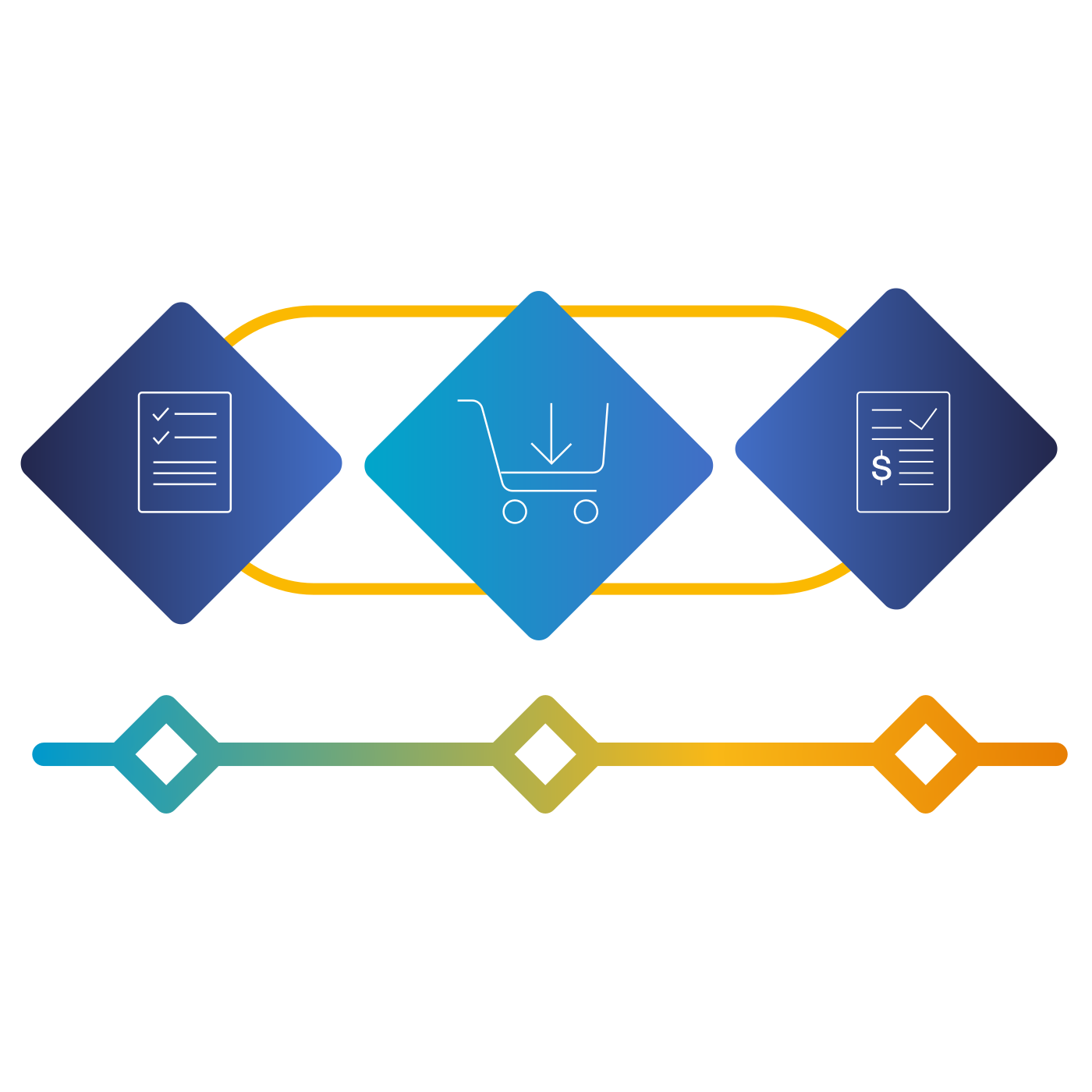
The Seven Steps of the Procure-to-Pay Workflow
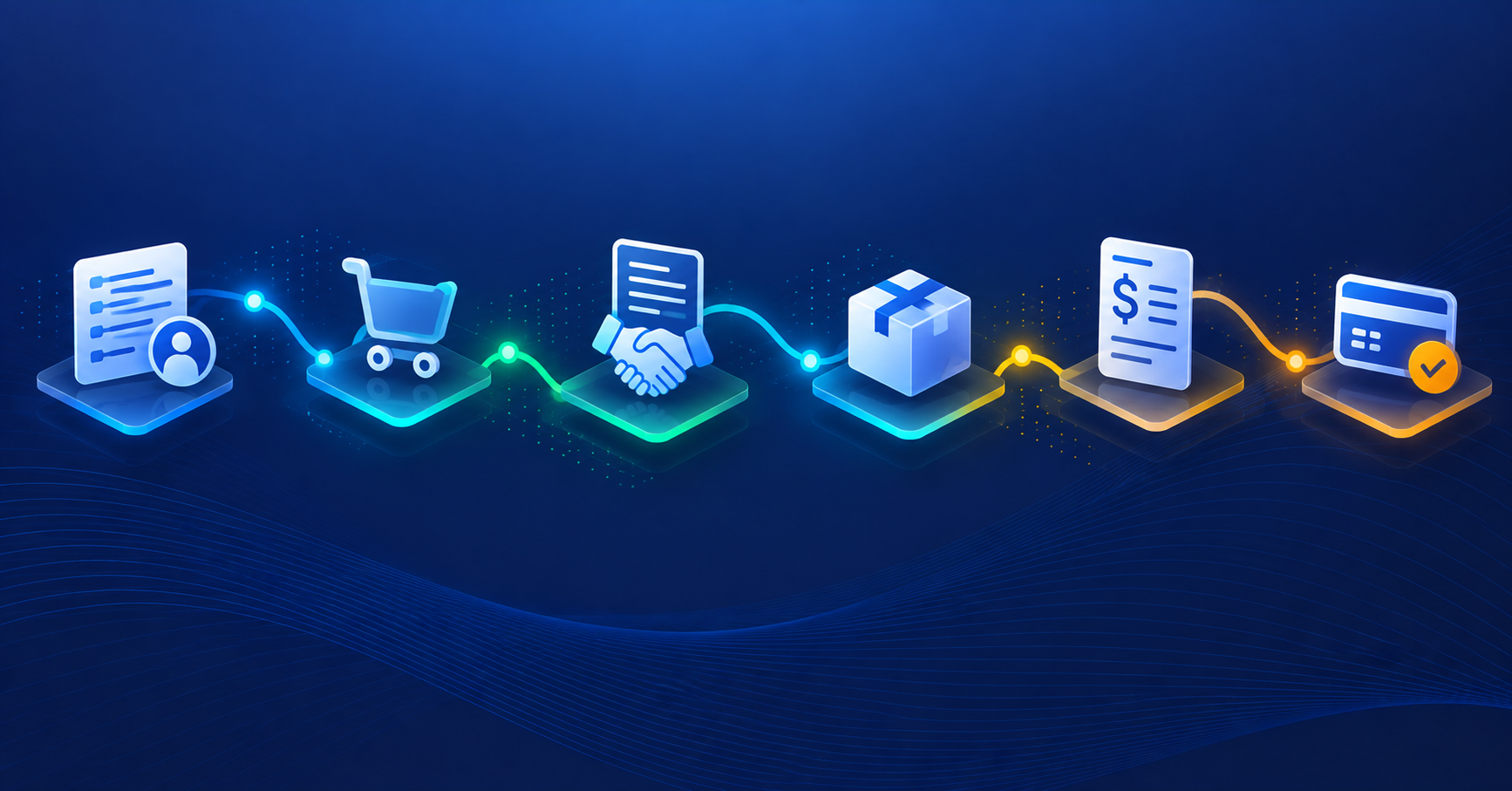
The Procure-to-Pay workflow consists of seven connected steps that move a purchase from an initial request to final supplier payment. Each stage of the P2P workflow involves different owners, but they all depend on accurate data entering the workflow throughout the process. That means every handoff is critical.
Below we walk through the seven steps on the workflow in detail, and how a unified P2P platform like Ivalua simplifies handoffs and improves efficiency throughout the P2P process.
Step 1 — Intake and Purchase Requisition
Primary owner: Business stakeholder with procurement oversight
An employee identifies a business need for goods or services and submits a request, which outlines all of the required information for structured intake management, such as budget and spend category information. The request is routed automatically to the appropriate procurement workflow based on company policies and approval rules.
Sometimes, employees submit requests via email or other informal channels, which may bypass procurement and result in maverick spend or poor spend visibility. Agentic AI helps eliminate this risk by turning the intake process into a conversation.
Using Ivalua’s Intelligent Virtual Agent (IVA), powered by IVA StudioTM, employees simply describe what they need in natural language and the system identifies the right item, checks contract compliance, and applies the correct coding. It even recommends approved alternatives when needed and flags potential budget issues.
Finally, IVA routes the request for approval. It executes all of these actions while steering purchases toward preferred suppliers and contracted items.
Step 2 — Supplier Selection and Approval Routing
Primary owner: Procurement
Once a purchase request is approved, procurement needs to select a supplier from an approved list. It may also initiate a new supplier request, which triggers qualification and onboarding.
The request then moves through an approval workflow based on various factors, including spend threshold, category, organizational structure, and purchasing authority. The biggest handoff risk at this stage is inconsistent approval routing across business units, regions, or departments. Different approval paths and disconnected processes can delay the process or create compliance issues.
Agentic AI streamlines supplier selection by verifying supplier risk, contract status, and performance before the PO is issued. For new suppliers, IVA validates documentation and manages qualification workflows. It can also detect duplicate records or enrich existing records with new data.
IVA StudioTM enables you to configure approval workflows by spend, category, organization, and supplier, and it leverages Governed Autonomy to enforce user permissions while maintaining a complete audit trail.
Step 3 — Purchase Order Creation and Dispatch
Primary owner: Procurement
Once approved, a purchase request is converted into a purchase order (PO), whether standard, blanket, scheduled, or call-off, and sent to the supplier, sometimes consolidating multiple requests onto a single order.
The primary handoff risk at this stage is issuing a PO that fails to reference the correct contract, which leads to off-contract pricing and unauthorized spend.
As part of Ivalua’s eProcurement software, Agentic AI enables purchase order automation, including creation, updates, and tracking while validating pricing against contract terms issuing the PO. Ivalua’s IVA can consolidate multiple requisitions into optimized purchase orders, manage supplier acknowledgments and change orders, and allow suppliers to propose approved delivery or quantity changes through a collaborative workflow – all with a complete audit trail.
Step 4 — Goods Receipt and Service Confirmation
Primary owner: Receiving or business requester
The next step is to confirm that the goods and services delivered match what’s on the PO. For physical purchases, the system records a goods receipt. For services, someone needs to confirm that the work was completed.
Handoff breaks down when receiving records have been created in a different system, leaving invoice matching without the data it needs. This can result in payment delays and invoice exceptions.
Agentic AI supports different receiving workflows based on the purchase type. For example, auto-receiving can be applied to low-risk purchases, partial receipts to staggered deliveries, and approval-based receipts when it’s a strategic purchase. Suppliers can submit Advanced Shipping Notices (ASNs), while receiving teams can record receipts from mobile devices by scanning a barcode or QR code.
Since everything resides on a single platform, all of the data flows directly into 3-way matching, without any downstream data gaps.
Step 5 — Invoice Capture and Three-Way Matching
Primary owner: Accounts Payable
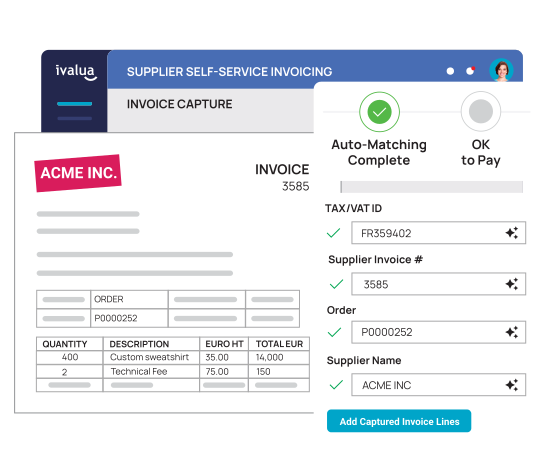
Once the supplier submits an invoice, the AP automation solution captures the data using OCR, EDI, XML, or a supplier portal. It then performs a 3-way match, checking the invoice against the purchase order and goods receipt. This step in invoice processing is how organizations validate all of the terms of the contract before approving the invoice and paying the supplier.
However, Ardent Partners reports that the average organization takes 9.2 days and $9.40 to process an invoice. By contrast, best-in-class organizations using e-procurement software and Agentic AI can complete the process in 3.1 days at $2.78 per invoice.
Agentic AI automates much of invoice processing, including invoice capture, matching, coding, tax validation, and invoice reconciliation at both the header and line level. Ivalua’s IVA converts PDF invoices into e-invoices and validates them against the PO and goods receipt, and contract where needed. This helps ensure e-invoicing compliance and reduce exceptions because suppliers can pre-match invoices before submitting them. It also results in faster invoice approvals and higher straight-through processing rates.
Step 6 — Exception Resolution and Payment Approval
Primary owner: Accounts Payable, with procurement and business stakeholder support
When an invoice fails the 3-way matching process, an exception workflow is triggered. Depending on the issue, these exceptions are routed to AP, procurement, or the business unit that initiated the request.
According to Ardent Partners, 53% of organizations say invoice exceptions are their top AP challenge. Effective governance defines clear ownership and escalation paths to help resolve exceptions quickly.
Agentic AI accelerates exception handling by providing the context needed to resolve issues, all in one place. Ivalua’s IVA identifies the root cause and surfaces the relevant data such as contract terms, purchase order, and pricing history. Next, it routes the exception to the appropriate owner while allowing other invoices to continue processing.
IVA also checks for duplicate invoices or suspicious payment details, reducing the risk of fraud. Configurable no-code workflows enforce consistent governance and escalation policies.
Step 7 — Payment Execution and Reconciliation
Primary owner: Accounts Payable and Treasury
Once an invoice is approved, it enters the payment processing queue. Organizations may pay suppliers through ACH, virtual cards, payment networks, or other electronic methods. Ardent Partners reports that 68.3% of enterprise B2B payments are now made electronically.
Payment timing is a strategic lever that enables organizations to maximize cash flow and capture early payment discounts through dynamic discounting or supply chain financing, all while preserving strong supplier relationships.
In modern Procure-to-Pay solutions, Agentic AI helps optimize these execution schedules and automates payment reconciliation across suppliers and accounting systems. By linking every payment directly to its corresponding invoice and broader P2P transaction history, IVA delivers end-to-end audit visibility and significantly reduces fraud risk.
Suppliers can track payment status through a self-service supplier portal, reducing inquiries and improving transparency across the Procure-to-Pay automation process.
Why Integration Complexity Is the Biggest Barrier to P2P Performance
Most Procure-to-Pay initiatives that fail are unsuccessful because companies have disconnected systems. For example, one application is managing requisitions while another handles POs, and yet another processes the invoices. Every handoff between those systems is a potential point of failure, leading to missing data, duplicate records, approval delays, or invoice exceptions.
With limited visibility across the P2P lifecycle, procurement can’t easily trace a purchase from requisition through payment. Finance won’t have a complete view of what money goes in and out, which makes spend analysis extremely challenging. Beyond a lack of transparency, data scattered across multiple systems is often out of sync, prone to duplication, and vulnerable to manual input errors. Indeed, 87% of organizations say poor data quality hinders the value of their digital initiatives.
Procurement automation is most effective when every stage operates on a shared data model. Ivalua’s IVA works across the entire P2P lifecycle as a single agent, not separate AI tools or a swarm of multiple different agents, so context is carried from requisition through payment and spend analysis.
By pairing ready-to-go ERP connectors with full API, ETL, and EAI orchestration, using industry-standard protocols to streamline connections, Ivalua makes integration seamless and helps lower security risks, and adapt to diverse tech ecosystems.
How Agentic AI Transforms Each Procure-to-Pay Step
AI in procurement is advancing, but most organizations are still trying to decide where to leverage AI as an autonomous agent, and where to keep humans in the loop.
According to PwC, 83% of operations leaders believe AI agents will help break down functional silos, but only 37% are comfortable allowing them to execute processes on their own.
Governed Autonomy supports the model where AI handles repetitive, rules-based work, and humans oversee exceptions and high-impact decisions. This approach enables AI to deliver maximum value, without compromising control:
- Requisition: Triages requests, classifies spend, routes approvals, recommends preferred suppliers, and flags budget or policy issues before purchasing begins
- Purchase Order: Validates contract pricing, applies negotiated terms, prevents off-contract purchases before the PO is issued
- Receiving: Matches goods receipts or service confirmations to purchase orders, tracks partial deliveries, prepares transactions for invoice processing
- Invoice processing: Performs commodity- and line-level matching across invoices, purchase orders, receipts, contracts while automatically coding and validating invoice data
- Exception management: Resolves routine discrepancies using business rules and historical context; escalates edge cases or policy exceptions for human judgment
The Hackett Group found that organizations using AI-driven Procure-to-Pay automation can improve requisition and PO processing efficiency by 57% and data management automation by 52%.
When it’s governed by business rules and human oversight, modern AI procurement software can help organizations accelerate the P2P process while reducing errors and improving compliance.
How the Commonwealth of Virginia Transformed $10.8 Billion in Annual Spend with Ivalua
The Commonwealth of Virginia Department of General Services manages procurement for approximately 100,000 employees and $10.8 billion in annual spend. Its legacy procurement environment had evolved into a collection of disconnected tools, making the purchasing process complex and inefficient.
After implementing Ivalua’s unified Source-to-Pay platform, the state benefitted from improved efficiency, transparency, and control across the entire Procure-to-Pay lifecycle. In fact, the Commonwealth achieved more than $5 million in annualized savings across procurement while reducing the average solicitation cycle from 121 days to 69 days.
“Ivalua is a backbone for us.”
— Shane Caudill, Director of eVA, Virginia’s eProcurement Program at the Department of General Services, Commonwealth of Virginia
What Analysts Found When They Evaluated Ivalua’s P2P Platform
In their evaluation of Ivalua’s Procure-to-Pay automation capabilities, independent analysts at Spend Matters cited the platform’s single codebase and centralized data model as key enablers of guided procurement, automation, and AI.
The report also highlighted Ivalua’s Purchasing Optimization Center for consolidating requisitions into optimized POs, advanced invoice matching across POs, receipts, and contracts, and a flexible, LLM-agnostic AI architecture that enables organizations to build custom AI use cases, without being locked into a single model.
Ivalua’s closed-loop architecture helps organizations automate procurement while continuing to post financial transactions to their ERP, as well. Of all 19 customers surveyed in Spend Matters’ SolutionMap, Ivalua ranked at or above the benchmark across every category.
It’s important to choose a solution that can provide these key benefits. In the next section, we explain how you can ensure you make the right choice.
Five Questions to Ask in a Procure-to-Pay Platform Demo
Not all Procure-to-Pay solutions deliver the same level of automation or control. Asking these questions will help you determine which platform really delivers a connected P2P workflow:
- Can you run matches on a non-PO invoice at the line-item level? Look for line-level matching across contracts, receipts, and invoices. The platform should support configurable tolerance rules by supplier, category, or business unit, automatically approve in-tolerance lines, route only exceptions, and handle services, blanket orders, and contract-backed purchases without requiring a PO on every invoice.
- How does an invoice exception route from AP to the right business owner? Look for configurable routing by exception type; a single view of the PO, contract, receipt, and invoice; and reporting that measures resolution time by exception category.
- Can you trace a single requisition from intake through payment in one system? This reveals whether the platform operates on a unified data model or depends on integrations. The same contract, category, and transaction data should flow from requisition through payment and into analytics, without having to sync data nightly.
- What happens when the AI can’t resolve a task on its own? Agentic AI in procurement should operate within clear governance. The ability to escalate exceptions to appropriate approvers with full transaction context and audit trails, and configurable business rules are key features to look for.
- What percentage of invoices achieve straight-through processing, and how is it measured? The industry benchmark is 32.6%. Ask if the vendor defines straight-through processing as zero human intervention across the entire invoice lifecycle. Also check if the solution measures all invoice types and tracks improvement over time.
Build a Procure-to-Pay Workflow That Runs on Data, Governance, and AI
As agentic AI reshapes procurement, success won’t come from adding another tool, but from providing AI with the data, context, and governance necessary to do its job, while humans supervise.
Leading organizations are taking a platform approach instead of relying on disconnected point solutions for every stage in the process. With its unified Source-to-Pay platform, Ivalua increases visibility and control while helping organizations leverage AI to make the entire Procure-to-Pay process more efficient.
Transform Your Procure-to-Pay Process with Ivalua
Frequently Asked Questions About the Procure-to-Pay Process
The Procure-to-Pay process steps are:
- Intake and purchase requisition
- Supplier selection and approvals
- Purchase order creation
- Goods receipt or service confirmation
- Invoice processing and 3-way matching
- Exception resolution
- Supplier payment
The terms purchase to pay and Procure-to-Pay are often used interchangeably. Some organizations use “purchase-to-pay” for the transactional purchasing and payment activities, while “Procure-to-Pay process” can encompass broader procurement governance and controls.
During 3-way matching, the supplier invoice is compared to the purchase order and the goods receipt/service confirmation to make sure everything is aligned before issuing payment. It helps prevent overpayments or duplicate payments, and identifies invoices for goods or services that were never received.
Agentic AI proactively routes requests, validates contract pricing, matches invoices, and resolves routine exceptions on its own, while escalating complex issues for human review. It enables procurement and finance teams to process transactions faster, while maintaining governance and compliance.
It’s important to track:
- Requisition-to-PO cycle time
- Invoice processing time
- Straight-through processing rate
- Invoice exception rate
- Early payment discount capture
- Maverick spend
- Supplier on-time payment performance
These metrics provide insight into the levels of efficiency and compliance, as well as financial performance.
Procure-to-Pay refers to the operational purchasing process through payment. Source-to-pay covers this portion of the procurement lifecycle, plus strategic sourcing activities such as supplier selection, negotiations, contracting, and supplier onboarding.