

Procurement teams know the pain all too well: requests coming in from everywhere, disconnected systems, stalled handoffs between sourcing, legal, finance, and vendor risk management. Compliance slips through the cracks, ownership is fuzzy, and data is scattered. Procurement orchestration acts as a coordination layer that unifies fragmented workflows across your enterprise.
Orchestration serves as an intelligent layer connecting ERP, P2P, CLM, ITSM, and ticketing systems, to standardize intake, request routing, and decision-making.
Instead of forcing users into a single portal, procurement orchestration supports multiple intake channels including email, forms, chat, portals, and more, and translates them into a common data model. It applies policy-driven routing, SLAs, and approvals from end to end, helping to eliminate the chaos and increase control, while providing a foundation for faster, smarter procurement.
In this blog, we explain how orchestration aligns stakeholders and enforces policy without slowing the business. You’ll learn how to leverage this governance layer to maintain audit-ready transparency and reduce risk, while improving the user experience.
Key Takeaways
- Orchestration unifies fragmented procurement processes by coordinating intake, routing, approvals, and systems like ERP, CLM, and ITSM through one intelligent layer.
- Orchestration enables faster, more compliant decision-making by applying policy-based workflows and approvals, automating handoffs, and eliminating manual exceptions and oversight gaps.
- Procurement teams can leverage procurement orchestration to reduce cycle times, increase spend under management, and gain real-time visibility, without replacing existing tools.
Why Procurement Fragmentation Still Dominates Enterprise Environments
Despite widespread eProcurement adoption, many organizations still operate with disconnected systems, siloed teams, and inconsistent processes.
Point solutions proliferate around ERPs, but intake, approvals, and purchasing workflows often live in separate tools or worse, managed primarily through email. This leads to blind spots, rogue spend, inconsistent data, and cycle-time delays.
n Without a single source of truth or unified procurement workflows, requests bouncing between IT, legal, finance, and procurementcreate gaps in visibility and control over total spend.
Policy enforcement becomes manual and error-prone, resulting in stalled approvals, missed savings, and fragmented supplier engagement. This scenario undermines category strategies and compliance.
Global supply chain disruptions and organizational decentralization make things worse, pushing buying decisions to the edge where local teams optimize for speed and ad-hoc savings, not governance. Without unified workflows and shared data models, procurement can’t monitor risk or benchmark performance effectively.
Closing these gaps requires true procurement transformation and digitalization. What does that mean? Implementing a procurement platform that consolidates intake, provides policy-aware workflows and embedded approvals, and performs analytics that span the whole process from requests to payment. Only then can you reduce maverick spend and cycle times, and restore enterprise-wide oversight.
Intake Channels Multiply, But Visibility Doesn’t
Unstructured intake such as email, Slack messaging, disconnected portals, and manual forms mean requests bypass established control points. They may also lack essential information, and evade tracking or compliance workflows that serve to mitigate risk.
A centralized intake management system addresses these challenges by funneling all submissions into a single, standardized hub. Purchase requests are captured uniformly, triaged, and routed through defined workflows.
When intake management software provides workflows and structure, you benefit from better spend visibility and the ability to enforce policy compliance.
Approval Routing Is Inconsistent Across Categories and Regions
Approval workflows often vary dramatically based on spend type, department, region, or business unit. One team may route marketing purchases through a VP, while another sends similar requests to finance, creating a patchwork of rules that can be difficult to govern effectively.
Inconsistencies also create audit gaps, as approvals may not follow documented procedures or leave a clear trail. This results in increased risk of policy violations, delayed approvals, and missed opportunities for process improvement.
Existing Systems Can’t Adapt to How Teams Actually Work
Legacy ERPs and rigid P2P systems are built for structured, linear processes, which is not the way dynamic, cross-functional teams operate. These systems are often inflexible when it comes to handling exceptions, accommodating diverse workflows, or integrating seamlessly with newer tools.
Because of this inflexibility, teams may come up with workarounds outside the system, which can undermine compliance and visibility.
A flexible orchestration layer that complements existing infrastructure is necessary to streamline processes without forcing a complete overhaul.
What Is Procurement Orchestration?
Procurement orchestration is the coordinated management of people, systems, and policies across the entire intake-to-pay process. It’s not just another automation tool or dashboard—it’s the operational logic layer that ensures every request, approval, and transaction flows seamlessly through the right channels.
By aligning procurement workflows with business rules, stakeholder roles, and system capabilities, orchestration transforms fragmented activity into a unified, controlled process.
Orchestration through intake management brings visibility, control, integration, and automation to the forefront. It connects intake forms, ERP systems, approval matrices, and supplier management portals into a single, cohesive workflow. This allows procurement teams to standardize enforcement, reduce errors, accelerate cycle times, and eliminate workarounds.
Unlike siloed tools or static reports, procurement orchestration dynamically adapts to business needs, routing requests based on spend category, region, or risk profile, and ensuring compliance at every step.
It’s how leading enterprises bridge the gap between rigid legacy systems and the agile, cross-functional way teams actually work.
Understand The Role of Intake in Procurement Orchestration
How Orchestration Differs From Traditional Procurement
Procurement automation focuses on executing individual tasks such as issuing purchase orders, routing approvals, processing invoices, or matching payments. By contrast, a procurement orchestration platform orchestrates the entire procurement process end-to-end, starting from intake management through to payment.
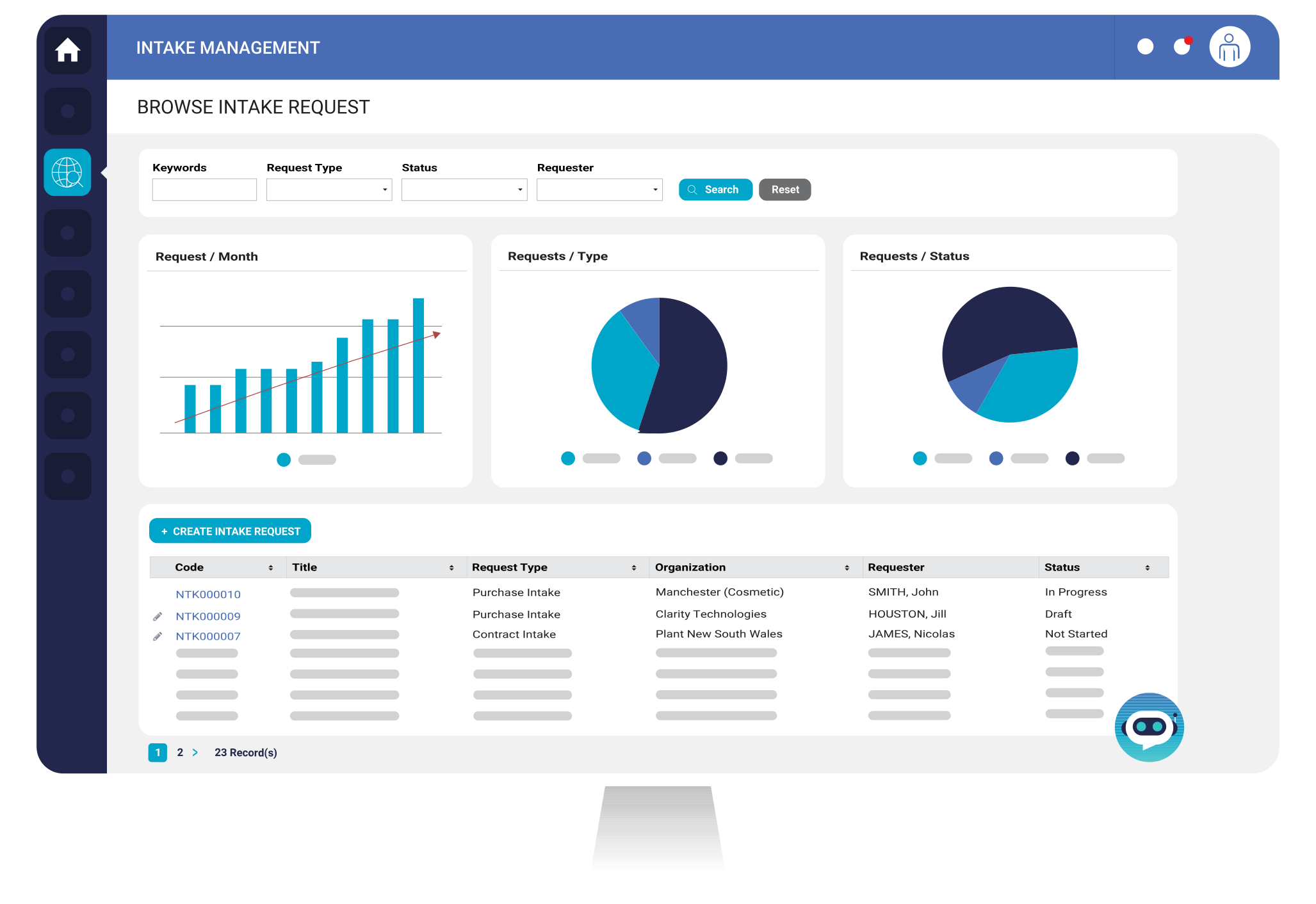
Intake management acts as the critical entry point, capturing, categorizing, and prioritizing procurement requests accurately to ensure data quality and accelerates downstream workflows. The orchestration platform provides an intelligent logic layer that ensures each action occurs in the correct sequence,, by the appropriate stakeholder, under the relevant policy and compliance context.
Rather than simply automating isolated steps, orchestration coordinates systems, people, and rules across categories, regions, and risk profiles. It integrates seamlessly with enterprise systems to provide real-time visibility and control, enforcing compliance and mitigating risks dynamically, from intake to payment.
Unlike a dashboard or isolated automation module, orchestration enables dynamic, policy-driven, scalable and automated workflows to adapt in real time.
The table below outlines the distinctions between orchestration and traditional procurement:
| Feature | Traditional Procurement | Procurement Orchestration |
| Process flow | Linear | Dynamic and integrated |
| Stakeholder engagement | Fragmented | Centralized and transparent |
| Data handling | Siloed | Unified |
| Automation level | Low to moderate | High |
Planned vs. Unplanned Procurement Needs a Single Model
Procurement leaders often face a split reality: structured, forecasted spend on one side, and unpredictable, ad-hoc requests on the other. Orchestration brings both into a single, flexible operating model, ensuring consistent control, no matter how the request starts.
Orchestration:
- Handles renewals and budgeted projects with robust pre-configured workflows that ensure compliance, budget alignment, and timely execution.
- Supports one-off purchases by guiding unstructured intake through dynamic routing, while maintaining strong governance controls.
- Streamlines vendor onboarding for both strategic suppliers and urgent, short-term needs, seamlessly integrating risk checks and approval paths.
- Adapts to policy thresholds based on spend amount, category, or location—automatically adjusting review steps and escalation paths as needed.
- Provides a unified and intuitive experience for requesters and approvers, whether the need is anticipated or spontaneous.
By orchestrating both planned and unplanned activity through the same logic layer, procurement teams gain visibility, enforce policy, and eliminate the chaos of parallel, disconnected processes.
The Role of AI in Dynamic Orchestration
AI plays a pivotal role in elevating procurement orchestration by making automated workflows truly adaptive.
Rather than following rigid, predefined paths, AI – especially agentic AI – monitors real-time bottlenecks, behavioral patterns, and contextual data, then dynamically reconfigures task flows.
This enables procurement systems to reroute requests, escalate issues, or redistribute workload automatically, maintaining momentum without requiring manual intervention.
For example, Ivalua’s autonomous agents are powered by generative AI and integrated into a no-code platform that automates 40–70% of procurement tasks. This includes tasks like RFI/RFP generation, intake workflows, and contract lifecycle management.
Ivalua’s agents also adjust actions based on evolving data and business requirements. In other words, they learn, adapt, and optimize to make proactive, data-driven decisions in real time.
By embedding AI at the orchestration layer, organizations gain a self‑tuning system that ensures agility, control, and continuous execution excellence.
What Procurement Orchestration Looks Like In Practice
Here’s how orchestration actually works inside a large enterprise.
Step-by-Step Framework
- Map existing procurement workflows: Document intake-to-pay processes across departments, categories, and regions to uncover inefficiencies, redundancies, and non-compliant workarounds.
- Identify integration points across systems: Determine where data and processes intersect (ERPs, P2P platforms, supplier management portals, risk management tools, and spend analytics dashboards), and how they should connect in real time.
- Define orchestration rules and triggers: Establish logic to guide automated workflows: who approves what, under which conditions, at what thresholds. Configure dynamic routing based on spend type, region, risk, or urgency.
- Automate approvals and exception management: Streamline routine decisions while flagging anomalies or policy violations for manual review. Reduce delays and increase compliance without sacrificing flexibility.
- Monitor performance through dashboards: Use real-time, role-based dashboards to track process health, cycle times, compliance rates, and savings impact, enabling continuous improvement and executive visibility.
Each step builds toward a flexible, connected, and governed procurement function that aligns day-to-day activity with enterprise goals. The next sections dive deeper into how to execute each one.
Centralized Intake Captures Every Request Up Front
A unified intake “front door” ensures every request enters through the same channel and in the same data format, thereby eliminating the risk of ad hoc emails or forms slipping through the cracks. Each request is automatically filtered and routed by type, user role, or budget owner, so the right workflow is triggered from the start.
This upfront control during the intake process connects directly into downstream processes – sourcing, purchasing, invoicing, and payment – creating end-to-end procurement visibility and compliance. The result is smoother execution, stronger accountability, and a single source of truth for all procurement activity.
Configurable Workflows Route Approvals With Control
Policies become smart workflows that read and adapt to context such as spend thresholds, category, region, or urgency automatically.
Workflow automation for approval routing and exception handling ensures routine requests move fast, while flagged items are escalated with the right evidence to the right person. Rules enforce budgets, segregation of duties, and risk checks without piling admin tasks on buyers or approvers.
The result is consistent compliance and faster cycle times, with enforcement embedded in the flow rather than bolted on after the fact.
Cross-System Sync Creates a Single Flow of Truth
Orchestration connects ERP, CLM, ITSM, and finance so requests, approvals, and transactions move as one governed process, without duplicate entries or swivel-chair work.
Unlike generic integration platforms, orchestration applies business logic (who, what, when) to route work and enforce policies, and trigger the next logical steps.
Data synchronization across ERP, P2P, and SRM systems enables you to retain the masters and transactions that are aligned, while workflows handle exceptions and handoffs smoothly automatically.
This advanced procurement technology enables a single, coherent flow across systems with less rekeying, fewer breaks, and enhanced end-to-end visibility.
Collaboration layer (internal teams, suppliers, finance)
Orchestration uses role-based logic and embedded workflows to coordinate and engage multiple teams such as IT, Legal, and Finance when spend category, supplier status, or policy triggers require it.
Purchasing requests arrive with the right context including requirements, risk flags, and budgets, and are routed to the next stakeholder seamlessly.
With Orchestration, no manual chasing or one-off emails are needed. Approvals, documents, versions, and comments are captured within the process, creating a shared source of truth and a complete audit trail. End-to-end coordination can take place with fewer communication gaps and faster, policy-compliant decisions.
Analytics and intelligence (spend analysis, predictive procurement)
Orchestration brings together procurement data from ERP, sourcing, and supplier systems to enable real-time spend analysis and predictive insights. Agentic AI capabilities and the use of AI agents in procurement help to identify risks, delays, and off-contract behaviors early, so workflows can be dynamically adjusted to mitigate issues proactively.
Enterprise Results You Can Measure From Day One
To prove the value of AI-powered orchestration, you need metrics that go beyond surface-level improvements. Here are key metrics that you can use to prove orchestration is working:
- Purchase Order Cycle Time Reduction (%): Track how orchestration shortens the time from requisition to PO, often by double-digit percentages.
- Automation Rate (% of Processes Automated): Gauge the percentage of procurement tasks—like approvals, invoicing, and contract routing—handled without manual input.
- Contract Compliance Improvement (%): Quantify how orchestration increases adherence to negotiated terms, reducing maverick spend.
- Cost Savings ROI (in $MM): Calculate the bottom-line impact through reduced process costs, optimized sourcing, and fewer delays.
Tracking these metrics provides proof points around efficiency, compliance, and financial performance.
Business Benefits of Orchestration
A procurement orchestration platform turns fragmented processes into connected, intelligent workflows that drive measurable business outcomes:
- Reduction in Cycle Times: Case studies show orchestration can cut PO and sourcing cycle times by 30% or more through streamlined approvals and automated task routing.
- Improved Supplier Compliance Rates: Centralized contract management and real-time tracking make it easier to adhere to negotiated terms and SLAs.
- Increased Spend Under Management: Orchestration brings more categories and suppliers into controlled, visible processes, so you can secure better pricing and improve policy compliance tracking.
- Real-Time Decision-Making: Unified data and AI-driven alerts empower your teams to act fast to mitigate risks and eliminate delays.
- Enhanced Audit Readiness: Automated documentation and consistent workflows make it easier to demonstrate compliance and respond to audits with accurate information.
By aligning systems, teams, and data, orchestration delivers real-time insights and control at every stage of the procurement lifecycle.
Next we take a look at Körber’s procurement transformation journey, which illustrates how procurement orchestration software can unify fragmented systems, support innovation through AI, and uphold ethical standards across the procurement function.
Körber Unifies Procurement with an Orchestration Layer
Körber transformed its complex procurement environment by adopting Ivalua as a centralized orchestration layer. Saddled with managing more than seven ERP systems and various disconnected platforms, the company needed a unified solution to coordinate procurement, sourcing, and data exchange.
Ivalua delivered deep integration across ERPs, third-party data sources (e.g. Dun & Bradstreet and IntegrityNext), internal data warehouses, and supplier portals to help Körber digitize sourcing and contracting processes while automating ERP interactions across its global operations.
Additionally, Körber piloted Ivalua’s Intelligent Virtual Assistant (IVA), introducing AI-powered automation and real-time spend analytics to streamline workflows. To ensure responsible AI adoption, they also implemented formal guiding principles and established an ethics council.
Today, Körber has a scalable, standardized procurement framework that improves efficiency and visibility.
“We started our AI journey in 2023, currently we are running a very successful pilot with Ivalua IVA, we are primarily asking our users to propose use cases, and what we hear most often right now is Automation type use cases and Analytics type use cases.”
– Jan Van Hueth, Senior Project Manager and Ivalua Platform Lead, Körber.
Read the full Körber case study.
Repeatedly recognized as a Leader in 2025 Gartner’s Magic Quadrant for Source-to-Pay Suites, Ivalua delivers measurable value and savings for customers. A recent study revealed that our customers in general report
- Nearly 400% ROI
- Payback in under 6 months.
- $25.5M Net Present Value (NPV) generated over three years
The Total Economic Impact™ of Ivalua’s Spend and Supplier Management Platform
How to Start Building Your Procurement Orchestration Layer
The first step toward procurement orchestration is gaining a clear picture of how work currently flows.
Begin by mapping your end-to-end intake-to-pay processes across teams, systems, and regions. Document intake channels, approval workflows, system handoffs, and stakeholder collaboration touchpoints. This holistic view will reveal hidden inefficiencies, duplicated efforts, and manual workarounds.
Next, identify the most pressing bottlenecks and compliance gaps:
- Are purchase requests bypassing approval thresholds?
- Are vendors being onboarded without proper checks?
- Are manual processes delaying cycle times or undermining audit readiness?
These pain points define where orchestration can deliver the greatest impact.
Finally, scope an orchestration layer that complements rather than replaces your existing ERP and P2P systems. Look for a platform that integrates seamlessly with your tech stack, enforces policy through configurable logic, and adapts to both structured and unstructured requests.
With the right orchestration approach, you can unify fragmented processes for value creation and to enhance agility, without a costly rip-and-replace transformation.
See How Procurement Orchestration Drives Smarter, Compliant Operations
Frequently Asked Questions About Procurement Orchestration
Automation handles individual tasks such as approving a purchase request or matching an invoice, using predefined rules. Orchestration coordinates entire workflows across departments, systems, and stakeholders, connecting intake, sourcing, legal, risk, and finance into one governed process that adapts dynamically to business context.
Procurement orchestration sits above your ERP, P2P, and CLM tools as a coordination layer. It connects data and workflows across systems using APIs and process automation. Instead of replacing ERP procurement, it unifies intake, approvals, and sourcing events across all platforms, ensuring visibility, compliance, and a consistent user experience.
Successful orchestration follows a phased approach:
Assessment: Audit current procurement processes and pain points.
Design: Build an orchestration blueprint aligned with business rules and systems.
Pilot: Test in one business unit or category to validate workflows.
Scale: Extend orchestration enterprise-wide based on pilot results.
Optimize: Continuously monitor KPIs, SLAs, and exceptions to drive improvement.
No. While orchestration delivers major benefits at enterprise scale, mid-sized organizations also gain from it, especially those managing multiple systems, categories, or geographies. The key driver isn’t size, but process complexity and the need for unified control and visibility.
Procurement orchestration typically delivers measurable gains across speed, compliance, and visibility. Companies report:
30 -50% faster cycle times
25 – 40% fewer manual handoffs
Stronger policy enforcement and audit readiness
Higher stakeholder satisfaction from simplified intake and approvals
Over time, orchestration also enables continuous process improvement and greater alignment between procurement and the business.