

Artificial intelligence has rapidly moved from an emerging technology to a strategic priority for procurement organizations. Over the past year alone, conversations have shifted from whether AI belongs in procurement to how quickly organizations can deploy it across sourcing, supplier management, contracting, invoicing, and every stage of the Source-to-Pay process.
Procurement leaders are under increasing pressure to modernize operations, improve resilience, and deliver greater strategic value—all while managing growing complexity with limited resources. Organizations investing in AI procurement software are discovering that success depends not just on powerful models, but on connected enterprise data, governance, and orchestration.
Key Takeaways
- AI-first procurement is about building the operational foundation for enterprise AI—not simply deploying new AI tools.
- Connected procurement data, governance, and orchestration are essential for scaling AI in procurement.
- New Ardent Partners research shows many organizations are enthusiastic about AI but lack the architecture needed for enterprise-wide execution.
- Procurement AI agents represent the next evolution beyond AI assistants, automating complex Source-to-Pay workflows while keeping humans in control.
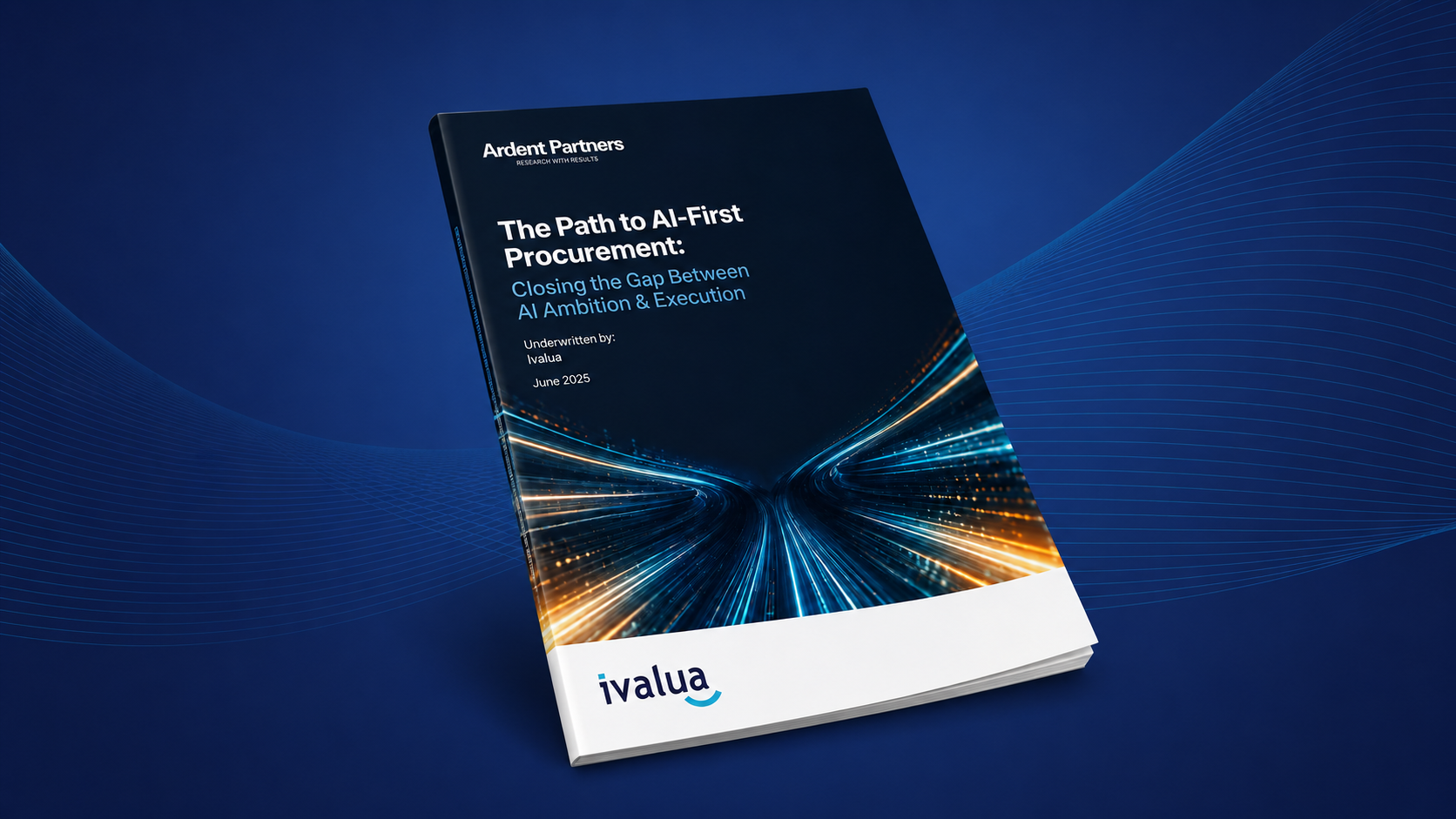
Against this backdrop, Ardent Partners’ latest research report, The Path to AI-First Procurement: Closing the Gap Between AI Ambition and Execution, arrives at an important moment. The report explores how procurement organizations are approaching AI adoption, where they are making progress, and, perhaps most importantly, where they continue to struggle.
Enthusiasm for AI has never been higher. However, the research reveals a consistent pattern: many organizations recognize AI’s transformative potential, but far fewer have built the operational foundation required to realize it at scale.
That distinction is critical.
The conversation surrounding AI has matured significantly over the past 18 months. Procurement teams are no longer asking whether AI can summarize contracts, recommend suppliers, analyze spend, or assist with sourcing events. Today’s AI models are already capable of performing these tasks with remarkable speed and sophistication. The challenge has shifted from capability to execution.
A New Phase of AI Maturity
As the Ardent research highlights, organizations are entering a new phase of AI maturity where success depends less on individual AI features and far more on operational readiness. Fragmented data, disconnected workflows, inconsistent governance, and legacy technology continue to limit the value organizations can extract from even the most advanced AI capabilities.
Successfully scaling AI in procurement requires more than deploying intelligent assistants—it requires connected processes, trusted data, and an operating model designed for enterprise AI. AI has evolved faster than the environments in which it operates.
This is an important realization because it changes the conversation entirely.
For years, procurement transformation focused on digitizing individual processes. Organizations modernized sourcing, automated invoices, introduced supplier portals, and implemented contract lifecycle management systems. Each initiative delivered measurable improvements, but many were still approached as separate technology projects rather than components of a unified operating model.
Artificial intelligence exposes the limitations of that approach.
Unlike previous generations of software, AI does not operate effectively within isolated processes. It depends on connected information, consistent governance, contextual understanding, and seamless orchestration across functions.
AI cannot reason effectively about suppliers if supplier information is fragmented across multiple systems. It cannot make intelligent sourcing recommendations without understanding contracts, historical performance, inventory constraints, market conditions, and organizational policies. Nor can it execute procurement workflows confidently when approval structures and governance rules differ from one business unit to another.
In other words, AI amplifies both the strengths and weaknesses of an organization’s operating model.
This is why becoming an AI-first procurement organization is fundamentally different from simply adopting AI. Purchasing new AI capabilities is relatively straightforward. Building an environment where intelligence can consistently create business value across thousands of procurement decisions is considerably more challenging.
The organizations seeing the greatest returns from AI are not necessarily deploying more algorithms than everyone else. They are creating operating environments where data, processes, governance, and people work together as a connected system. AI becomes a natural extension of the procurement platform rather than another disconnected layer of technology.
That observation may be the single most important takeaway from the Ardent Partners research. The report describes an industry eager to embrace AI but still working to overcome foundational challenges that have existed long before generative AI entered the conversation. These include fragmented data, inconsistent governance, disconnected applications, and operational complexity—issues that cannot be solved by adding another AI model alone.
AI Readiness Is No Longer About Technology
For much of the last decade, procurement technology discussions centered on functionality. Could a platform automate sourcing? Could it digitize contracts? Could it streamline supplier onboarding or reduce invoice processing costs? Innovation was measured by features, and procurement transformation often focused on replacing manual activities with digital workflows.
Artificial intelligence has raised the bar considerably.
Today, nearly every enterprise platform offers some form of embedded AI. Large language models have become increasingly accessible, and organizations can integrate powerful AI capabilities more quickly than ever before. As a result, AI itself is becoming less of a competitive differentiator.
The question is no longer whether an organization can access sophisticated AI models. Increasingly, everyone can. The differentiator is whether those models have access to the right information, within the right context, and under the right governance framework to produce reliable business outcomes.
The Hidden Friction of Disconnected Enterprise Data
Years of technology investments have created environments where information is distributed across ERP systems, contract repositories, supplier databases, spend analytics platforms, external risk providers, and regional applications.
Each system may perform its intended function well, but AI does not think in terms of individual applications. It attempts to understand relationships across the entire procurement ecosystem.
An AI assistant might successfully summarize a contract while remaining unaware of supplier performance issues documented elsewhere. It may recommend a sourcing strategy without considering inventory forecasts. It may identify cost-saving opportunities without visibility into supplier risk or sustainability commitments.
These are not failures of artificial intelligence. They are symptoms of disconnected operating environments.
The Ardent Partners report reinforces this point by emphasizing that organizations must strengthen the underlying data and operational foundations supporting AI before expecting transformative outcomes. AI performs best when it can operate across connected processes rather than isolated systems. Without that foundation, even sophisticated AI capabilities remain confined to incremental productivity gains instead of enabling enterprise-wide transformation.
For procurement leaders, this represents an important shift in thinking.

Pro Tip
Instead of asking, “Which AI feature should we implement next?” organizations should begin asking, “What operational barriers prevent AI from working across our entire Source-to-Pay process?”
The answer often has little to do with the AI itself. It has everything to do with the architecture surrounding it. For a closer look at what that architecture requires in practice, see our guide to AI procurement implementation, which covers automation, governance, and risk management as part of a broader AI procurement strategy.
From AI Assistants to AI Agents: The Next Evolution of Procurement
As procurement organizations strengthen the operational foundation for AI, the next phase of transformation becomes possible. AI moves beyond simply assisting employees and begins actively participating in the execution of procurement work.
Much of today’s conversation still centers on AI assistants. These tools answer questions, summarize documents, generate content, or recommend next steps. They are incredibly valuable because they eliminate repetitive work and allow procurement professionals to spend less time searching for information and more time making decisions. For many organizations, assistants represent the first meaningful application of generative AI.
However, assistance is only the beginning.
The next generation of enterprise AI will be defined by intelligent agents capable of executing complex, multi-step business processes while operating within clearly defined governance and business rules.
Rather than supporting isolated tasks, these agents will work across interconnected workflows, coordinating activities, retrieving information from multiple systems, making recommendations, and initiating actions that previously required significant manual effort. For a full breakdown of how these systems work end to end, see our guide to AI agents in procurement.
This is especially true in AI in sourcing, where intelligent procurement agents can support every stage of a transaction. Imagine a sourcing event that begins with a business request submitted through an intake process. Instead of routing that request through multiple disconnected systems and handoffs, AI agents can help identify qualified suppliers, analyze historical spend, surface existing contracts, recommend sourcing strategies, evaluate supplier responses, identify commercial or compliance risks, generate negotiation insights, and prepare approval recommendations before handing the decision to procurement professionals.
Each step remains transparent, auditable, and governed, but much of the operational effort shifts from manual coordination to intelligent orchestration. This is the essence of AI in procurement orchestration: connecting once-siloed procurement workflows into a single governed flow.
This evolution represents one of the most significant opportunities for procurement in decades. Rather than replacing procurement professionals, AI agents elevate their role. Teams spend less time coordinating processes and gathering information and more time managing supplier relationships, mitigating risk, driving innovation, and supporting strategic business decisions.
Strengthening AI vendor management practices helps keep procurement data accurate as more of the coordination work shifts to procurement automation.
Yet this vision depends on far more than powerful AI models.
An AI agent cannot effectively execute procurement work if it lacks visibility into supplier records, contracts, sourcing events, policies, inventory data, invoices, or organizational workflows. It cannot coordinate decisions when data is inconsistent or governance is unclear. The effectiveness of an AI agent is directly tied to the quality of the enterprise environment in which it operates.
This is precisely why the Ardent Partners research places such a strong emphasis on operational readiness. Organizations that have invested in connected data, standardized processes, and governance are positioned to move beyond isolated AI use cases toward AI-enabled execution. Building a trusted AI data foundation ensures procurement AI can generate recommendations using complete business context instead of disconnected information. Those that have not may find themselves deploying increasingly sophisticated AI capabilities without realizing meaningful business transformation.
Governance Is Not a Barrier to AI—It Is What Makes Enterprise AI Possible
One of the more important themes throughout the Ardent report is governance. As AI becomes more deeply embedded within procurement operations, trust becomes every bit as important as capability. Procurement decisions carry financial, contractual, regulatory, and reputational consequences. Organizations cannot simply deploy autonomous technology and hope for the best. Enterprise AI must be transparent, explainable, and accountable.
For some organizations, governance is still viewed as a constraint that slows innovation. In reality, the opposite is true.
Governance creates the confidence required to expand AI adoption. When procurement leaders understand how AI reaches its recommendations, when users can trace decisions back to trusted enterprise data, and when organizations retain appropriate human oversight, AI becomes significantly easier to deploy across mission-critical processes.
Embedding Human-in-the-Loop Control & Explainability
This balance between intelligence and control will define successful enterprise AI strategies over the next several years. Organizations need AI that accelerates work without compromising compliance, introducing unnecessary risk, or creating black-box decision making. Human expertise remains central, particularly for high-value sourcing decisions, supplier negotiations, and strategic risk management. AI should augment judgment, not replace it.
Building that level of trust requires governance to be embedded directly into the platform rather than added as an afterthought. Permissions, audit trails, policy enforcement, role-based access, explainability, and human approval workflows must work together with AI rather than independently of it. Effective governance is also the foundation of Enterprise AI for procurement enabling organizations to scale AI while maintaining transparency, compliance, and human oversight.
Building an AI-First Procurement Operating Model
The organizations that will lead the next phase of procurement transformation are unlikely to be those experimenting with the largest number of AI tools. They will be the organizations that rethink procurement as an intelligent operating model rather than a collection of individual applications.
This is where unified enterprise platforms become increasingly important.
Instead of treating AI as another layer added to existing technology, procurement leaders have an opportunity to embed intelligence directly into the processes where work happens. AI can become part of sourcing, supplier management, contracting, invoicing, payments, risk management, and intake—not as separate experiences, but as connected capabilities operating across a shared data model and governance framework.
A New Approach to Agentic AI
At Ivalua, this approach to agentic AI in procurement comes to life through IVA Studio™, the agentic control tower designed to govern, extend, and continuously refine AI across the entire Source-to-Pay lifecycle.
IVA, Ivalua’s Intelligent Virtual Agent uses the entire Source-to-Pay platform as its action layer from day one. Through IVA Studio, teams can encode institutional knowledge into reusable skills, align AI-driven execution with business rules, and connect natively to unified enterprise data—all while maintaining permission-bounded governance, auditability, and human oversight.
This architectural approach is increasingly important because procurement challenges rarely exist in isolation. Supplier risk influences sourcing decisions. Contract obligations affect purchasing. Inventory levels impact supplier collaboration. Payment performance influences supplier relationships. AI becomes exponentially more valuable when it can understand and act upon these interconnected relationships rather than operating within a single functional silo.
The future of procurement is therefore not about adding intelligence to individual tasks. It is about enabling intelligence to flow across the entire procurement lifecycle.
AI-First Organizations Are Really Architecture-First Organizations
The phrase “AI-first” has become common across nearly every industry, yet it is often misunderstood. Becoming AI-first does not mean replacing people with algorithms or deploying AI into every workflow as quickly as possible. Nor does it mean chasing every new model or technology trend.
Becoming AI-first means designing an organization where intelligence can operate consistently, responsibly, and at enterprise scale.
That requires connected data. It requires standardized processes. It requires governance that builds trust rather than limiting innovation. It requires platforms capable of orchestrating work across functions rather than automating isolated tasks. Most importantly, it requires recognizing that AI is not the transformation itself—it is an accelerator for organizations that have already established the right operational foundation.
The findings in The Path to AI-First Procurement: Closing the Gap Between AI Ambition and Execution reinforce this reality. Procurement has reached an important inflection point. The technology is ready. The opportunity is substantial.
The organizations that succeed will not necessarily be those with the most AI initiatives, but those that invest in the architecture needed to support them. Leaders ready to formalize that investment can build a clear business case for agentic AI to align stakeholders, demonstrate AI readiness in procurement, and secure budget.
Procurement has always been responsible for balancing cost, risk, resilience, supplier relationships, and business value. AI does not change that mission. It changes how effectively procurement teams can deliver against it.
By combining connected enterprise data, intelligent orchestration, trusted governance, and purpose-built AI agents, procurement leaders have an opportunity to move beyond incremental automation and build operating models capable of adapting continuously as business needs evolve.
The path to AI-first procurement is not defined by AI alone.
It is defined by the strength of the foundation that enables AI to create value every day.
Frequently Asked Questions
AI-first procurement means designing the data, workflows, and governance of a procurement organization so that AI can operate reliably at scale, not simply adding AI features to existing tools. It requires connected enterprise data, standardized processes, and clear governance before AI agents can be trusted with real work. In this sense, AI-first is an operating model, not a technology purchase.
Adopting individual AI tools can improve isolated tasks, but it does not address the fragmented data and disconnected workflows that limit AI’s impact across the organization. AI-first procurement instead treats intelligence as a capability that runs across sourcing, contracting, supplier management, and payments on a shared data model. That architecture is what allows AI to scale beyond a handful of pilots.
AI agents can only be as effective as the information they can see, and fragmented supplier, contract, and spend data leads to incomplete or unreliable recommendations. When procurement data is connected and consistent, AI can reason across the full picture instead of a single system. This is why the Ardent Partners research places such heavy emphasis on operational and data readiness ahead of AI deployment.
AI assistants typically help with a single task, such as summarizing a contract or answering a question, and still rely on a person to take the next step. AI agents go further by coordinating multi-step processes, such as evaluating suppliers, surfacing risk, and preparing recommendations, while operating inside defined governance and approval rules. Both have a role to play, but agents represent the next stage of procurement automation.
Most organizations should start by assessing how connected their supplier, contract, and spend data actually is, since that foundation determines what AI can safely do. From there, teams can prioritize governance, such as audit trails and human approval workflows, before expanding AI into higher-stakes sourcing and supplier decisions. Ardent Partners’ research offers a useful benchmark for where procurement organizations typically stand on this journey.