

Procurement teams must juggle a lot of responsibilities, including managing expanding supplier bases, mitigating escalating risk, ensuring compliance, and delivering measurable savings – yet budgets are tight.
The Hackett Group reports that procurement workloads have increased by roughly 10% while budgets have grown by just 1%. That widening gap is a structural challenge that traditional sourcing processes can’t absorb.
AI in strategic sourcing represents an important change in procurement operations, enabling procurement teams to scale insight and automation to accelerate decision-making, without adding headcount.
This guide explores high-impact use cases for AI in sourcing and how it’s delivering measurable value today. We also provide a practical, phased roadmap for getting started in 2026.
Key Takeaways
- AI automates high-volume sourcing tasks while enabling advanced capabilities such as should-cost modeling and real-time price benchmarking.
- Agentic AI enables the orchestration of multi-agent workflows that run sourcing events end-to-end within human-defined guardrails.
- A unified data model is essential, because fragmented systems result in unreliable AI outputs.
- The real value of AI in sourcing is scale and consistency. It accelerates cycle times while empowering procurement to deliver strategic impact.
What Is AI in Strategic Sourcing?
AI in strategic sourcing is the application of machine learning (ML), natural language processing (NLP), and agentic AI to optimize and automate the end-to-end strategic sourcing process.
Below, we explore how AI transforms the sourcing lifecycle and what distinguishes basic automation from true autonomy.
How AI Transforms the Sourcing Lifecycle from Manual to Autonomous
AI in sourcing is the application of advanced technologies to supplier discovery, intake management, spend analysis, RFx creation, bid evaluation, contract negotiation, and supplier performance monitoring tasks.
Unlike traditional procurement automation, which features fixed rules and predefined workflows, AI in sourcing learns from data patterns and contextual signals to improve decision quality and speed.
Organizations typically fall into one of three maturity categories:
- Rules-based automation: Digitizes tasks but still requires heavy human oversight
- Copilot AI: Enhances assisted decision-making, surfacing recommendations and insights while humans retain control
- Agentic AI: Employs AI agents to execute sourcing events end-to-end, within defined guardrails
Level 3 requires a unified, semantically rich data model that connects sourcing, contracts, supplier management, and spend analytics with a single platform.
AI in sourcing and procurement adoption is already accelerating: McKinsey reports that 40% of procurement functions have piloted or implemented generative AI. Ivalua’s unified Source-to-Pay platform combines a Trusted System of Record, a Coordinated System of Action powered by IVA, and an Adaptive System of Governance through Agent Studio to ensure AI operates on accurate, complete data.
Why CPOs Are Prioritizing AI-Powered Sourcing in 2026
The Hackett Group reports that procurement workloads are increasing by 10% annually, while budgets are growing by just 1%. That’s a 9% efficiency gap that manual processes will never be able to close – and it’s why 64% of procurement leaders expect AI to transform their roles within five years. In fact, 49% have already piloted generative AI use cases.
Still, according to the Hackett Group, only 4% report large-scale deployment. Early movers who operationalize AI at scale will have a significant competitive advantage – and up to 20% additional savings potential. AI is no longer viewed as a productivity tool layered onto existing workflows; rather, it’s becoming an operating model.
Instead of simply assisting tasks, AI agents increasingly own defined outcomes within human-set guidelines. Gartner has recognized Ivalua’s significant investments in advanced AI and its focus on embedding agentic AI technology into a hybrid human-agent operating platform, underscoring how leading platforms are architecting for this shift.
Next, we break down the specific, measurable benefits AI delivers across the sourcing lifecycle.
7 Key Benefits of AI in Strategic Sourcing
The value of AI in procurement is measured using several metrics: cycle time reductions, improved savings capture, stronger supplier resilience, and greater organizational agility. The chart below summarizes the benefits organizations can gain from using AI sourcing tools.
Summary of Benefits
| Benefit | One-Line Description |
|---|---|
| Accelerate Supplier Discovery | Automates supplier research and qualification using real-time intelligence |
| Automate Spend Classification | Cleans and categorizes enterprise spend to uncover savings opportunities |
| Generate & Analyze RFx Faster | Creates and evaluates RFx events in minutes with AI-driven insights |
| Real-Time Should-Cost Modeling | Calculates defensible target pricing using live market and bid data |
| Strengthen Contract Intelligence | Automates drafting, risk detection, and post-award compliance monitoring |
| Proactive Supplier Risk Monitoring | Continuously tracks financial, regulatory, and ESG risk signals |
| Multi-Agent Orchestration | Scales sourcing capacity through coordinated autonomous workflows |
Accelerate Supplier Discovery and Qualification
Procurement teams manage 50% more spend per employee than they did five years ago, according to McKinsey, and manual supplier discovery simply cannot keep pace.
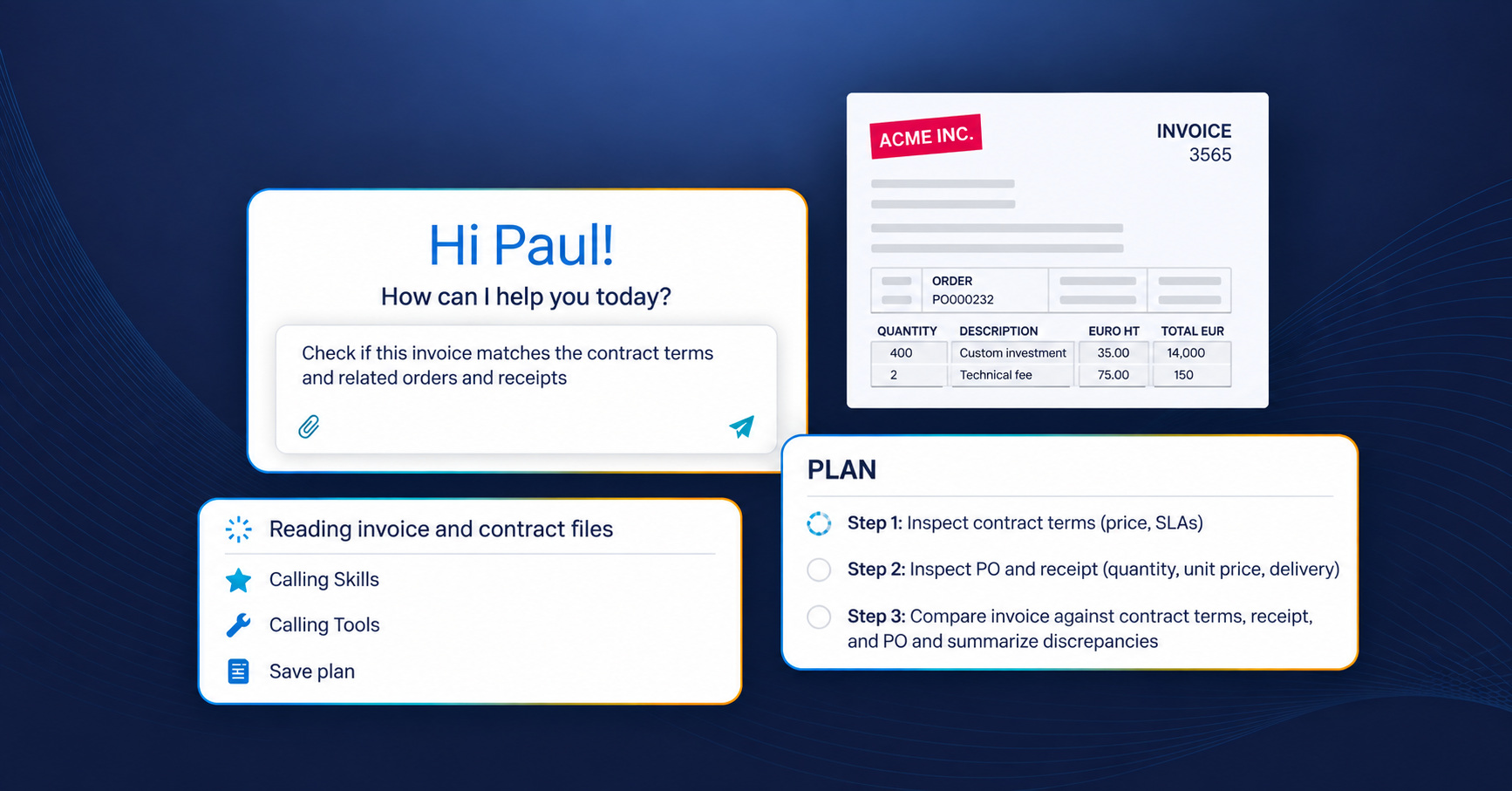
AI agents in procurement research and evaluate potential suppliers autonomously, pulling data from a variety of internal and external sources, then creating structured profiles. They conduct initial screening, financial health assessments, and compliance verification before a sourcing manager ever reviews a shortlist.
AI enables dynamic supplier scorecards with up-to-the-minute performance metrics – on-time delivery (OTD), quality, cost competitiveness, and service levels. Teams can view supplier intelligence in real-time and proactively identify high-performing – or high-risk – partners.
Ivalua’s IVA takes this a step further by combining internal performance data with external intelligence feeds, and enables supplier onboarding automation, data enrichment, and compliance document analysis. It can pull certifications, insurance records, ISO standards, and ESG documentation without manual intervention, ensuring sourcing decisions are grounded in complete, verified data.
Automate Spend Classification and Unlock Hidden Savings
Accurate, categorized data is the basis for every effective sourcing strategy, yet many organizations struggle with fragmented ERP and business unit data. AI-powered spend classification automates up to 80% of categorization across suppliers, cost centers, and commodity codes, reserving only complex exceptions for human review.
Advanced spend analytics can also expose maverick spend and contract leakage, and surface consolidation opportunities that humans may overlook. In fact, McKinsey found organizations using advanced analytics in procurement can unlock up to 20% additional savings potential.
Ivalua’s unified Source-to-Pay platform embeds spend analytics within its broader procurement technology ecosystem, ensuring data flows seamlessly into sourcing, contracts, and supplier management without silos.
Generate and Analyze RFx Documents in Minutes, Not Weeks
AI-powered RFx generation automation makes generating RFP, RFQ, and RFI documents fast and easy. The AI draws from historical templates, category requirements, commodity specifications, and prior event data, so it doesn’t have to start from. Teams can create from structured, context-aware drafts that reflect best practices and enterprise standards.
On the evaluation side, NLP capabilities analyze incoming supplier responses, and extract key commercial and technical terms, which they can automatically map against predefined scoring criteria. Having side-by-side comparisons across bids and visibility into outliers, missing information, and non-compliant responses simplifies the review process.
According to The Hackett Group, AI-powered procurement tools deliver up to 10% productivity and quality improvements, as well as cost savings, by accelerating documentation and analysis. Plus, autonomous agents can execute sourcing events end-to-end within defined guardrails, escalating only key decision points for human approval.
Ivalua’s sourcing solution enables this capability through its virtual assistant (IVA), which orchestrates the full sourcing cycle while maintaining governance at critical approval gates.
Enable Real-Time Should-Cost Modeling and Price Benchmarking
Effective negotiation starts with knowing what something should cost. AI-powered should-cost modeling analyzes commodity trends, historical bids, supplier cost structures, and market indices to generate defensible target prices that update dynamically as new data enters the system.
Real-time benchmarking can be used to continuously compare supplier quotes against historical pricing and peer contracts, and flag anomalies or cost creep. And, it works: McKinsey cites a specialty chemicals company that reduced raw-material spending by 13% using advanced should-cost modeling.
Ivalua embeds these capabilities directly into its unified platform, combining commodity intelligence and sourcing data within the workflow, so pricing insights feed directly into negotiation strategy and contract terms.
Strengthen Contract Intelligence from Drafting to Compliance
AI-driven contract intelligence automates redlining and clause suggestions to speed up the drafting process. It can flag deviations from approved templates and insert category-specific language based on prior agreements and risk profiles. That way, you maintain consistency across regions and business units while saving time.
AI can also identify unfavorable terms, liability exposure, penalty clauses, and compliance gaps before contract execution, enabling teams to focus on high-risk provisions early. Given that Deloitte’s 2025 Global CPO Survey cites siloed ways of working (57%) and competing priorities (46%) as top barriers to procurement value delivery, intelligent contract workflows help break down fragmentation by embedding governance directly into the process.
After execution, AI monitors obligations, tracking pricing tiers, rebates, SLAs, and approvals through procurement workflow automation.
Ivalua’s native CLM capabilities integrate automated redlining, risk extraction, and ongoing obligation tracking directly with sourcing and supplier management. This helps to ensure contracts are active, governed documents and part of the broader procurement automation framework.
Detect and Mitigate Supplier Risks Before They Disrupt Operations
AI agents continuously monitor financial filings, news, regulatory databases, ESG disclosures, and internal performance data to deliver supply chain visibility in real time. If they detect any warning signs – financial instability, compliance violations, or geopolitical exposure appear, for example – the AI generates alerts so teams can intervene proactively.
Deloitte’s 2025 Global CPO Survey found that the top risk mitigation strategies include maintaining active alternative sources (74%), enabling greater supply chain visibility (64%), and enhancing supplier collaboration (61%) – capabilities that AI monitoring supports at scale.
Dynamic segmentation further strengthens resilience by adjusting supplier classifications based on risk and performance trends, while proactively recommending alternatives during sourcing events.
Ivalua embeds real-time risk detection and dynamic scorecards directly into its unified platform, integrating supplier intelligence with sourcing and contract workflows.
Scale Procurement Capacity with Multi-Agent Orchestration
The most significant shift in 2026 is the rise of agentic AI in procurement as an operating model. Instead of supporting isolated tasks, AI agents own defined outcomes within human guardrails and provide a coordinated execution layer across the sourcing lifecycle.
In a multi-agent environment, specialized agents work in parallel, analyzing supplier performance and flagging pricing anomalies. It suggests corrective actions and an orchestrator ensures compliance. The result is an autonomous sourcing platform that enables you to manage more events without adding headcount.
For example, AI can automatically generate supplier briefing packs with performance data, risk insights, cost trends, and negotiation talking points in minutes.
Deloitte reports that top procurement organizations achieve 3.2X returns on GenAI investments, compared to only 1.5X for followers. Clearly, enterprise-wide procurement orchestration offers significant value.
Ivalua’s IVA serves as the coordination layer across Source-to-Pay, with Agent Studio enabling no-code configuration and governance to ensure AI operates securely and at scale.
These benefits have been proven in real-world implementations at large organizations, such as Ivalua client, Veolia.
How Veolia Manages €16B in Spend with AI-Powered Strategic Sourcing
Veolia – a global leader in environmental services operating across water, waste, and energy management in 48 countries – was managing €16 billion in annual spend across a fragmented, multi-category supplier base under stringent regulatory requirements. Disparate systems and inconsistent processes limited visibility, slowed sourcing cycles, and made global standardization difficult.
To address this complexity, they selected Ivalua’s AI procurement sourcing software to unify procurement operations across business units and geographies. By harmonizing supplier data, workflows, and governance within a single source-to-pay automation platform, the organization established consistent processes and a shared system of record across all regions.
As a result, Veolia:
- Gained end-to-end visibility into global spend
- Streamlined strategic sourcing events
- Standardized supplier management practices worldwide.
Thanks to implementing Ivalua, the company now has a unified, semantically rich data model that’s able to support AI-powered sourcing at enterprise scale.
“We chose the Ivalua solution because of the breadth of its functional footprint and its modularity. We have a “glocal” organization [of suppliers] that is very close to the business that we are able to manage as closely as possible. At the same time, we are able to benefit from the size of [our] group to establish relationships with global suppliers with added value.”
– Florence Baiget, Purchasing Director at Veolia Group
How to Implement AI in Strategic Sourcing: A Phased Roadmap
So, how do you implement it without disrupting operations? The most successful organizations treat AI adoption as a phased evolution rather than a one-time transformation. Below is a practical roadmap for building the right foundation.
Phase 1: Establish the Data Foundation
Every successful AI initiative in procurement starts with data consolidation. This phase includes cleansing and standardizing spend data across business units and geographies, ensuring insights reflect true demand patterns. You should also assess sourcing workflows to identify where automation adds value versus where human judgment remains essential.
Deloitte research found that top performers invest up to 24% of procurement budgets in technology, with a strong focus on data architecture, before they scale AI adoption.
A unified Source-to-Pay platform brings supplier records, contracts, spend data, and performance metrics into a single system of record. Built on a single codebase and rich data model, Ivalua’s unified strategic sourcing solution provides the governance foundation required for enterprise-scale AI.
Phase 2 – Deploy AI Copilots for Sourcing Intelligence
With clean data in place, organizations can introduce copilot-level capabilities through an AI sourcing platform. At this stage, AI isn’t yet acting autonomously, but it assists with automating spend classification, supplier screening, RFx generation, and contract recommendations. Humans remain in control.
Conversational AI expands access further, allowing business users to submit requests that are compliant using natural language – workflows are governed within the unified data model.
During this phase, you may also begin building category-specific AI models that are trained on historical sourcing decisions, supplier performance outcomes, pricing benchmarks, and contract terms. These models will become increasingly context-aware over time, improving recommendations and identifying optimization opportunities unique to each spend category.
In this phase, success is measured through cycle time reduction, savings, reduction in manual effort, and compliance gains. According to McKinsey, Procurement can become 25 – 40% more efficient using technology, and copilot-level AI is a great starting point to those efficiency gains.
Phase 3 – Scale with Agentic AI and Autonomous Sourcing
In the third and final phase, you move from assisted intelligence to full agentic AI in Procurement. AI agents execute tail-spend sourcing events end-to-end on their own. They issue RFx documents, analyze bids, and recommend awards autonomously. Humans still oversee the defined approval gates, but agents manage the operational workflow independently within established guardrails.
An autonomous sourcing platform such as Agent Studio enables teams to configure category-specific workflows aligned to compliance and risk requirements – without developer support – so that each AI experience is tailored to the unique needs of each spend category.
Clear-box transparency ensures that agentic models operate within structured policies, grounded in the unified data model, avoiding black-box risk.
Scalability is the payoff. As AI absorbs operational density, procurement teams can expand their reach into new categories, increase sourcing event volume, and deepen supplier engagement without proportional headcount growth.
As Gartner’s 2026 Magic Quadrant for Source-to-Pay Suites points out, agentic AI as a top market differentiator, and strong Agentic strategies are essential for leaders. If you stop AI adoption at the copilot level, you’ll likely fall behind.
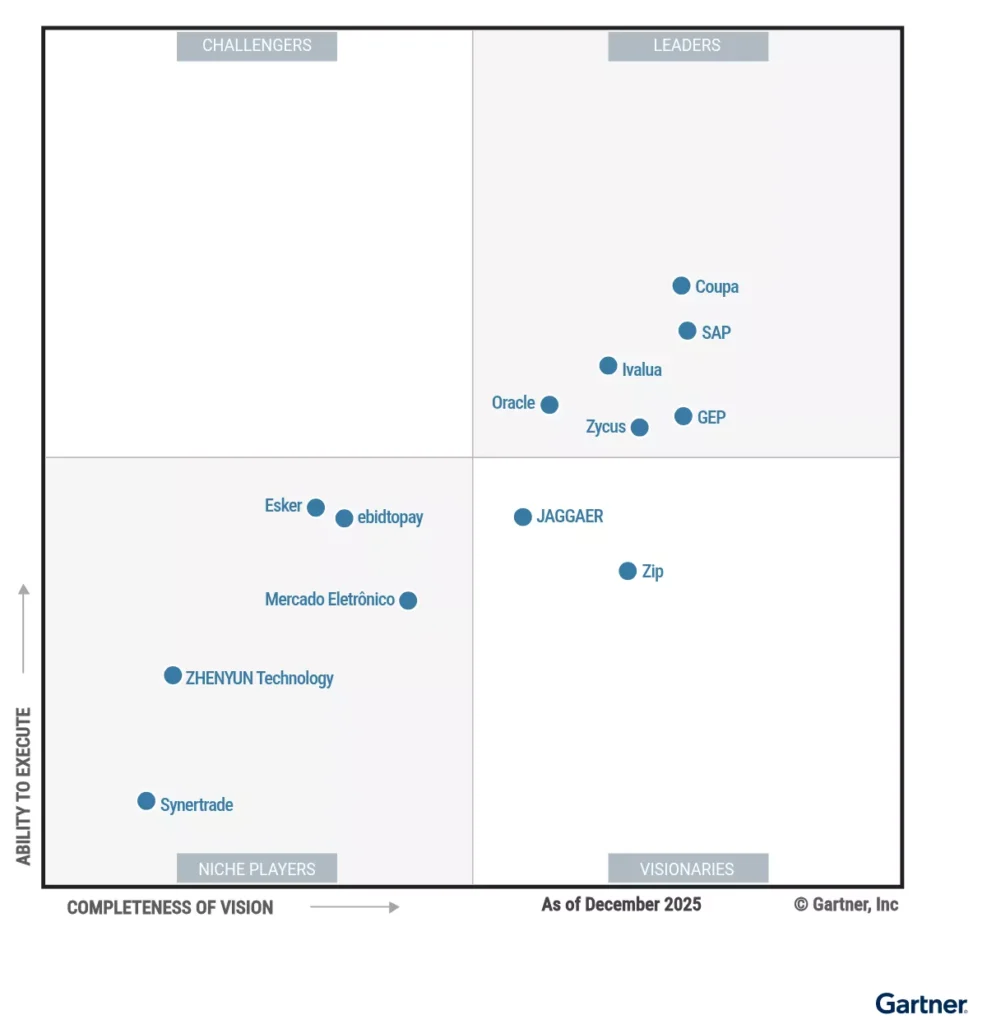
Source: Gartner’s 2026 Magic Quadrant for Source-to-Pay Suites
The three-phase roadmap provides a clear path – organizations that start now compound their advantage as the market shifts to AI-first sourcing.
See how an autonomous sourcing platform powered by agentic AI in procurement can transform your strategic sourcing performance.
The Strategic Imperative for AI in Sourcing
The case for AI in strategic sourcing gets stronger every day, as workloads rising 10% and budgets growing just 1%. Companies that still rely on manual workflows and disconnected systems will struggle to scale impact, capture savings, or proactively manage risk.
That’s why AI in sourcing and procurement must be baked into the operating model with data-driven orchestration. When it’s grounded in a unified procurement platform like Ivalua, agentic AI enables procurement teams to automate their operational workload, leverage real-time intelligence, and execute sourcing events with speed and governance. It doesn’t replace human expertise; it amplifies it.
The path forward starts with modernizing sourcing and building a strong data foundation. Learn how Ivalua can help you close the efficiency gap and drive strategic value in sourcing with AI.
See How Agentic AI Transforms Strategic Sourcing Performance
Frequently Asked Questions About AI in Sourcing
AI in sourcing uses machine learning, natural language processing, and intelligent agents to automate and enhance the strategic sourcing lifecycle. It analyzes unified supplier, spend, contract, and performance data to generate insights, assist decisions, or autonomously execute defined tasks within governance rules.
The benefits of AI in sourcing include faster supplier discovery, automated spend classification, accelerated RFx generation, improved bid analysis, and proactive risk monitoring. It drives measurable outcomes such as cycle time reduction, stronger compliance, and increased savings capture.
Traditional automation follows predefined rules to digitize tasks, while agentic AI in procurement can analyze context and autonomously execute multi-step workflows within guardrails. Instead of simply routing processes, agentic AI owns defined outcomes while maintaining transparency and control.
High-impact use cases for AI sourcing tools include spend analytics, supplier screening, RFx generation, bid evaluation, should-cost modeling, and contract intelligence. Tail-spend sourcing is especially well suited for autonomous, end-to-end execution with human approval at key decision points.
Embedding AI into the strategic sourcing process starts with consolidating and cleansing procurement data within a unified platform. Organizations typically progress from copilot-level assistance to agent-based orchestration through a phased, measurable rollout.
Data quality is foundational to the success of any AI sourcing platform. Clean, connected, and standardized data ensures AI outputs are accurate, explainable, and aligned with enterprise governance.