


Modern enterprise procurement teams expect a lot from strategic sourcing software. Today’s platforms have to connect sourcing with supplier management, contracts, purchasing, and AI-driven decision-making, all while supporting increasingly complex global supply chains.
As you evaluate strategic sourcing technology, the challenge is to look past features and find something that will support your immediate and long-term needs, allowing your strategic sourcing practices to evolve and mature.
The Strategic Sourcing Readiness Matrix can help you evaluate whether a solution will support your short and long-term requirements. Instead of asking whether software includes RFx or auctions, the framework measures how well each solution handles sourcing intake and orchestration, automated and autonomous sourcing, spot bids, project-based sourcing, complex categories, multi-supplier strategies, AI-enabled decision making, and downstream visibility and integration .
Ivalua developed the Strategic Sourcing Readiness Matrix to help procurement teams evaluate sourcing solutions across five dimensions that increasingly shape enterprise requirements.
In this guide, we explain what enterprise strategic sourcing software needs to deliver in 2026 and show you how you can evaluate solutions based on the various capability tiers.
Key Takeaways
- Strategic Sourcing software shouldn’t be selected based on company size alone.
- The S2P market is consolidating around integrated suites, not standalone eSourcing tools. Because while sourcing creates value, that value must be captured and realized.
- Enterprise CPOs managing direct materials sourcing across multi-tier supply chains require a unified S2P platform with a native AI architecture.
A Five-Dimension Framework for Evaluating Sourcing Platforms
According to the Hackett Group, procurement workloads increased 10% in 2025 while budgets grew just 1%, creating a 9% efficiency gap, and 64% of procurement leaders expect AI to transform their roles within the next five years. The platform you choose today will determine how effectively your organization closes that gap.
The Strategic Sourcing Readiness Matrix is a simple self-assessment that helps procurement leaders match their operating reality to the right category of strategic sourcing software.
| Dimension | Lower Complexity | Higher Complexity |
|---|---|---|
| Spend complexity | Most indirect spend can often be managed with a capable eSourcing solution | Complex indirect and direct materials, complex services, and CapEx sourcing require deeper capabilities and may also require BOM integration and cross-functional collaboration |
| Operating model | Decentralized procurement teams may succeed with lightweight sourcing tools and basic workflow automation | Centralized, coordinated decentralized, and procurement organizations managing multiple business units will benefit from a sourcing application that handles simple and complex needs, with suppliers at the core. |
| AI readiness | If the goal is automating individual tasks, embedded AI features are typically sufficient | Organizations pursuing agentic and autonomous sourcing need native AI agents built on a governed enterprise data foundation |
| Platform strategy | Standalone sourcing tools can meet short-term sourcing requirements | A unified S2P platform connects sourcing, contracts, purchasing, invoicing, and supplier data without re-entering information across systems |
| Primary outcome | If the priority is reducing sourcing cycle times, most modern sourcing platforms can deliver value | Organizations focused on savings tracking, risk-integrated sourcing at scale require native supplier management, analytics, performance monitoring, and end-to-end data visibility |
With Ivalua, organizations get the best of both worlds. If you have simple needs, sourcing can get up and running fast and allow you to accelerate sourcing cycle times and put more spend through a sourcing process. If your needs are going to get more complex or already are, Ivalua can support with deeper capabilities, and supports the transformation journey to enable seamless connectivity from sourcing to suppliers, contracts, and procure-to-pay.
What to Look for in Any Top Strategic Sourcing Solution: A 3-Tiered Capability Checklist
Use this 3-tiered checklist during the vendor selection process to distinguish essential functionality for your eSourcing strategy from the features that enable long-term procurement transformation.
Tier 1 — Foundational Capabilities
Every platform on a serious shortlist should provide comprehensive RFx management,supplier discovery and pre-qualification, sourcing automation for various types of events, spot bids, bid collection and scenario analysis, seamless contract handoff without re-entering award terms, savings tracking, and spend analytics. These capabilities establish the baseline for effective strategic sourcing. AI is foundational to support the above, but don’t get sold on the number of agents a provider offers. These are usually rigid, narrow agents and
Tier 2 — Strategic Capabilities
Strategic capabilities might include auctions, category management, program and project management. Look for a unified user experience across modules, no-code or low-code configuration managed by procurement rather than IT, supplier risk, and performance data embedded directly within sourcing events. Deep ERP integrations with platforms such as SAP, Oracle, and Workday is also essential.
Tier 3 — Differentiating Capabilities
Leading enterprise platforms support direct materials sourcing with BOM integration and engineering collaboration. Agentic AI executes multi-step sourcing workflows, and ESG and sustainability metrics are embedded into award decisions. These capabilities are typically native to the platform, or absent altogether.
Ultimately, the most important thing to consider is how data from across procurement aspects will be used to inform sourcing strategies and execution.. When sourcing, supplier management, contracts, procurement, and analytics share a single data model, every capability becomes more connected and valuable over time.
Comparing The Best Strategic Sourcing Software and Tools in 2026
The platforms below cover range from specialized strategic sourcing solutions built for indirect spend optimization or as part of a larger Source-to-Pay suite. The sourcing solution that is best for your organization will depend on where it sits across the five dimensions of the S2P Sourcing Readiness Matrix.
| Platform | Maturity Tier | Best For | Pros | Cons |
|---|---|---|---|---|
| Ivalua | Tier 3 — Full S2P (Unified Architecture) | Enterprises over $1B in revenue Needing a mix of simple to complex strategic sourcing needs . | Sourcing can be used standalone. Seamless link between Supplier Data, Sourcing, CLM and P2P. Leading customer retention and Agentic AI at the core. | Smaller peer-reference network than some leaders. Not for companies Under $500M in Revenue. |
| SAP Ariba | Tier 2–3 — Full S2P (ERP-Native) | Large enterprises deep in the SAP ecosystem | SAP ecosystem, largest supplier network | Steep implementation complexity and change management, AI value concentrated in-SAP |
| Coupa | Tier 2–3 — Full S2P (Execution-Focused) | Indirect-heavy enterprises wanting spend visibility | Strong execution scores, fast-moving Navi AI roadmap | Less flexible for non-standard approval chains, AI agent swarm approach |
| GEP SMART | Tier 2–3 — Full S2P | Enterprises needing supply chain integration | LLM-agnostic Qi orchestration layer, GEP NEXXE tie-in | End-to-end execution depth needs validation |
| JAGGAER | Tier 2 — Full S2P | Manufacturing, life sciences, and public sector direct-materials sourcing | Deep BOM & quality management | S2C/P2P UX inconsistency, agent orchestration still maturing |
Here’s a detailed look at the best Strategic Sourcing Solutions, starting with Ivalua, a Tier 3 solution.
1. Ivalua
Maturity Tier: Tier 3
Overview: Ivalua’s strategic sourcing solution is built on an AI platform that supports all spend types of spend, including direct, indirect, CapEx, Project-based spend and services. Supporting rapid sourcing automation needs for simple items to more sophisticated sourcing projects involving many items. Every module, including sourcing, contract management, procurement, invoicing, supplier management, and spend analysis, shares the same data foundation, so sourcing decisions flow into contracts, purchasing, and invoicing without re-entering data or manually reconciling information between systems.
Best For: Enterprises over $1B in revenue that want AI powered strategic sourcing with the option to eSource-to-Pay platform to manage complex, industry-specific procurement processes across direct and indirect sourcing.
Core Strengths:
- Unified S2P Platform: Complete strategic sourcing covering indirect, direct, CapEx, and services.
- Agentic AI Orchestration: Embedded IVA acts as an active coworker, automating every stage of sourcing: Supplier selection, RFX creation, bid summaries, negotiations tactics, awards, scenarios, historical and benchmark pricing and more.
- Direct Spend & BOM Management: Connects procurement with engineering, offering deep BOM hierarchies, cost breakdowns, NPI tracking, and Product Quality.
- Smart Award Optimization: Run multi-variable “what-if” bid scenarios balancing cost, capacity, ESG, and risk factors.
- No-Code Configurability: Empowers business users—not just IT—to instantly tailor workflows and forms across global operations.
- Connected Risk & ESG: Integrates real-time supplier health, ESG metrics, and sub-tier visibility directly into sourcing decisions.
AI Approach:
IVA (Intelligent Virtual Agent) is a single governed AI agent that helps sourcing teams execute strategic sourcing activities using the full Ivalua platform to access reliable customer data, processes and policies and execute actions. Grounded in a unified data model, IVA draws on supplier information, spend history, contracts, risk, and performance data to identify suppliers, create sourcing events, analyze bids, and support award decisions. Powered by IVA Studio, organizations can govern AI behavior and capture sourcing best practices as reusable Skills.
Implementation:
Phased, beginning with high-value capabilities and expanding over time. Timelines vary by module and often run 3-6+ months for Source-to-Contract.
What to Watch For:
Buyers seeking a large peer-reference network should evaluate Ivalua’s customer community programs to meet that need.
Access our On-Demand Demo Library to see Ivalua in Action:
2. SAP Ariba
Maturity Tier: Tier 2–3
Overview: SAP Ariba is a Source-to-Pay platform that integrates with SAP Business Network and core SAP ERP applications, including SAP S/4HANA and SAP ECC, to support supplier collaboration and procurement workflows.
Best For: Large enterprises with deep SAP ERP investment who prioritize scale, supplier network access, and native ERP data integration.
Core Strengths:
- ERP-to-procurement data integration available for organizations already running SAP
- Global supplier reach and support for global compliance requirements across tax, trade, and regulatory frameworks
- Long-term architectural commitment that addresses historical complaints about fragmented module experiences
Procurement, sourcing, invoicing, and expense management within a single platform
Supply chain planning and treasury capabilities through the Total Spend Management suite
AI Approach: Joule, SAP’s AI assistant, is embedded across sourcing, supplier management, and buying workflows, providing AI-driven supplier recommendations, bid analysis, and real-time decision guidance within sourcing events.
Implementation: Deployments for large enterprises typically run longer than most competitors. Expect a phased, SI-partner-led rollout with significant change management, particularly while SAP’s next-generation BTP architecture continues rolling out throughout 2026–2027.
What to Watch For: Organizations outside the SAP ecosystem may face greater implementation complexity and integration requirements.
3. Coupa
Maturity Tier: Tier 2–3
Overview: Coupa’s Total Spend Management platform combines procurement, supply chain planning, and treasury with support for enterprise spend management.
Best For: Enterprise organizations with predominantly indirect spend that need spend visibility, supplier community access, and a peer-reference network.
Core Strengths:
- Procurement, sourcing, invoicing, and expense management within a single platform
- Supply chain planning and treasury capabilities through the Total Spend Management suite
- AI-assisted spend analysis, sourcing, and procurement workflows
AI Approach: Coupa offers multiple task-specific AI agents supporting supplier matching, cost formulas, and procurement requests, with Agent Studio for customization.
Implementation: Enterprise rollouts commonly run 6–12+ months, phased across modules, business units, and regions, with integration complexity and supplier onboarding cited as common reasons for delay.
What to Watch For: Standardized workflows may require additional configuration for organizations with complex approval processes or exception handling. AI capabilities are primarily focused on P2P and indirect spend. Data may sit in different systems.
4. GEP SMART
Maturity Tier: Tier 2–3
Overview: GEP combines strategic sourcing, category management, spend analysis, supplier management, and contract management within its Source-to-Pay platform.
Best For: Enterprises seeking supply chain integration, particularly in manufacturing and regulated industries with complex vertical requirements.
Core Strengths:
- Three-layer architecture (SMART application + QUANTUM platform + Qi agentic AI) provides structural separation between the application, platform, and intelligence layer
- Cloud-native, LLM-agnostic architecture avoids vendor lock-in to a single AI model
AI Approach: GEP Quantum Intelligence (Qi) is an agentic AI orchestration layer distinct from the application layer that coordinates individual agents for different tasks on an LLM-agnostic, open architecture.
Implementation: Single-module GEP SMART deployments often run 6 – 9 months; full S2P rollouts run 12–18+ months, depending on ERP integration complexity and change management scope.
What to Watch For: Organizations should validate how sourcing, supplier, and contract data flow into downstream P2P execution before assuming end-to-end depth matches requirements.
5. JAGGAER
Maturity Tier: Tier 2
Overview: Jaggaer supports direct and indirect procurement through its Source-to-Pay platform, with industry-specific capabilities for manufacturing, life sciences, higher education, and public sector organizations.
Best For: Manufacturing, life sciences, and public sector organizations that need industry-specific sourcing configurations and direct materials support.
Core Strengths:
- Strategic sourcing, supplier management, contract management, and spend analysis
- Support for direct and indirect procurement with ERP integration capabilities
- Industry-specific functionality for manufacturing, life sciences, higher education, and the public sector
AI Approach: AI capabilities support contract management, category management, and supplier intelligence, with additional agent-based capabilities under development for forecasting, spend management, and RFx automation.
Implementation: Implementation timelines vary by scope, with single-module deployments typically taking 3–6 months and full Source-to-Pay implementations taking 12–18 months.
What to Watch For: Gartner Peer Insights reviews note that user experience and system flexibility can be inconsistent across upstream (S2C) and downstream (P2P) modules, which are architecturally distinct platforms unified by a Supplier IDM layer, a legacy of historical acquisitions.
What the Gartner Magic Quadrant for S2P Suites Reveals about the 2026 Sourcing Market
For independent analyst validation of the platforms listed above, the Gartner Magic Quadrant for Source-to-Pay Suites is the most comprehensive third-party framework available.
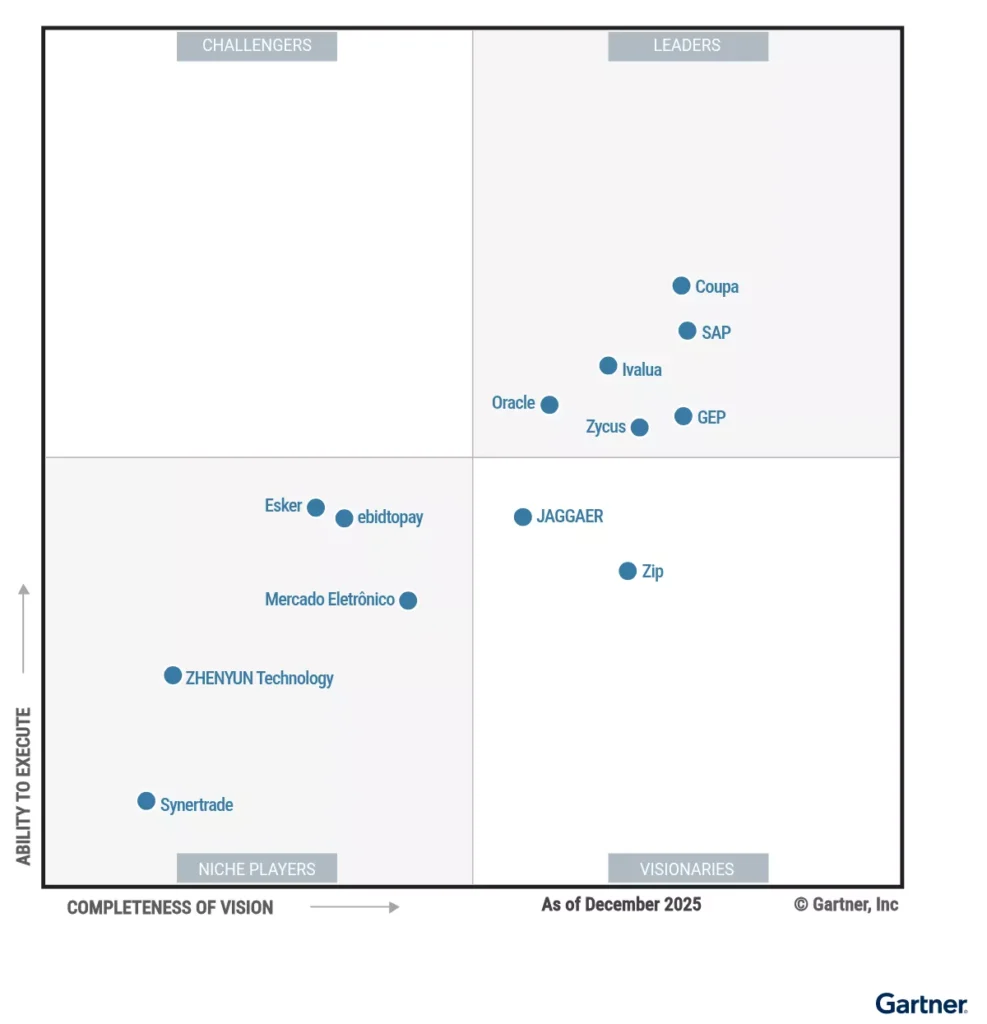
These five key findings can help you to evaluate whether the strategic sourcing software or Source-to-Pay platform you’re considering is positioned for long-term success.
1) Market Consolidation Is Accelerating
Gartner estimates the Source-to-Pay technology market will reach approximately $18.7 billion in annual spend by 2029, growing at a 16.3% CAGR.
What this means for buyers: Enterprise investment is consolidating around integrated suites. Choosing a standalone eSourcing tool may solve today’s sourcing needs, but it can create a far more expensive migration when broader Source-to-Pay capabilities become a business requirement.
2) Ivalua Recognized as a Leader
Gartner recognized Ivalua as a Leader, citing its unified codebase and data model, the highest average customer contract retention rate, and the shortest average support ticket resolution time among evaluated vendors.
What this means for buyers: When selecting software expected to support procurement for the next five to ten years, customer retention and support quality are often stronger predictors of success than an impressive product demonstration.
3) Ivalua’s Roadmap Targets Enterprise Complexity
Ivalua’s 2026 investment priorities include a hybrid human-agent operating platform with embedded agentic AI, expanded direct materials sourcing capabilities, and AI-powered intake and orchestration.
What this means for buyers: These investments directly address the areas where enterprise sourcing is becoming most complex. A vendor’s roadmap alignment with your future operating model is often more valuable than comparing current feature lists.
4) Agentic AI Is Emerging as a Key Differentiator
Leaders in the market all demonstrate a credible agentic AI strategy.
What this means for buyers: Agentic AI is a qualification criterion. Vendors without a mature agentic AI architecture are unlikely to remain competitive as enterprise procurement continues to automate increasingly complex workflows.
5) Platform Architecture Now Matters More Than Feature Count
Gartner identifies three primary market differentiators for 2026: agentic and generative AI, intake and process orchestration, and highly configurable platforms that can be adapted without modifying core code.
What this means for buyers: Architecture is more important than features. Ask whether AI is native or bolted on, whether orchestration works across external systems in both directions, and whether procurement teams can configure workflows themselves without depending on IT.
Let’s take a look at how one Ivalua customer is leveraging agentic AI in sourcing.
How Dole Achieved 10x ROI on Source-to-Contract with Ivalua
Before implementing Ivalua, Dole Food Company managed sourcing and contract activities across disconnected systems and had to transfer negotiated terms manually from sourcing events into contracts. They lacked a centralized way to measure savings across categories and business units, which made tracking sourcing performance and cycle times extremely difficult.
With Ivalua’s unified Source-to-Contract platform, Dole standardized sourcing for indirect spend, direct materials, CapEx, and services within a single environment. Sourcing events now flow directly into contracts and purchasing without any manual intervention, and they use centralized savings dashboards to create a closed-loop view of realized value. As a result, Dole has greater visibility and stronger compliance. They have even achieved a 10x ROI since implementation.
“With Ivalua, we realized tremendous speed-to-value and benefited from a simpler and more focused source-to-contract solution. We have already achieved 10x ROI in a very short time.”
— Arindam Sengupta, Global VP Strategic Sourcing & Procurement, Dole
Read the full Dole case study.
Find the Top Strategic Sourcing Solution for Your Operating Environment
If you manage direct materials, operate a centralized procurement function, and are preparing for agentic AI, a unified Source-to-Pay platform with a single data model and native AI architecture provides the foundation to scale. However, if your focus is primarily indirect spend within a decentralized operating model, a specialized eSourcing solution may be a better fit.
The S2P Sourcing Readiness Matrix helps you align your operating model and AI strategy before comparing vendors, so you can choose the right platform for your organization.
Turn Strategic Sourcing Into a Competitive Advantage With Ivalua
FAQs
Strategic sourcing software helps procurement teams identify the best suppliers and negotiate the best outcomes before purchases are made. It supports spend analysis, supplier discovery and pre-qualification, RFx management, category management, bid evaluation, contract handoff, and increasingly AI-powered capabilities that automate analysis, summarize supplier responses, and recommend sourcing decisions.
A typical strategic sourcing software implementation can range from several months for a focused deployment to more than a year for a global enterprise rollout across multiple business units. The timeline depends on process complexity, ERP integrations, data migration, and whether the organization is deploying a standalone sourcing tool or a unified Source-to-Pay platform.
Yes. Leading sourcing platforms offer deep ERP integration with SAP, Oracle, Workday, and other enterprise systems, allowing supplier, purchasing, contract, and financial data to flow automatically. The strongest platforms support bidirectional integration so sourcing decisions remain synchronized with procurement execution and finance.
Indirect sourcing software focuses on categories such as office supplies, professional services, and some types of MRO, while direct materials procurement platforms support manufacturing-specific processes including BOM management, engineering collaboration, supplier capacity planning, and new product introduction. Organizations sourcing both typically benefit from a single platform that manages both spend types.
Modern sustainable sourcing software embeds ESG considerations into supplier qualification, sourcing evaluations, and award decisions. By combining supplier sustainability data with sourcing, risk, and performance information, procurement teams can balance cost, resilience, and environmental or social objectives throughout the sourcing process.
A sourcing software RFP should evaluate more than RFx functionality. Include requirements for AI capabilities, supplier management, ERP integrations, configurability, reporting, security, implementation approach, pricing transparency, and long-term product roadmap to ensure the platform aligns with both current needs and future procurement strategy.