

Direct materials procurement is the sourcing of every raw material, component, and subassembly that becomes part of a finished product. And, if you’re the person responsible in your organization for sourcing direct materials, you’re probably feeling a lot of pressure. 89% of companies have experienced a supplier risk event in the past five years, and manufacturers expect input costs to increase by an average of 5.4% over the next year.
In this environment, disciplined, data-driven procurement is more critical than ever. Grounded in 2025–2026 market realities, this guide walks through the entire direct materials sourcing process from end-to-end.
Key Takeaways
- Direct materials procurement encompasses all items that become part of a finished product.
- Direct materials procurement is being reshaped by cost inflation, supply volatility, and rising supplier risk.
- Agentic AI is transforming how enterprise teams manage direct spend with automation and real-time decisioning.
What Is Direct Materials Procurement?
Direct materials procurement sits at the center of manufacturing performance. It has a direct impact on cost, risk, and production continuity.
Managing direct materials procurement effectively requires a clear understanding of what qualifies as direct spend and how it moves through the full procurement lifecycle stages. This must be taken in the context of today’s pressure such as inflation and supply chain disruption, and how those forces are reshaping traditional procurement processes.
Fortunately, new technologies like AI are redefining how teams operate, helping direct materials procurement teams be more flexible and proactive.
Let’s dive into a more detailed definition of direct procurement and how it differs from indirect procurement.
Direct Materials Defined: Raw Materials, Components, and Subassemblies
Direct materials are the inputs that physically become part of the finished product. These inputs typically fall into three categories: raw materials sourcing (such as steel coils for automotive stamping or polyethylene pellets for packaging), components and parts (including circuit boards, brake calipers, and fasteners), and subassemblies (like wiring harnesses or pre-assembled display modules).
Just as important is what doesn’t qualify, such as production machinery, maintenance supplies, and post-production packaging, which are part of indirect spend. The distinction has real consequences for how procurement approaches direct spend management.
What counts as direct varies widely by industry, requiring specialized expertise rather than a one-size-fits-all procurement approach.
Direct vs. Indirect Procurement: Why the Distinction Changes Everything Downstream
The differences between direct vs. indirect procurement determines how procurement operates across the business. Direct materials sourcing is tied to production volumes and customer demand, meaning sourcing must scale dynamically as demand shifts. Indirect spend, on the other hand, is typically either fixed or discretionary.
Supplier models differ as well. Direct procurement relies on long-term, strategic partnerships with shared forecasts and co-investments, whereas indirect sourcing is more transactional.
Financially, direct materials flow into the Cost of Goods Sold (COGS) and have a direct impact on gross margin. Indirect spend, on the other hand, is an operating expense.
These differences determine technology requirements. Direct procurement requires ERP and MRP integration, BOM visibility, and APQP workflows. Indirect procurement requires catalogs and approvals.
Platforms built for both often have fragmented data, which is why a unified, purpose-built approach is critical.
Ivalua’s unified Source-to-Pay platform is built on three pillars specifically for direct materials and manufacturing:
- Embedded industry best practices
- Comprehensive capabilities purpose-built for direct spend management
- A single data model at its foundation
Leaning on these pillars, Ivalua enables organizations to make award decisions that balance cost, quality, and supply continuity from a single source of truth.
Now let’s explore what’s required to manage the direct materials procurement process, end-to-end.

The Direct Materials Procurement Process
During the direct materials procurement process, risk and fragmentation are common. Breakdowns can stem from gaps and manual handoffs, or disconnected data across procurement lifecycle stages.
Here we walk through each stage of the process, and what pitfalls to watch for so you can quickly diagnose and resolve potential issues.
Stage 1: Demand Planning and Sourcing
Direct materials sourcing begins with production. If you decouple demand planning from procurement, you can end up experiencing stock-outs and excess inventory at the same time.
That’s because direct materials requirements are driven by the bill of materials (BOM) – a structured list of every component and subassembly needed for your product. Having adequate BOM visibility is essential to generating accurate demand signals.
Sales forecasts and production schedules flow into MRP systems, which explode the BOM to calculate component-level requirements. These requirements drive sourcing decisions. If this chain is broken or managed manually, procurement will be reactive.
This is particularly true in complex industries such as automotive or electronics, where BOMs span thousands of parts across multiple tiers and component lead times can run 26-52 weeks.
A modern direct sourcing strategy begins at the earliest stages of product development, not when you issue the purchase order. When procurement, engineering, and quality teams share BOM visibility from the beginning, it improves demand forecasting models, so sourcing can estimate lead times or choose design alternatives, if necessary.
Ivalua’s Forecast Collaboration connects Procurement to supplier capacity signals before demand becomes urgent. The platform embeds Procurement into the full product lifecycle – from BOM analysis through to supplier quality management – rather than activating procurement only at the point of purchase.
Stage 2: Supplier Selection, RFx, and Contract Negotiation
Sourcing decisions in direct procurement are extremely high-stakes and have lasting impact. Selecting the wrong supplier or failing to model total cost of ownership properly is a problem that can take years to fix.
To that end, the direct materials strategic sourcing process requires clearly defined RFx stages, each serving a distinct purpose within a disciplined category management approach. Let’s go over key RFI, RFP, and RFQ differences:
- Request for Information (RFI): Assess supplier capability
- Request for Quotation (RFQ): Gathers pricing and lead time commitments
- Request for Proposal (RFP): Needed when technical specifications require deeper evaluation
These are not interchangeable tools; they’re structured steps in the contract negotiation process.
In addition to price, supplier selection criteria include production capacity and scalability, financial stability, geographic proximity, quality certifications such as IATF 16949 or ISO 13485, and proven delivery performance.
This is where total cost of ownership becomes critical: unit price must be evaluated alongside tooling, inbound freight, quality-related costs, and inventory carrying costs, as lower pricing is often offset elsewhere.
Today, 39% of companies are pursuing dual sourcing strategies and 33% are investing in nearshoring. Resilience now competes directly with cost in sourcing decisions.
Stage 3: Purchase Orders, Quality Control, and Supplier Performance
Purchase order management and quality control measures are live coordination functions in direct procurement. When handled manually, they become a consistent source of delays and cost.
Direct materials POs typically follow scheduled release patterns that are tied to production (such as blanket orders with releases or kanban-style signals), making inbound logistics management critical to keeping lines running.
Frameworks such as Advanced Product Quality Planning (APQP) are used to govern quality upstream, especially in automotive and industrial manufacturing. This framework helps to validate all components before full production using samples, dimensional reports, material certifications, and formal sign-off.
The loop closes with supplier performance evaluation – scorecards track defects, on-time delivery, and responsiveness.
Leading Procure-to-Pay platforms like Ivalua connect all of these steps through four capabilities:
- Supplier Risk and Performance monitoring
- BOM Management across the product lifecycle
- Inventory Management Optimization for direct allocation decisions
- APQP for product quality and launch management.
Most organizations, however, lack this level of integration in procurement management which is why five common challenges persist.
Key Challenges in Direct Materials Procurement
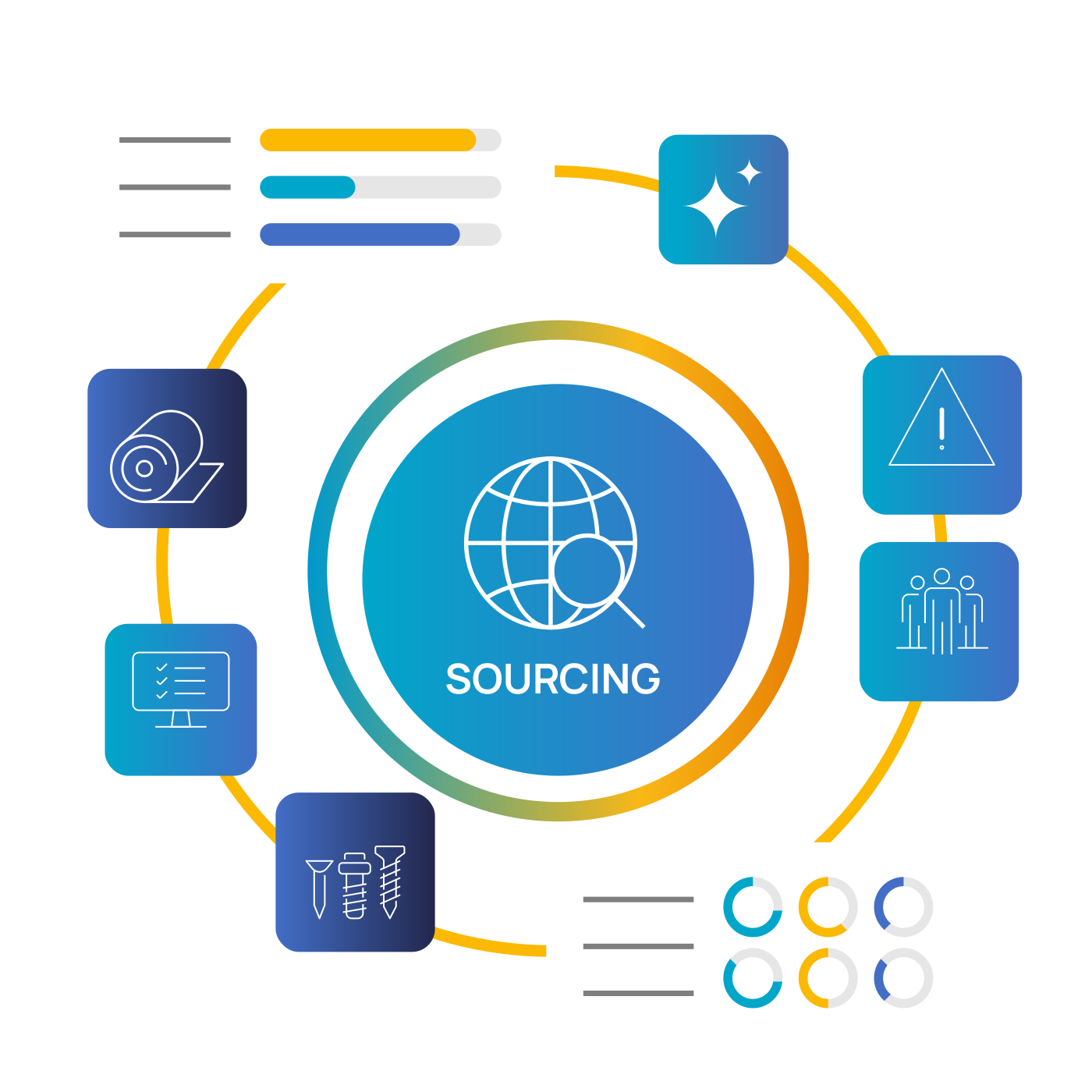
Even with a defined process, most organizations struggle with making direct materials procurement a consistent process. Based on Ivalua’s manufacturing framework, five core challenges repeatedly undermine supply chain resilience:
- Manual and disconnected processes
- Inefficient product launches
- Poor supplier and stakeholder collaboration
- Supply disruptions and inconsistent quality
- Stock-outs that drive excess safety stock
The sections below break down each challenge, using these categories as a diagnostic lens to identify where direct materials procurement breaks down, and why.
Disconnected Systems Create Blind Spots Across the Lifecycle
Direct materials procurement generates high-volume, time-sensitive data. When that data is fragmented across ERPs and spreadsheets, it’s hard to get a complete picture of what’s happening.
In many organizations, demand signals sit in one ERP module, supplier data in another system, quality records in separate tools, contracts in shared drives, and order confirmations buried in email, so there’s a reliable view.
Given these challenges, it’s no surprise that nearly two-thirds of organizations were late responding to supplier risk events, because they lacked continuous monitoring – a direct result of siloed data. In regulated industries, fragmentation also creates traceability and compliance risks.
A unified, e-procurement platform integration that’s built on a single data model can connect procurement process mapping and spend analysis tools into a single source of truth.
Tier-2 Visibility Gaps Leave Organizations Exposed to Upstream Risk
Supply risk in direct materials often originates far upstream. Without visibility beyond tier 1, you won’t know when a disruption is coming.
For example, an automotive OEM may contract with a tier-1 supplier for components, while that supplier depends on a tier-2 provider that sources raw steel from a tariff-affected region.
There’s no way to see that risk until the supply chain is already impacted. Sadly, only 42% of companies have visibility into tier-2 or deeper supply chain risks, leaving gaps in supply chain continuity.
Gartner recommends segmenting critical suppliers and applying proactive risk management frameworks, yet only 35% of organizations have a formal enterprise-wide risk appetite for procurement.
Poor Supplier Collaboration Inflates Safety Stock and Slows Response
Direct materials procurement depends on information that lives with suppliers, and organizations that don’t have good communication with suppliers are at a disadvantage.
While procurement needs accurate capacity and lead time data, suppliers depend on forward demand signals to plan production. Exchanging this information by email or phone calls leads to a disconnect, and companies have to operate on inaccurate information. They may build excess stock to lower risk and uncertainty.
This challenge is intensifying as global sourcing strategy shifts; 43% of companies plan to move more supply chain footprint to the U.S.. Structured collaboration models must replace fragmented communication, so all parties can work in sync.
Manual Processes Slow Product Launches and Inflate Costs
The handoff between product development and direct materials procurement is chronically undermanaged. The result is higher costs from delayed launches and expedited sourcing.
New product introductions force procurement to source, qualify, and contract materials on timelines set by engineering, which can change frequently as designs evolve. When procurement isn’t engaged until late in the process, samples may enter production unvalidated, leaving APQP records incomplete at launch.
Effective manufacturing process integration connects engineering BOMs to sourcing and quality workflows. This enables procurement digitalization initiatives that surface long-lead or single-source risks early, before designs are locked in.
Solving all of these challenges requires a platform that connects the full lifecycle.
How Agentic AI Is Changing Direct Materials Procurement
The challenges outlined above – fragmented systems, limited visibility, reactive collaboration, and disconnected product lifecycles – are exactly what agentic AI is designed to solve.
That’s why 80% of manufacturing executives plan to invest 20% or more of their improvement budgets in smart manufacturing in 2026.
The procurement capabilities underpinning those investments have matured at the same time, and as a result, AI has evolved from a simple reporting tool to an acting agent that can be embedded directly into direct materials procurement workflows.
From Spend Dashboards to Autonomous Sourcing Workflows
Agentic AI for direct materials procurement is only as effective as the data it runs on. When BOMs and supplier records are spread across different systems, AI struggles to make informed decisions.
With strong e-procurement platform integration, agentic AI can operate like it’s supposed to, learning and acting across sourcing processes and executing tasks in compliance with controls.
In direct materials environments, analytics agents are being used to generate real-time sourcing and supplier insights. Here are a few examples:
- Category Intelligence deepens direct category analysis
- RFx Price Benchmark supports should-cost modeling
- Sourcing Supplier Finder identifies and invites qualified suppliers
- Supplier Improvement Plans translate performance data into action
Deloitte notes that agentic AI is now used to quantify should-cost and recommend suppliers. It can even initiate negotiations with human approval. And, according to Gartner, technology adoption nearly doubles the effectiveness of supplier risk evaluation compared to manual approaches.
Ivalua’s IVA (Intelligent Virtual Agent) orchestrates these agents across Source-to-Pay, automating outcomes while maintaining human oversight. The key distinction from point solutions is that because Ivalua handles both direct and indirect spend on a single platform with one data model.
AI for direct procurement has access to the complete picture of supplier performance, cost history, and contract compliance, so outputs reflect real supplier performance and history.
Ivalua never uses customer data to train LLMs or pools data across tenants, which matters acutely for manufacturers whose BOM, supplier, and contract data is competitive intelligence. Download the Ivalua Agentic AI whitepaper to learn more.
How Antolin Streamlined Direct Materials Procurement Across 150 Factories
Antolin is a global automotive interior manufacturer operating 150 factories across 26 countries. They were challenged with using legacy systems for managing direct materials spend, which were unable to integrate with their PLM (Teamcenter).
As a result, manual data entry was necessary at every procurement stage, leaving buyers with zero visibility into BOM status or supplier risk.
Using Ivalua, Antolin can automatically load BOMs through integrations and give stakeholders real-time visibility into components, investments, and POs.
Procurement now collaborates with engineering and suppliers early in the product lifecycle, rather than at the point of purchase, and they can manage about 40K suppliers and over 1200 contracts using a single platform.
“With Ivalua, our organization has improved collaboration both internally and externally with suppliers, automated processes and greatly improved our visibility across the end-to-end direct materials procurement process.”
– Beatriz Jimenez Benito, Control and Systems Purchasing Director, Antolin
Read the full Antolin case study.
Direct Materials Procurement as a Strategic Function
Direct materials procurement sits at the intersection of production continuity, cost management, and supply chain resilience. If your organization treats it as a cost-cutting function rather than a strategic one, you will compromise performance and fall behind your competitors.
A modern direct procurement strategy focuses on building a resilient and agile supply chain and support for close collaboration across procurement and engineering from the earliest stages of product development. To achieve this you need:
- A technology-connected lifecycle process that breaks down data silos
- Proactive supplier risk management beyond Tier 1 suppliers
- AI that powers smarter decision-making and helps you balance cost, quality, and supply continuity.
Get started with Ivalua and learn how you can move from reactive sourcing to a coordinated and resilient direct materials procurement model.
Build a Smarter Direct Materials Procurement Process With Ivalua
Frequently Asked Questions
FAQs
Direct materials procurement software integrates with ERP, MRP, and PLM systems to connect demand signals, BOM data, and supplier transactions into a single workflow. This ensures sourcing decisions reflect real production requirements, engineering changes, and inventory constraints in real time.
Enterprise platforms should include BOM management, sourcing optimization, supplier risk and performance management, APQP workflows, and deep ERP/MRP integration. These capabilities enable end-to-end control from product design through supplier execution and quality validation.
A direct materials procurement platform improves supplier collaboration by replacing email-based communication with shared workflows for forecasts, orders, and performance tracking. This gives both buyers and suppliers real-time visibility into demand, capacity, and issues.
Manufacturers unify these data sets by using a platform built on a single data model that connects engineering, procurement, and quality processes. This eliminates silos and ensures every decision is based on consistent, up-to-date information.
Visibility improves when organizations consolidate sourcing, supplier, contract, and transaction data into one system with real-time analytics. This enables accurate tracking of spend, supplier performance, and risk across categories and regions.
AI enhances direct materials spend management by automating analysis, identifying cost and risk patterns, and supporting faster, more informed sourcing decisions. It can also recommend suppliers, benchmark pricing, and proactively flag disruptions.
Procurement teams balance these priorities by using total cost of ownership models, supplier performance data, and risk insights within a unified platform. This allows them to evaluate trade-offs holistically rather than optimizing for cost alone.