

The procurement management process is a sequence of activities that you can use to identify your organization’s business needs, find suppliers, purchase goods and services, and pay your suppliers. It helps you control cost and risk, while maintaining compliance.
However, in an enterprise, it’s often difficult to connect all these steps into a seamless workflow. When all functions are operating independently across disconnected systems, you can lose visibility into the process – and lose control of costs.
In this guide, we explain how procurement management works across the Source-to-Pay lifecycle and how a unified platform can reduce fragmented procurement processes that can create risk.
Key Takeaways
- Multiple procurement activities run in parallel and depend on shared data and coordinated workflows.
- Disconnected systems can lead to maverick spend and compliance gaps.
- A unified S2P platform connects the process, creating the data foundation for automation today and agentic AI tomorrow.
What Is the Procurement Management Process?
Essentially, managing procurement means following policies, workflows, and activities to acquire the goods, services, and materials. It helps you control cost, risk, supplier performance, and compliance, as well, and encompasses the entire procurement lifecycle.
It’s important to distinguish procurement management from related business functions. For example, purchasing is a transactional process of creating purchase orders and buying goods or services, while supply chain management includes inventory, logistics, warehousing, and distribution.
Procurement management is important in strategic procurement, where teams are expected to accomplish more with the same or even fewer resources. McKinsey reports that procurement organizations now manage 50% more spend per full-time employee than they did just five years ago, indicating a need for standardized, connected procurement processes.
The steps in the procurement process fall into three interconnected operating areas, as outlined below.
Planning and Governance
During planning and governance, you establish the policies and controls that guide procurement decisions. It includes:
- Aligning budgets
- Creating approval workflows
- Setting Procurement policies
Organizations often formalize these activities through established procurement management frameworks. This helps to ensure purchases align with business objectives and governance requirements.
Sourcing and Execution
Procurement teams identify suppliers, negotiate commercial terms, and complete transactions across the procurement lifecycle stages, including:
- Supplier identification
- RFx processes (RFI, RFP, and RFQ)
- Supplier evaluation and selection
- Negotiation
- Contract creation and execution
- Purchase order creation
- Goods and services receipt
- Invoice matching
- Payment
Oversight and Optimization
Continuous oversight is needed to improve financial performance and supplier relationships. This encompasses:
- Spend analysis
- Supplier performance evaluations
- Compliance monitoring
- Contract renewal and renegotiation
- Continuous process improvement
Unfortunately, these three operating areas often span multiple teams and disconnected applications, which means teams lack visibility and may struggle with governance. It also complicates the process of implementing AI-driven workflows.
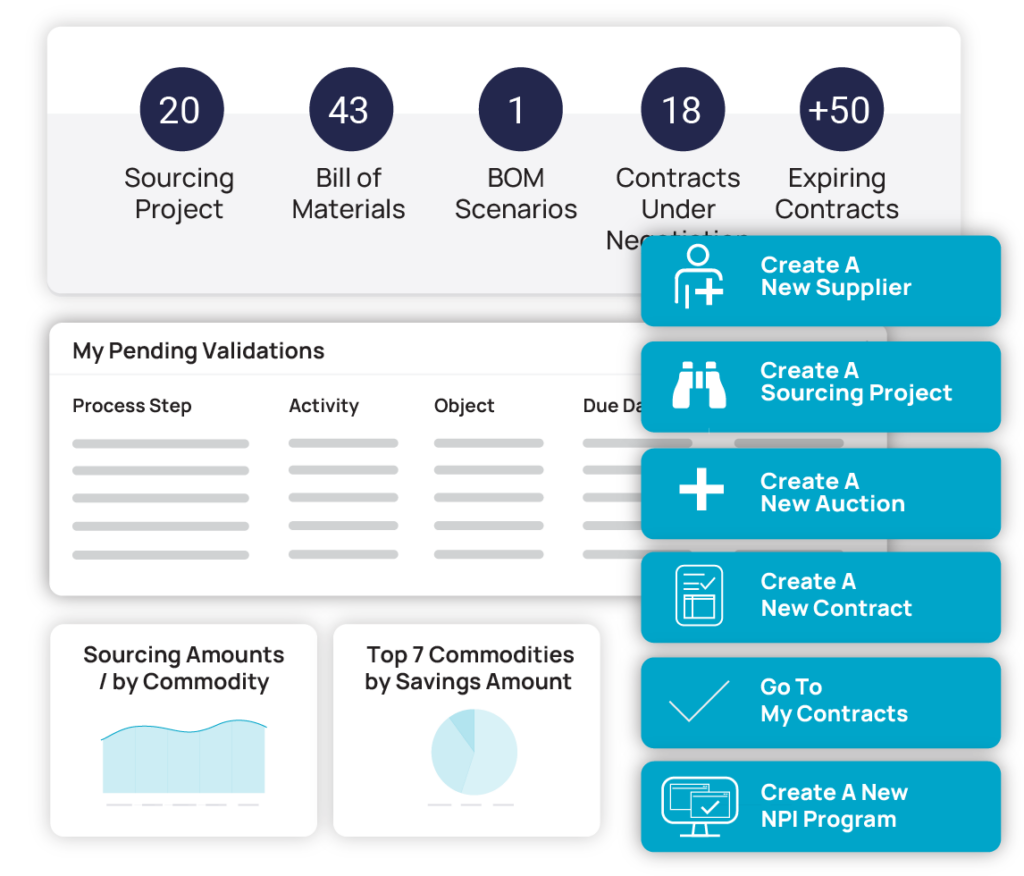
Ivalua’s Source-to-Pay platform connects planning, sourcing, purchasing, supplier management, contracting, and accounts payable on a single platform. This enables end-to-end visibility and stronger governance, plus a unified data foundation for leveraging agentic AI across the entire procurement lifecycle.
The Problem with the Traditional Step-by-Step Model at Enterprise Scale
Most diagrams of the procurement lifecycle present a simple sequence:
- Define a need
- Source a supplier
- Negotiate a contract
- Create a purchase order
- Receive goods
- Pay the invoice
- Evaluate performance
However, this sequence doesn’t reflect how enterprise procurement actually works.
In reality, the stages of procurement management overlap. While one team is running new sourcing events, existing contracts are up for renewal. Invoices are being processed while supplier performance reviews are also taking place. Compliance checks can occur at any time during the process, and teams may have to move back and forth between stages if there are exceptions.
To make matters even more confusing, not all purchases require the same scrutiny. A $500 office supply purchase requires less attention than a $5 million strategic services engagement.
That’s why enterprise procurement requires different approval workflows, sourcing requirements, risk assessments, and governance controls. The approach depends on the spend amount, category, regulations, and other factors.
The traditional procurement process also overlooks an organization’s maturity level. For example, one company might be managing procurement using spreadsheets and disconnected ERP systems, whereas another is using an integrated Source-to-Pay platform. Procurement process improvement has to take into consideration how information is flowing between procurement steps before understanding where to focus on making improvements.
The Hackett Group found that Digital World Class procurement organizations achieve 58% shorter requisition-to-purchase-order cycle times and 24% shorter sourcing cycles than their peers by redesigning how to best connect and automate workflows. This is the foundation for modern procurement transformation – using a procurement governance framework that adapts to different purchase types, orchestrates parallel workstreams, and connects every stage of the Source-to-Pay lifecycle.
The next section introduces a practical framework for managing procurement this way.
The Procurement Process Maturity Stack: A Better Operating Framework
The traditional procurement management process describes what happens, but the Procurement Process Maturity Stack explains how modern procurement organizations operate at enterprise scale. It organizes the procurement management process into three interdependent operating layers that run at the same time. Each layer of the stack builds on the one below it.
The table below outlines the Maturity Stack, including an overview of each layer.
| Layer | What It Covers | Low Maturity State | High Maturity State |
|---|---|---|---|
| Foundation — Govern & Plan | Procurement planning, policies, approvals, budgets, governance | Manual approvals, inconsistent policies, fragmented data | Standardized intake, policy-driven workflows, unified data foundation |
| Execution — Source, Contract & Transact | Supplier sourcing, RFx, negotiations, contracts, purchase orders, receiving, invoice matching, payment | Email-based handoffs, disconnected systems, manual processing | Connected workflows, automated execution, end-to-end visibility |
| Intelligence — Analyze, Optimize & Scale | Spend analysis, supplier performance, compliance, optimization | Static reports and reactive decisions | Real-time insights, continuous optimization, AI-driven recommendations |
Foundation Layer: Govern & Plan
The Foundation layer establishes how demand enters procurement, how purchases are approved, which policies apply, and how procurement strategy aligns with business objectives. By standardizing these processes, it makes automating and governing subsequent activities easier.
Execution Layer: Source, Contract & Transact
The execution layer manages day-to-day procurement activities such as supplier identification, RFx events, contract execution, purchase orders, receiving, invoice matching, and payment. Procurement automation tools that are supported by consistent governance and unified data can deliver meaningful value at this layer.
Intelligence Layer: Analyze, Optimize & Scale
Truly mature procurement organizations implement continuous improvements. This means analyzing spend and evaluating supplier performance, monitoring compliance, identifying savings opportunities, and refining strategies using trusted operational data. Intelligence means that every transaction feeds a connected system.
Interdependence Is Key
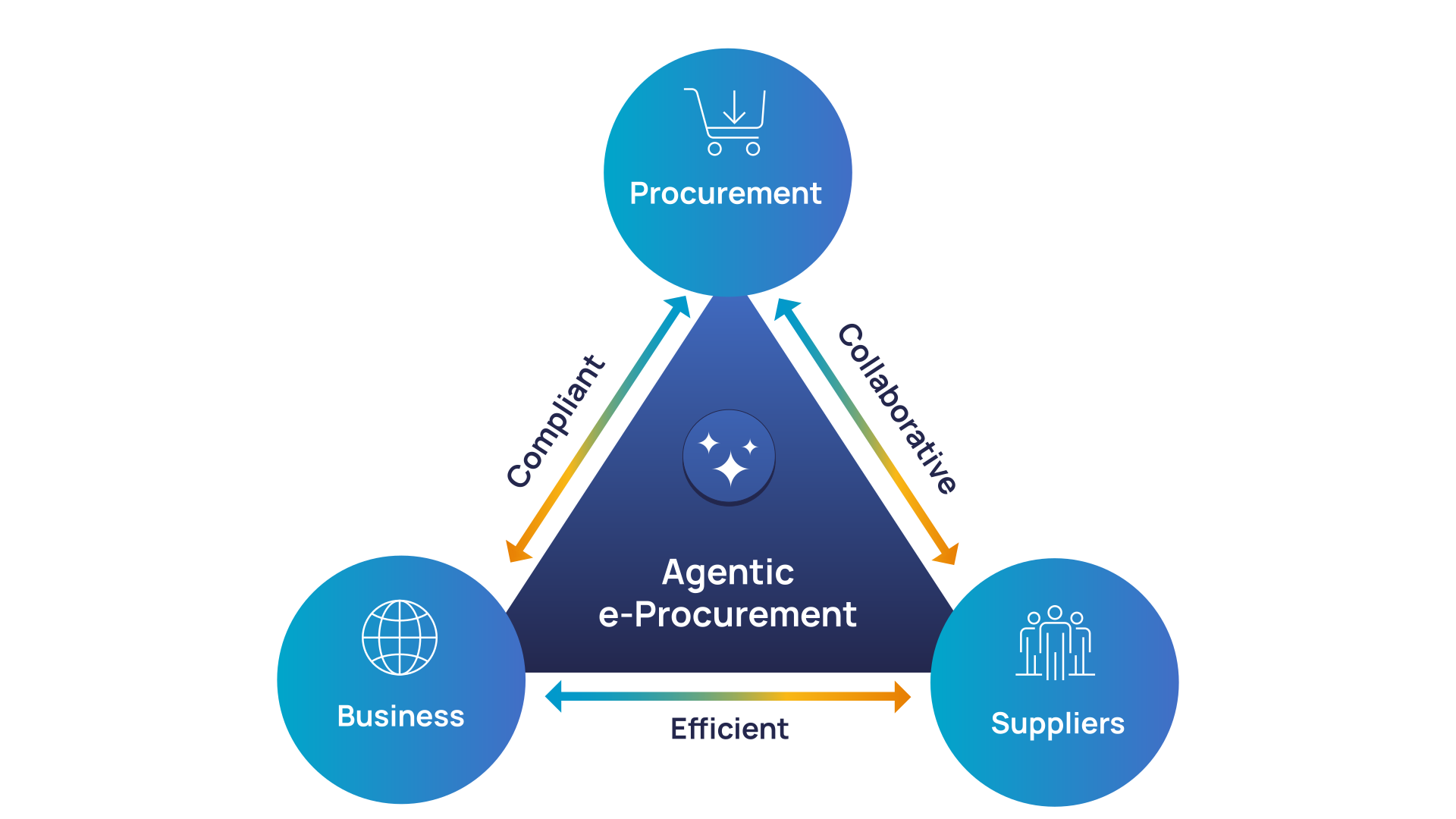
These layers must operate together to achieve true automation and procurement optimization. This requires a unified Source-to-Pay platform that connects them and enables data to flow seamlessly from planning through execution.
Ivalua’s platform architecture provides:
- A trusted system of record support of procurement data.
- A coordinated system of action to carry out connected workflows and automation.
- An adaptive system of governance that supports the intelligence layer with continuous monitoring, policy enforcement, and AI-assisted decision making.
While traditional procurement models were designed for linear workflows and human coordination, today’s procurement teams must manage growing spend, mitigate supply risk, support ESG initiatives, improve resilience, and create strategic value, all while handling increasing transaction volumes with lean teams.
The Procurement Process Maturity Stack illustrates how you can graduate from manual governance and sequential workflows to policy-driven intake and connected, automated workflows.
In the next sections, we examine each layer of the Maturity Stack in detail, including why it’s critical and what’s involved.
Foundation Layer — Govern and Plan
The foundation layer of the maturity model is where the governance, policies, and decision-making framework are established.
A strong procurement planning process can help reduce delays and compliance issues, while controlling unnecessary spend.
And that’s important: Deloitte reports that 71% of procurement time is spent on operational and transactional activities. Organizations making the greatest progress are changing how they approach these efforts.
Set Policies, Approval Workflows, and Spending Controls
Governance determines how a request moves forward in the system, according to set policies. But these policies only help reduce maverick spend if they are executed within the procurement system. According to The Hackett Group, Digital World Class procurement organizations with strong governance lose 60% less negotiated savings.
Ivalua customers can realize these savings through procurement automation. Using Ivalua’s low-code/no-code AI-workflow engine, procurement teams can configure approval thresholds, routing rules, buying channels, and policy logic without help from IT, so that governance is operational and enforced automatically.
Align Procurement Strategy With Business Objectives
Governance also aligns procurement with business strategy. McKinsey reports that two-thirds of procurement leaders now report directly to the CEO or CFO, with many separating strategic procurement from transactional buying to focus on higher-value work.
Ivalua’s Intake Management solution offers a single AI-powered entry point for procurement requests, along with guided workflows that capture business requirements and apply policy-driven routing. They connect requests directly into sourcing, purchasing, contracting, and invoicing.
Remember, the platform you choose for the Foundation Layer determines what’s possible everywhere else. A unified platform built on a single code base and data model connects governance, execution, analytics, and AI, whereas “suite-in-a-box” architectures are disconnected and prone to creating silos.
Execution Layer — Source, Contract, and Transact
Execution covers every activity throughout the Source-to-Pay process. High-performing organizations treat them as a connected workflow, with data flowing seamlessly from start to finish.
According to McKinsey only about 60% of large organizations and 30% of smaller organizations have implemented a Procure-to-Pay (P2P) platform, despite its potential to lower procurement costs by up to 5%. The opportunity is to execute every activity on a single platform.
Source and Select Suppliers
The strategic sourcing process starts with understanding the supply market and identifying suppliers that can meet your business requirements. This involves conducting research; issuing RFIs, RFPs, or RFQs; evaluating proposals; negotiating commercial terms; and selecting suppliers.
High-maturity organizations use e-sourcing platforms rather than manual processes, automating the request for proposal process and other tendering process steps. They also use standardized RFx templates and weighted scoring models along with supplier performance history to compare suppliers and keep a complete audit trail.
While human judgment still drives supplier selection and negotiation, AI can dramatically shorten sourcing cycles and improve procurement decision quality.
Negotiate and Execute Contracts
Modern Contract Lifecycle Management (CLM) platforms connect sourcing directly to contracting, rather than storing contracts in shared folders or email threads. Things like standard clauses, approval workflows, and automated renewal management can be used to ensure contracts are connected to the purchasing process and not just static documents.
Agentic AI can expand CLM by automatically extracting obligations, milestones, pricing terms, and compliance requirements from executed agreements. It can also be used to monitor performance against those commitments continuously, adjust clauses before a renewal, or flag missed obligations. This can all be done without manual intervention.
And, automation pays. According to Kearney, identifying and preventing contract leakage can recover up to 3% of organizational spend that would otherwise be lost because organizations lack the capacity to compare every transaction against negotiated terms.
Purchase, Receive, and Manage Orders
The Purchase-to-Pay experience plays a significant role in compliance. Guided buying, supplier catalogs, punchout marketplaces, and preferred buying channels make it easier for your employees to leverage approved suppliers and not go rogue.
Routing requests through structured intake and into connected purchasing workflows helps reduce maverick spend while eliminating manual work. Ivalua estimates that 20% of purchasing activities consume 80% of procurement time.
Process Invoices and Execute Payment
Accounts payable receives supplier invoices and validates them against purchase orders and receipts. They resolve any exceptions at this stage and approve the invoices before issuing payment.
Low-maturity organizations perform most of the invoice approval workflow manually, whereas high-maturity organizations automate PO and non-PO invoice processing. AI handles 3-way matching, detecting any duplicates or price discrepancies, and sends exceptions for human review.
Non-PO spend, such as utilities, recurring services, and contract-based purchases, may require human review, but AI can still help match invoice lines at the commodity and contract level, and validate invoices against contracted services. This extends automated matching to spend categories that historically required manual intervention.
Supplier communication can also be improved with AI. Rather than contacting Accounts Payable directly, suppliers can use an AI assistant embedded in a self-service portal to find information themselves. This reduces the number of inquiries to AP while improving security by reducing the exchange of sensitive information via email.
Ivalua’s Procure-to-Pay, Accounts Payable Automation, and Payments software connect all of this on a single platform. The solution supports every order type, automates processing for PO and non-PO invoices, and provides a secure supplier portal with AI-assisted self-service.
Intelligence Layer — Analyze, Optimize, and Scale
At the Intelligence Layer, the procurement management process starts to self-improve. Leading organizations continuously measure supplier performance and analyze outcomes, and they use those insights to improve sourcing and purchasing decisions.
The Hackett Group found that Digital World Class procurement organizations spend 26% more time analyzing data instead of collecting it, and McKinsey’s long-term procurement research revealed that companies with advanced procurement operating models increase EBITDA margins by 5%.
Conduct Spend Analysis and Identify Savings Opportunities
Spend analytics brings procurement data together to determine where money is actually being spent. It classifies purchasing activity across suppliers, categories, business units, and geographies, and finds unmanaged spend and other errors that may go undetected otherwise.
Low-maturity organizations analyze spend maybe once a quarter using ERP data and spreadsheets, which is slow and inefficient. High-maturity teams, on the other hand, embed analytics directly into day-to-day operations, automatically classifying spend as transactions occur. They may also use AI to look for abnormal purchasing behavior and savings opportunities.
Evaluate Supplier Performance and Manage Risk
By evaluating supplier performance on an ongoing basis, you can keep procurement decisions aligned with business objectives over the course of the supplier relationship. Key KPIs to measure include:
- On-time delivery
- Product and service quality
- Responsiveness and service levels
- Cost competitiveness
- ESG and regulatory compliance
- Financial and operational risk
These metrics should feed directly back into sourcing strategies and supplier relationship management tools. This makes it easier to identify strategic partners and any performance issues that need corrective action.
The Hackett Group found that top-performing procurement organizations generate over 2X greater cost savings as a percentage of spend when they have the ability to renegotiate supplier relationships based on ongoing performance data.
Monitor Compliance and Drive Continuous Improvement
Driving continuous improvement requires ongoing contract compliance monitoring, to ensure suppliers are adhering to policies and regulations, as well as performance expectations. It helps close the loop between governance and execution.
But continuous improvement can only happen when the Foundation and Execution layers share a common data foundation that helps procurement leaders identify trends and issues across supplier categories and business units.
Ivalua’s embedded analytics capabilities unify this intelligence across the entire Source-to-Pay platform. Spend Analysis, supplier scorecards, compliance dashboards, and procurement KPIs all draw from the same shared data model and single source of truth, providing real-time visibility and insights into performance.
Digital World Class procurement organizations achieve 2.6 times greater ROI than their peers while operating with 31% fewer FTEs and 19% lower procurement costs as a percentage of spend. Those outcomes reflect strong governance and continuous intelligence working together as one operating model.
How Agentic AI Changes What Happens at Each Layer
While AI in procurement focuses on individual tasks, agentic AI has the ability to execute actions within defined business rules and coordinate work across the entire procurement management process.
McKinsey estimates agentic AI could improve procurement productivity by 25–40%, enabling teams to spend more time on strategic decision-making.
AI in the Foundation Layer — Intelligent Intake and Policy Enforcement
AI agents convert unstructured business requests into structured procurement intake. They can be used to evaluate requests against policies and budgets, and automatically route them to the appropriate buying channel.
When AI is foundational, policies can be proactively enforced throughout the procurement lifecycle.
AI in the Execution Layer — Autonomous Sourcing, Matching, and Negotiation
AI agents can perform complex tasks such as generating RFx packages or analyzing supplier proposals. Human judgment still drives negotiations, but AI significantly reduces administrative work.
AI in the Intelligence Layer — Real-Time Analytics and Predictive Optimization
As part of an eSourcing solution, AI continuously analyzes spend, supplier performance, compliance, and operational risk. It can identify contract leakage and predict supplier issues, recommending corrective actions before they escalate into serious problems.
Why the Foundation Has to Be Solid Before AI Can Scale
While you don’t need perfect data, you do need a trusted system of record with unified procurement data.
AI Across the Source-to-Pay Lifecycle
| Area | Examples of Agentic AI |
|---|---|
| Supplier Management | Supplier onboarding, data enrichment, risk monitoring, performance evaluation |
| Strategic Sourcing | Autonomous sourcing events, RFx generation, proposal analysis, price benchmarking |
| Contract Management | Contract digitization, clause drafting, risk analysis, obligation monitoring |
| Procurement Automation | Guided buying, purchase orchestration, invoice matching, exception handling, payment automation |
| Analytics & Governance | Spend analysis, compliance monitoring, supplier risk prediction, savings identification |
Ivalua’s IVA Studio orchestrates all of these Source-to-Pay activities. Grounded in trusted procurement data, IVA works across procurement workflows.
IVA Studio helps teams build agentic Skills using no-code configuration. The result is a hybrid operating model where AI manages routine execution and procurement professionals focus on strategy and value creation.
How UPL Centralized Fragmented Procurement Across 12,000 Employees With Ivalua
UPL, a global agrochemicals manufacturer, needed to replace fragmented regional procurement processes with a unified operating model. Disconnected systems were limiting spend visibility, and inconsistent supplier data made it difficult to consolidate sourcing activities or negotiate strategically across regions. What’s more, direct materials procurement lacked centralized pricing controls, making it difficult to manage costs.
Using Ivalua, UPL transformed procurement onto a single global platform, achieving 100% purchase requisition-to-purchase order adoption in India. They consolidated multiple purchase requests into larger sourcing events, and established a global shared services center to improve visibility and standardize operations.
“The biggest benefit is having a single source of truth in one centralized platform. With strategic sourcing and transactional procurement on one platform globally, we benefited from scale and efficiency.”
Sylesh Gopan, Global ERP Head at UPL
UPL’s transformation illustrates the Procurement Process Maturity Stack in practice, and how organizations can move from a fragmented procurement management process to a unified operating model built on a single e-procurement system.
Build Your Procurement Management Process Around a Unified Platform
The most effective procurement management process is a connected operating model. When you build a strong foundation for governance and automation, you can continuously optimize performance, reduce costs, and realize the full value of agentic AI.
Ivalua’s unified Source-to-Pay platform connects every stage of the procurement lifecycle on a single data model, providing the trusted system of record and the adaptive governance you need to scale automation and continuously improve procurement performance as your business evolves.
Build a procurement management process ready for AI.
Frequently Asked Questions About the Procurement Management Process
FAQs
The steps of the procurement process typically include planning and governance, supplier sourcing, contract negotiation, purchasing, receiving goods or services, invoice processing, payment, and ongoing performance management. In enterprise organizations, these activities operate as connected workstreams rather than a simple linear sequence, with governance, execution, and optimization happening simultaneously.
The procurement management process covers the entire lifecycle of acquiring goods and services, including planning, sourcing, contracting, supplier management, purchasing, and performance analysis. Purchasing is one stage within that process, focused on creating purchase orders, receiving goods, and completing transactions.
Procure-to-Pay (P2P) focuses on the operational purchasing cycle, including requisitions, purchase orders, receiving, invoicing, and payment. Source-to-Pay (S2P) includes the entire P2P process while extending upstream to strategic sourcing, supplier management, contract lifecycle management, and spend analysis.
Across the procurement lifecycle stages, common KPIs include sourcing cycle time, supplier response rates, contract compliance, purchase order cycle time, invoice processing time, spend under management, supplier performance, maverick spend, cost savings, and on-time payment rates. Leading organizations also track policy compliance, supplier risk, and AI-driven automation rates to measure procurement maturity.
AI in procurement automates repetitive work while improving decision-making across the entire lifecycle. AI agents can route intake requests, generate RFx documents, analyze supplier bids, automate invoice matching, monitor supplier risk, identify savings opportunities, and recommend corrective actions, allowing procurement professionals to focus on strategy and supplier relationships.
The best procurement management software provides more than standalone automation. Enterprise buyers should prioritize a unified Source-to-Pay platform with a single data model, configurable workflows, embedded analytics, strong integration capabilities, and AI that operates across the entire procurement lifecycle rather than within isolated modules.