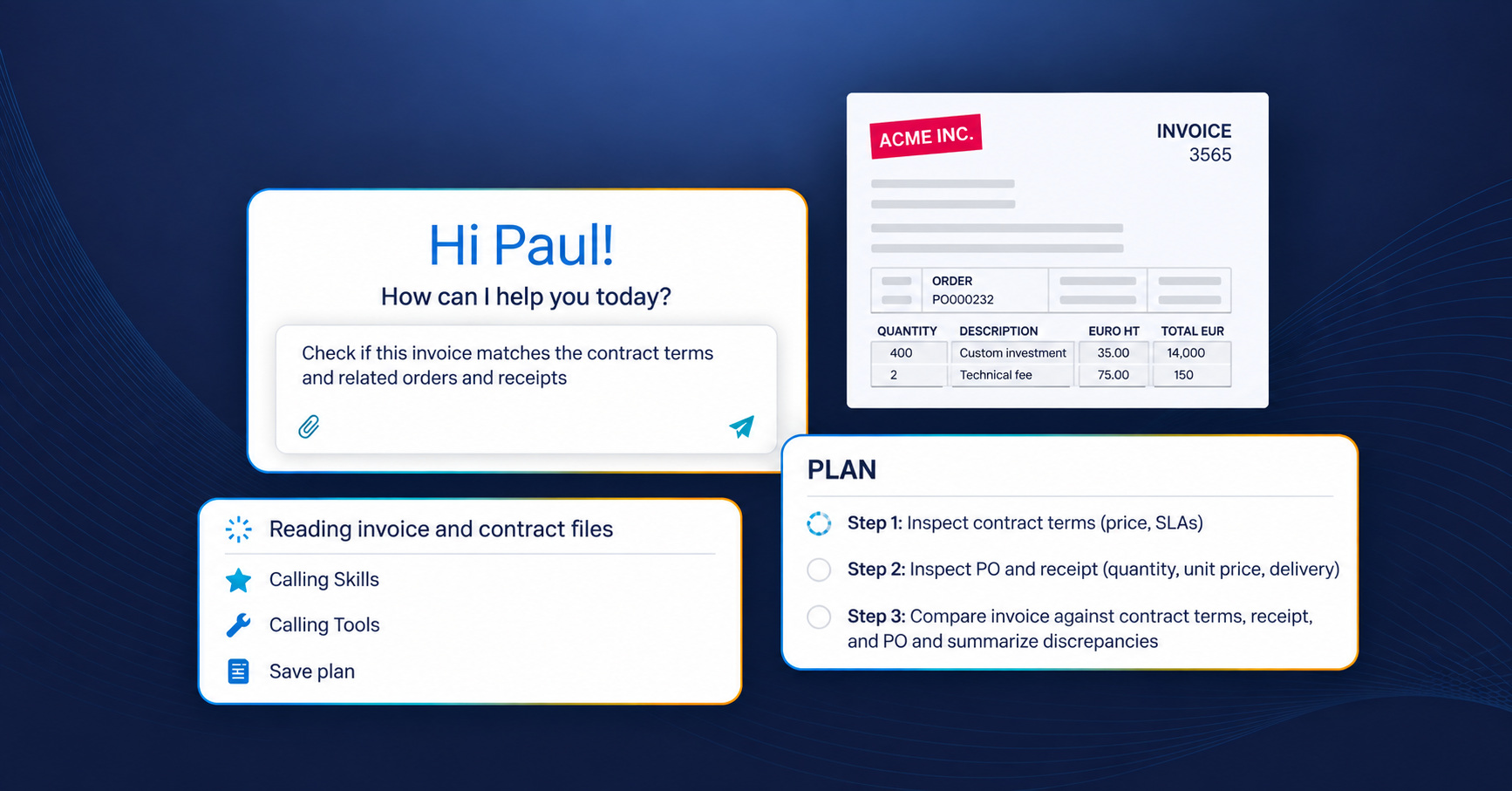


Procurement AI agents do not just surface insights and wait for someone to act. They should recommend suppliers, approve workflows, flag risks, create purchase orders, validate invoices against buried contract terms, and trigger downstream actions across Source-to-Pay.
You want something that can automate, connect the dots, act as a master tactician and importantly for this topic, take action. Once an agent can act, not just inform, the governance conversation changes completely.
AI governance in procurement is the system of controls that defines what AI agents can access, what they can do, when humans must approve actions, and how every decision is monitored and audited.
Get it wrong and you have autonomous agents operating without guardrails. Get it right and you have a procurement team with a serious competitive edge.
This is the second article in a three-part series on agentic AI in procurement. It covers what governance actually requires at enterprise scale, why human accountability needs to be structural, and what separates AI deployments that scale from those that stall.
Key Takeaways
- AI governance in procurement defines what agents can access, decide, execute, and escalate.
- Human accountability must be built into the architecture, not added as an optional setting.
- Enterprise AI agents require role-based access controls, decision boundaries, audit trails, and lifecycle monitoring.
- Strong governance gives procurement teams confidence to scale AI without losing control.
Autonomy Without Governance Is Just Risk
There is a meaningful difference between a procurement analytics tool that surfaces a spend anomaly and an AI agent that identifies the anomaly, determines which contracts are affected, flags the suppliers involved, and kicks off a corrective workflow. The first is a reporting function. The second is taking action on behalf of the organization.
When AI agents in procurement approve a purchase order, recommend a supplier for a strategic sourcing event, or negotiate pricing against predefined parameters, the stakes are operational and financial. It is worth noting that enterprise contracts for agentic AI are starting to look a lot like outsourcing agreements. That makes sense. You are delegating action, not analysis.
Most procurement leaders are past the question of whether to use AI agents. The harder question is how to trust them within enterprise boundaries, how to give agents enough room to be useful while maintaining enough control to be accountable.
That is the governance problem, and most organizations do not have a good answer yet.
What Governance Actually Means for AI Agents
Governance gets used loosely in procurement technology. In this context it has a specific meaning: it is an operating model embedded into how agents work. Not a policy doc. Not a compliance checkbox. Something that is enforced continuously and automatically at the platform level.
There are four pillars to get right:
Access control
is about what each agent can see. An agent working on behalf of a category manager should see what that category manager is authorized to see. Their categories, their suppliers, their contracts. Role-based access controls for AI agents should mirror the permission structures that already govern human users. If your AI procurement implementation does not enforce this at the platform level, every agent becomes a potential data exposure.
Decision boundaries
are about what the agent can do on its own. Can it approve a PO below a certain threshold? Can it recommend a supplier but not select one? Can it run a three-way match on an invoice but escalate exceptions? These need to be enforceable constraints, not guidelines. Without clear boundaries, autonomy is just uncontrolled execution.
Auditability
is about tracing actions and reasoning. Every agent action, every data point accessed, every tool called, every decision made should be logged. And not just the output. The reasoning chain. When a CFO or auditor asks why the agent recommended a particular supplier, the answer needs to be traceable. Not “the model determined…” but a concrete chain of data, logic, and permissions.
Continuous evaluation
is about what happens after deployment. An agent that performs well on day one can degrade as data shifts, policies evolve, or edge cases accumulate. Governance is not a gate you clear once. It is ongoing monitoring for accuracy, drift, and performance.
Human Accountability Is the Architecture, Not a Setting
Here is where this gets concrete.
Some vendors treat governance as configuration. They give you sliders for autonomy levels, toggles for human-in-the-loop approvals, dashboards for monitoring.
That sounds reasonable on the surface. But it puts the entire burden on the customer to figure out the right settings, maintain them as processes change, and answer for the consequences when something goes wrong.
After a governance failure, the question becomes “why did you configure it that way?” rather than “why did the platform allow it?”
There is a better model. Make human accountability structural. Every agent action is accountable to a named human, by design. When an agent operates in a chat conversation, it inherits the permissions of the user who invoked it and cannot exceed them.
When it runs autonomously in a workflow or in the background, it still has an accountable user whose permission boundary it follows and who it falls back to for human-in-the-loop decisions. There is no mode where the agent operates without a person responsible for the outcome.
In practice, this plays out across three levels of autonomy:
- Assist: The agent does the research, analysis, and recommendation work. The human reviews and decides. An agent might surface the top three suppliers for a sourcing event with full scoring rationale. The category manager makes the call.
- Execute: The agent acts within rules and parameters that a human has already approved. The AP team sets three-way match tolerances and exception thresholds. The agent processes everything that falls within those tolerances. Exceptions go to a person. The parameters are human decisions. The processing speed is the agent’s contribution.
- Orchestrate: The agent coordinates multi-step workflows with human checkpoints at critical stages. A supplier risk event triggers the agent to surface affected contracts, identify alternative suppliers, and draft a mitigation plan. The procurement lead reviews and approves each stage before the agent moves to the next.
At every level, someone is accountable. Governed autonomy is not about removing people from procurement. It is about giving them leverage while keeping them in command. That is what separates agentic AI in procurement that actually scales from agentic AI that stalls because leadership does not trust it.

Pro Tip
Download the Enterprise AI solution brief to see how Ivalua helps procurement teams scale AI with trust and control.
Why Black-Box Agents Will Not Survive Enterprise Procurement
Procurement decisions touch spend, margins, supplier relationships, contractual obligations, ESG commitments, and regulatory compliance.
When an AI agent makes or influences a decision in any of these areas, the organization needs to understand why. “The AI decided” is not going to hold up in a quarterly review, a compliance audit, or a supplier dispute.
What does hold up is a clear transparency standard:
Explainable outputs. Recommendations, risk flags, and supplier scores should come with the data points, context, and reasoning that produced them. Not a generic confidence score. An explanation in procurement terms: total cost breakdown, risk signals, performance history, contract compliance status.
Traceable decision chains. Every step in the agent’s reasoning should be logged: what data was accessed, which tools were called, what context was applied, what permissions governed the action. The full chain, not an after-the-fact summary.
Action logs with real context. Not just what the agent did, but when, on whose behalf, under what permissions, and against what data state. This is the audit trail compliance and legal actually need.
Replay capability. If a decision gets questioned, the organization should be able to replay the agent’s reasoning with the same inputs and verify whether the output is reproducible. If it is not reproducible, it is not auditable. And if it is not auditable, it will not survive scrutiny.
Defined escalation paths. When an agent encounters ambiguity, conflicting data, or a decision beyond its boundaries, it should escalate to a human. Not guess. Not default to the most probable answer. Escalate, with context, to the right person.
Building and Evolving Agents You Can Trust
Governance does not end at deployment. An AI agent is not software you configure once and leave running. It is a capability that needs continuous management, and most organizations underestimate this.
The lifecycle is straightforward:
- Build or configure : Start with pre-built capabilities or configure agents for specific workflows. Procurement teams should be able to define what agents do. IT should maintain centralized control over permissions, data access, and LLM selection. Both need to be involved, and neither should be a bottleneck.
- Test against accuracy KPIs: Before any agent touches production data, test it. What is the accuracy rate on invoice matching? How well does the supplier recommendation align with actual category strategy? Testing before production is not a best practice. It is the minimum.
- Deploy with guardrails: Initial deployment should start conservative: mandatory human approval for high-value actions, tighter decision boundaries than you think you need, heightened monitoring. You can loosen guardrails as confidence builds. You cannot undo the damage from going too fast.
- Monitor continuously: Accuracy can drift as supplier markets shift, category strategies evolve, or data quality fluctuates. The agent that performed well in Q1 may need recalibration in Q3. Continuous monitoring is what makes AI in procurement orchestration trustworthy over time.
- Refine and iterate: Based on performance data, adjust: tighter or broader boundaries, new skills, updated thresholds, expanded or restricted data access. This is not a one-time exercise. The best AI deployments are the ones where the team treats agent performance the way they treat supplier performance, as something you actively manage.
The point is not to centralize all agent development in IT. It is to give procurement teams real tools to build and refine capabilities while the governance framework ensures nothing goes off the rails.
Procurement knows the workflows. IT knows the security and compliance requirements. The platform should serve both without forcing either to wait.
Pro Tip
Download the practical guide to agentic AI in procurement to learn how enterprise teams can scale AI agents responsibly.
The Agent Sprawl Problem: Why More Agents Means More Risk
There is a governance dimension that most conversations about procurement AI miss entirely.
A lot of vendors have responded to the agentic AI moment by shipping more agents. A sourcing agent. A contracts agent. A supplier risk agent. An invoicing agent. A spend analytics agent.
Each with its own data connections, its own permissions model, its own audit trail (or lack of one), and its own governance requirements.
Even within a single S2P suite, this is a governance problem. When five or ten agents each have different access scopes, different decision boundaries, and different accountability structures, governance becomes a patchwork.
Who is responsible when the sourcing agent and the risk agent contradict each other? Which agent’s permissions govern when one agent triggers another? How do you audit a decision chain that crosses three different agents with three different logging mechanisms?
It gets worse when those agents sit on top of fragmented data, which most of them do. Now you have multiple agents making independent decisions from partial views of the same underlying reality.
Each one is governed individually, but no one is governing the interactions between them. That gap is where governance failures live.
The alternative is architectural. A single agent with access to the entire platform, governed by a single permission model, logging to a single audit trail. One permission framework.
One accountability model. One place to look when you need to audit a decision. Not because simplicity is a goal in itself, but because governance at scale requires consistency, and agent sprawl is the opposite of consistency.
Five Governance Questions Every CPO Should Ask
Before investing in procurement AI agents, evaluate governance with the same rigor you apply to capability. These five questions will tell you whether a deployment is built to scale or built to stall:
1. Can I see what data each agent accesses?
If you cannot define and audit the data scope for each agent, you cannot enforce data governance. Every agent should operate within a clearly defined, permission-based boundary.
2. Does every agent action have a named human accountable? Not “can a human review it if they want to.” Is a specific person responsible for the outcome, every time, by default? There should be no mode where the agent operates without that accountability.
3. Is every action logged and auditable? The audit trail should capture what the agent did, when, on whose behalf, with what data, and with what reasoning. Partial trails are partial governance.
4. Can I test accuracy before deployment? Agents should be testable against real procurement scenarios before they touch production. If the vendor cannot support pre-deployment testing, that tells you something about how the product was built.
5. Can procurement teams build or modify agents without creating shadow AI? Procurement needs the ability to refine and extend AI capabilities. But if that happens outside a governed framework, without monitored data access or an audit trail, you have shadow AI. The platform should enable empowerment and control at the same time.
Case Study: How Körber Is Scaling AI with Governance First
Körber, the global technology group, is running a successful pilot of Ivalua IVA with an approach that puts governance at the center from the start.
Their model is instructive. Rather than deploying AI top-down and figuring out governance later, Körber invited users to propose use cases, validated each against governance requirements, and scales only what meets the standard. It is an adoption pattern built on trust rather than mandates.
“We started our AI journey in 2023. Currently we are running a very successful pilot with Ivalua IVA. We are primarily asking our users to propose use cases, and what we hear most often right now is automation type use cases and analytics type use cases.” — Jan Van Hueth, Senior Project Manager, Körber
Governance is not what slows AI adoption down. It is what makes adoption stick. When users trust that the platform enforces boundaries, logs actions, and maintains human accountability, they lean in. When that trust is missing, they resist, no matter how good the technology is.
Read the full case study: How Körber is Pioneering Responsible AI and Procurement Automation with Ivalua
Conclusion: Governance Enables Scale
Governance is not a constraint. It is the reason AI scales. Without it, procurement leaders will not trust agents to act. And without that trust, adoption does not happen and the investment does not pay off.
The organizations that get this right are the ones that can prove, at any point, that every AI action was authorized, accountable, auditable, and aligned with policy. That proof is what turns a pilot into an enterprise deployment.
Governance tells agents what they can do. Skills determine what they know how to do. The next article in this series covers how procurement teams build the AI capabilities they actually need, and why the future belongs to organizations that treat procurement AI as an organizational capability, not a product you buy.
See How Agentic AI Performs Better With a Unified Data Foundation.
FAQs
AI governance in procurement is the system of controls that defines what AI agents can access, what decisions they can make autonomously, when human approval is required, and how every action is monitored and audited. It covers role-based access controls, decision boundaries, continuous audit trails, and agent lifecycle management to ensure AI operates within enterprise policies.
Governing AI agents requires four structural elements: access controls that define what data each agent can see, decision boundaries that define what actions agents can take on their own, auditability that logs every action with full reasoning context, and continuous evaluation that monitors accuracy and drift over time. Governance should be enforced at the platform level, not configured separately for each agent.
Procurement AI agents need role-based access controls that mirror human permission structures, defined autonomy levels (assist, execute, orchestrate), continuous audit trails that capture every action and reasoning chain, escalation paths for ambiguous or high-risk decisions, and lifecycle monitoring to detect accuracy drift. These controls should be enforced by the platform architecture rather than relying on manual configuration.
When AI agents approve purchase orders, recommend suppliers, or validate invoices, those actions affect spend, compliance, supplier relationships, and risk exposure. Human accountability means every agent action has a named person responsible for the outcome. This matters for audit, compliance, and building organizational trust. The strongest approach is enforcing human accountability by design rather than offering it as a toggle.
RBAC (role-based access controls) for AI agents means the agent inherits the permissions of the user it operates on behalf of and cannot exceed them. An agent working for a category manager sees only the categories, suppliers, and contracts that person is authorized to access. When agents run autonomously in workflows, they follow the permission boundary of an assigned accountable user. This prevents data exposure and keeps agents within organizational data governance boundaries.
Auditing AI agent decisions requires a continuous trail that captures what the agent did, when, on whose behalf, what data it accessed, which tools it called, what reasoning it applied, and what permissions were in effect. The trail should support replay so any decision can be reconstructed and verified. Organizations should be able to trace any output back through its full reasoning chain to the source data.