


Most modern procurement organizations are in the process of accelerating AI adoption. However, many still have low-quality supplier data that’s fragmented across systems. These two realities are incompatible – poor data quality can limit the impact of AI from the get-go.
If you don’t take action to improve your vendor data, your organization is at risk for wasting millions in duplicate payments, non-compliance, and missed savings opportunities.
Vendor master data management best practices are the governance frameworks and data quality controls that help keep your vendor master file accurate and AI-ready across the supplier lifecycle.
In this guide, we explain what belongs in a vendor master file, and best governance practices for effective vendor master data management.
Key Takeaways
- Poor vendor data quality can be costly and undermine efficiency because of duplicate records and compliance gaps.
- Strong data governance is necessary for realizing the full impact of AI, which requires accurate, trusted information.
- A unified platform like Ivalua improves vendor master data management, because it centralizes control and connecting supplier data across processes.
What Is Vendor Master Data Management?
Vendor master data management comprises processes and technologies that help procurement teams create and maintain an authoritative record of supplier data. It’s a core discipline within master data management, ensuring that the vendor master file remains accurate and complete, for use across the business.
Don’t think of vendor master data management as a one-time data cleanse – rather, it’s a continuous operational discipline that governs how supplier data is created and maintained over time.
It feeds every downstream procurement process, from onboarding to sourcing, contracting, invoicing, and payment. It helps with risk scoring and vendor selection, as well.
The master data file may include the vendor’s legal entity name, tax identifiers, bank details, contact information, category codes, compliance certifications, and performance history. These details are critical for procurement workflows to perform smoothly.
Unlike a static record, vendor master data management is the living practice that governs supplier records – the system of controls and accountability that ensures data can be trusted and actionable.
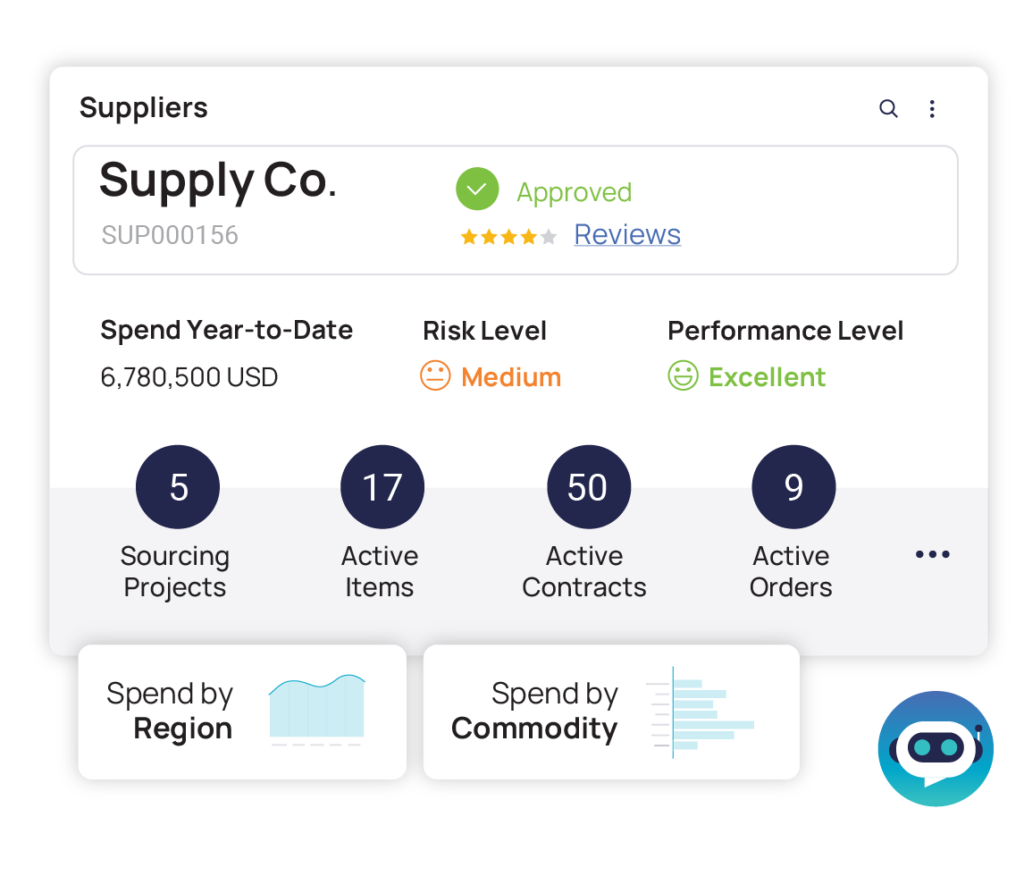
Organizations running procurement on a unified platform can manage vendor master data within the same environment as other procurement processes, eliminating the risk of fragmented data across point solutions. This integrated approach strengthens data quality and vendor management.
Next we examine the high cost of getting master data management wrong.
Why Vendor Master Data Quality Matters More in 2026
In recent years, AI adoption, rising procurement fraud, and increasingly stringent compliance requirements have heightened the need for vendor data management. Here’s a look at each of these market forces:
- AI Readiness: Procurement teams are rapidly deploying AI across sourcing, risk monitoring, and spend analysis, but these tools are only as reliable as the data you feed them. Unfortunately, Gartner found that 74% of procurement leaders say their data isn’t AI-ready. Low data accuracy and inconsistent formats in the vendor master file directly undermine business outcomes.
- Financial Exposure: Poor data quality can result in duplicate payments, missed early-payment discounts, and fragmented spend that limits negotiation leverage. IBM reported that over a quarter of organizations lose roughly $5 million annually because of bad data, with 7% reporting losses of $25 million or more.
- Fraud and Compliance Risk: Fragmented vendor data creates blind spots that make detecting fraud challenging. A study by SAS Institute found 7,216 vendors with different names sharing an address, and 4,745 vendors sharing a bank account – both clear indicators of potential fraud. The same analysis identified 54,127 duplicate invoices (same vendor and amount over $5,000), representing $4.35 billion in exposure. Without strong data quality and governance, these risks remain hidden until they surface in audits or investigations.
Together, these pressures make vendor master data management essential for risk mitigation and AI strategy. Adopting a platform approach to supplier management enables continuous visibility into the vendor master file, so you can detect and resolve issues early.
In the next section, we provide seven best practices for your master data management strategy.
7 Vendor Master Data Management Best Practices
The following vendor master data management best practices follow the natural lifecycle of supplier data, beginning with how it entered the system. We include best practices for governing and protecting data, and cleansing and enriching it over time:
In the sections that follow, we take a deep dive into these 7 best practices:
- Establish clear data governance ownership
- Standardize Vendor Onboarding with Validation at the Gate
- Deduplicate and Cleanse Existing Vendor Records
- Enrich Vendor Data with External and Third-Party Sources
- Maintain Audit Trails and Enforce Role-Based Access Controls
- Integrate the Vendor Master File Across ERP and Procurement Systems
- Implement Continuous Monitoring and Data Quality KPIs
1) Establish Clear Data Governance Ownership
Vendor master data quality degrades quickly if no one is in charge of it. It’s important to appoint a data steward (either an individual or a team) who has explicit authority over creating and modifying the vendor master file.
Both procurement and finance should be in charge of governing the file, as supplier master data feeds accounts payable, compliance reporting, and spend analytics.
Three roles define an effective governance model:
- The data steward enforces standards and resolves exceptions
- The data owner sets policy and priorities
- Data creators (buyers, onboarding teams) follow structured workflows to ensure consistency at entry
Gartner identifies data governance as a foundational step in making procurement data AI-ready. Platforms like Ivalua embed stewardship workflows directly into the system to help enforce consistent governance at the point of record creation or modification.
Keep in mind, governance is only effective if the rules can operate on accurate data.
2) Standardize Vendor Onboarding with Validation at the Gate
During onboarding, a vendor record is created – and it’s the most common stage for errors. “Validation at the gate” is the first line of defense and involves enforcing mandatory field completion and format standardization. The system should automatically check for duplicates, as well, to help minimize errors.
Effective onboarding workflows collect all critical data fields at the start, including banking details, compliance certifications, and risk-relevant attributes. Incomplete records can degrade data quality over time.
Progressive profiling can still be applied, staging data collection across registration, qualification, and approval phases, but always within structured workflows that prevent gaps and inconsistencies.
A well-designed supplier onboarding process ensures organizations standardize data during onboarding while adapting requirements according to the supplier type.
Vendor management Platforms like Ivalua allow you to configure onboarding validation rules and required fields dynamically, and adjust them by supplier category, geography, or spend tier.
Next, it’s critical to address bad data that already exists.
3) Deduplicate and Cleanse Existing Vendor Records
Duplicate records can have a significant impact on data accuracy and cost. Effective deduplication requires deduplicating files using fuzzy matching algorithms that detect variations.
They then merge the records by consolidating transaction history, contracts, and performance data into a single golden record. Finally, ongoing matching rules prevent future duplicates.
At the enterprise level, automating these processes is preferable to manual review, because it improves efficiency and surfaces hidden risks that otherwise would likely go undetected.
For example, SAS Institute identified 788 employees who shared a bank account with a vendor, a potential indicator of fraud or collusion. These insights only emerge when duplicate and fragmented records are resolved.
Deduplication should be an ongoing data hygiene discipline that monitors existing and new records. Ivalua embeds AI-powered entity resolution directly into procurement workflows to scan for probable duplicates, surface them for review, and automatically merge confirmed matches without disrupting transactions.
The next practice is about enriching records to support analysis and AI.
4) Enrich Vendor Data with External and Third-Party Sources
A vendor record containing only self-reported supplier data is incomplete by default. That’s why data enrichment is essential to improving data quality and decision-making.
During enrichment, vendor master records are augmented with external data such as:
- Financial health scores
- Sanctions and watchlist screening
- ESG ratings
- Ownership structures
- Adverse news monitoring
- Standardized industry classification codes
To be effective, enrichment must be automated and continuous. Ongoing updates account for changes to supplier risk profiles, compliance status, or financial stability and help strengthen both governance and security.
However, enrichment quality depends on having a clean, deduplicated foundation. Ivalua enables native integration with third-party data providers, automatically enriching vendor profiles at onboarding and on a recurring schedule.
This enriched data feeds directly into workflows such as supplier risk management to support risk scoring, segmentation, and proactive risk mitigation.
Next, we explain how to control and track changes to supplier records.
5) Maintain Audit Trails and Enforce Role-Based Access Controls
Every change to a vendor record must be made by someone who’s authorized to make changes. It must also be traceable to a timestamp and reason for the change.
A complete audit trail captures everything – the creation of the record, field-level edits, approvals and rejections, merge events, deactivation, and reactivation, creating a full history of how the vendor master file evolves over time. This level of traceability is essential for data integrity and compliance.
Additionally, role-based access controls should be employed to enforce the principle of least privilege, which is critical because of a sustained increase in fraud alongside geopolitical uncertainty.
Ivalua embeds audit logging and configurable, field-level permissions directly into procurement workflows, eliminating the need to add on compliance tools. You can adjust access rules by role, geography, and supplier category without relying on IT, protecting data integrity with minimal effort.
The next best practice connects the vendor master to the systems that consume it.
6) Integrate the Vendor Master File Across ERP and Procurement Systems
To avoid vendor master files becoming stale, integration is essential. Bidirectional synching between the vendor master and ERP systems, accounts payable, contract management software, and risk monitoring systems help ensure that all updates reflect across the ecosystem.
Critical fields such as banking details and compliance status require real-time or near-real-time synchronization, while less sensitive attributes can be updated through scheduled batch processes.
When systems are operating on outdated or duplicate records, data consistency is impossible. This undermines the value of centralized vendor data while increasing risk.
To avoid this, the vendor master must be designated as the system of record, with all approved changes flowing outward to consuming systems automatically.
Ivalua’s unified platform supports integration by centralizing sourcing, contracts, purchasing, invoicing, and supplier management on a single data model.
The final best practice is continuous monitoring, which ensures data remains accurate over time.
7) Implement Continuous Monitoring and Data Quality KPIs
Vendor data decays continuously. For example, suppliers may change their address or ownership structures, or start using different bank accounts. Without continuous monitoring, the vendor master file will degrade rapidly.
To govern data effectively, you need to have defined KPIs, such as:
- Duplicate rate (target <1%)
- Record completeness rate (>95% of mandatory fields populated)
- Time-to-onboard
- Data age (percentage of records not reviewed in 12+ months)
- Exception rate (percentage flagged by automated rules)
Metrics like these provide a clear, measurable view of data quality and data accuracy across the supplier lifecycle.
You can automate monitoring using dashboards that surface trends and anomalies in real time. These dashboards can also trigger review workflows before an issue spreads.
Be sure to report KPIs to procurement leadership on a quarterly basis – IBM reports that 43% of chief operations officers identify data quality as their top data priority.
You should also segment your suppliers when it comes to monitoring and reporting: strategic suppliers should be reviewed at a more frequent cadence while tail-spend vendors can be monitored primarily through automated rules.
Ivalua embeds analytics and configurable quality rules directly into procurement workflows, automatically generating KPIs, flagging degradation trends, and initiating remediation before issues lead to compliance gaps.
These insights can also feed into broader processes like vendor scorecard and supplier performance management to support a closed-loop approach to supplier governance.
Let’s take a look at how one Ivalua customer benefits from effective vendor master data management.
How Honeywell Built a Golden Record Across Multiple Business Units
Honeywell, a 100,000-employee manufacturer, consolidated fragmented vendor data across business units and geographies onto Ivalua to establish a unified “Golden Record” integrated with its ERP systems. This transformation spans the full source-to-pay lifecycle, including vendor master management, contracts, risk management, and spend analysis.
At Honeywell, vendor data now lives directly within the platform where procurement decisions are made every day, driving consistency, visibility, and control at scale.
“Ivalua allows us to meet our ever-changing business needs across all of our organizations, and deploy solutions both on our regionality and the needs of our business users going forward.”
– Steven Velte, Senior Director of Procurement Transformation, Honeywell.
Read the full Honeywell case study.
Why a Unified Platform Outperforms Point Solutions
At the enterprise level, following the seven best practices outlined above requires a unified platform. If you stitch together point tools for governance, deduplication, enrichment, risk, and analytics, there’s an integration tax: every connection introduces the risk of data drift, latency, and errors. This negates the benefits of vendor master data management.
A unified platform operating on a single data model solves the problem by centralizing supplier data and workflows.
According to Ardent Partners research, such integration is essential for effective supplier management, which is why Ivalua was named a Market Leader in the 2025 Supplier Management Technology Advisor, receiving “market-leading differentiated” scores across governance and control, data improvement and enrichment, KPIs and benchmarks, quality management, risk management scope, risk mitigation, and technology integrations.
This unified approach enables advanced capabilities like machine learning–driven entity resolution and fraud detection, which outperform static, rules-based systems by adapting to evolving patterns.
With integrated workflows across strategic sourcing, supplier management, supplier enablement, and supplier lifecycle management, you can manage supplier data as a continuous, connected system.
Building a Vendor Master Data Management Program That Scales
While most organizations recognize the strategic value of their suppliers, many still struggle to manage them effectively. A unified platform closes that execution gap by embedding data quality, governance, and intelligence directly into daily procurement operations.
AI spending is forecasted to surpass $2 trillion in 2026, growing 37% year over year – and creating a vendor master data management program is a first essential step to capitalizing AI adoption.
Use the vendor master data management best practices outlined in this blog to drive procurement efficiency and decision-making, and position your organization to deploy AI effectively, while preventing fraud and unlocking measurable cost savings.
Learn How To Improve Supplier Information Management With Ivalua.
Frequently Asked Questions About Vendor Master Data Management
FAQs
A vendor master file (or master data file) is the centralized repository of supplier master data, containing records like legal entity details, banking information, and compliance attributes. Vendor master data management is the ongoing practice of data governance, validation, and control that ensures the vendor master file remains accurate, complete, and usable over time.
Vendor master data should be maintained through continuous monitoring rather than periodic cleanups, because data decay begins as soon as supplier details change. Vendor master data management best practices rely on automated workflows and KPIs to sustain data quality and data accuracy on an ongoing basis.
Poor vendor data leads to duplicate records, compliance gaps, and increased exposure to fraud, all of which undermine risk mitigation efforts. It also reduces procurement efficiency by fragmenting spend visibility and increasing the likelihood of payment errors or missed savings opportunities.
Data quality is measured using KPIs such as duplicate records rate, record completeness, and overall data accuracy across the vendor master file. These metrics are often tracked through dashboards or incorporated into a vendor scorecard to ensure ongoing accountability and improvement.
Vendor master data management should be owned through a defined data governance model that includes a data steward responsible for enforcing standards and workflows. Procurement and finance leadership typically act as data owners, with access control ensuring that only authorized roles can create, approve, or modify vendor records.
While small organizations may start managing a vendor master file in Excel, it lacks the automation, data validation, and scalability required for enterprise-grade control. A platform approach enables centralized vendor data, real-time integration across systems, and the automation needed to maintain data quality at scale.